PestControlBasics
Menu

Eastern Pine Looper

Lambdina pellucidaria[3]

The eastern pine looper is a native inchworm caterpillar that feeds on the needles of pitch pine, red pine and other hard pines.[1][2]

Group
Insect
Order
Lepidoptera
Family
Geometridae
US records
19 states
Sources
3 cited
Updated
2026-10-16
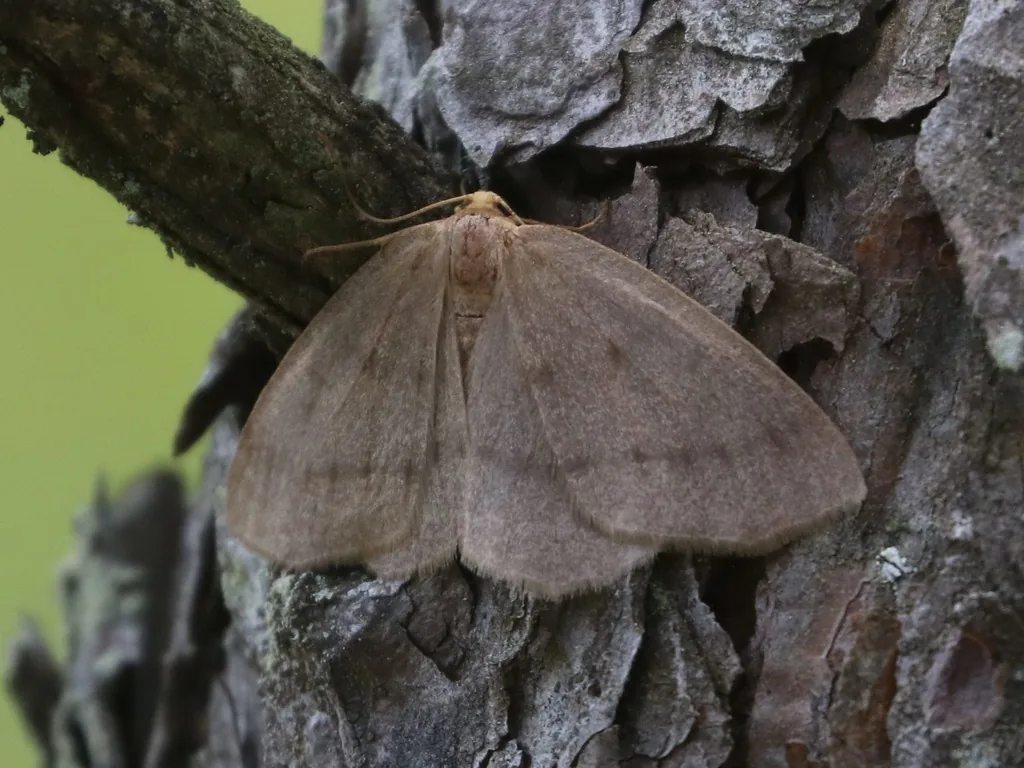
Eastern pine looper moth resting with wings spread in a triangle
Eastern pine looper moth resting with wings spread in a triangle. (c) Seth Wollney, some rights reserved (CC BY) — via iNaturalist, CC BY 4.0
On this page
  1. Identification
  2. Where it lives
  3. Biology
  4. Damage and signs
  5. Health risk
  6. Control
  7. Related profiles
  8. Common questions
  9. Sources

How to identify it

  • Caterpillars are slender and smooth, mottled brown and gray with stripes, a large spotted head and only two pairs of abdominal legs.[2]
  • Adults are mottled brown and gray moths that rest with wings in a broad triangle.[1][2]

Where it lives

Found in New England and North Carolina; also called the pitch pine looper and yellow-headed looper.[1][2]

US map: public records from 19 states since 1990 (GBIF).

Biology and life cycle

Pupae overwinter in leaf litter under host trees; moths emerge and lay pale green eggs in May and June.[1]

Heavier feeding by larger caterpillars may not show until late in the season.[1]

Damage and signs

  • Young larvae chew notches in needles that then brown; larger ones eat whole needles.[1][2]
  • It is rarely abundant, but outbreaks recur about every 10 years on Cape Cod, and heavy defoliation for 2 or 3 years can kill pines.[1][2]

Health risk

None to people or pets.[1][2]

Control

Pesticides

On small specimen trees, one application of a product labeled for caterpillars should eliminate the loopers.[2]

Common questions

What inchworms are browning my pitch pine?
Possibly eastern pine loopers, which notch and brown the needles.[1][2]

Sources

  1. UMass Extension Landscape, Nursery and Urban Forestry Program (Landscape Insect & Mite Guide), “Lambdina pellucidaria (Pine Looper).” www.umass.edu/agriculture-food-environment/landscape/publications-resources/insect-mite-guide/lambdina-pellucidaria (accessed 2026-10-16)
  2. NC State Extension, “Eastern Pine Looper (PDIC Factsheet).” content.ces.ncsu.edu/eastern-pine-looper (accessed 2026-10-16)
  3. iNaturalist, “Lambdina pellucidaria taxon page (order and family).” www.inaturalist.org/taxa/222620 (accessed 2026-10-06)

Updated 2026-10-16. Built from sourced records. Spot an error? Tell us.