The short answer
- Treat if the tree is a healthy, valued true ash and EAB has been found nearby. Research has shown insecticides can protect ash trees of all sizes for years, even where beetle numbers are very high.[1][9][8]
- "Nearby" varies by source: the multistate EAB insecticide bulletin says trees within 30 miles of noticeable EAB damage are probably at risk, the NC Forest Service says to start when EAB is within 10 to 15 miles, and University of Minnesota says trees more than 15 miles from a known infestation don't need treatment yet.[1][2][9]
- Skip treatment and plan removal if half or more of the canopy is already thin or dead. Sources put the cutoff at about 50 to 60 percent canopy loss.[1][2][9][10]
- Also lean toward removal if the tree has other defects, is declining for other reasons, isn't valuable to you, or was planted recently and is easy to replace.[11][10]
- Treatment is a long commitment. Wisconsin DNR and Iowa State say it typically has to be repeated for the life of the tree, every 1 to 3 years depending on the product.[8][10][9]
- Homeowners can apply soil drenches or granules of imidacloprid or dinotefuran once a year in spring. The most consistent, longest-lasting protection in university trials came from trunk injections of emamectin benzoate, applied by professionals.[1][2]
- If you remove an ash, do it while it's alive. Dead ash becomes brittle quickly and is harder and more dangerous to take down.[9][6][10][8]
Ash borers and look-alikes
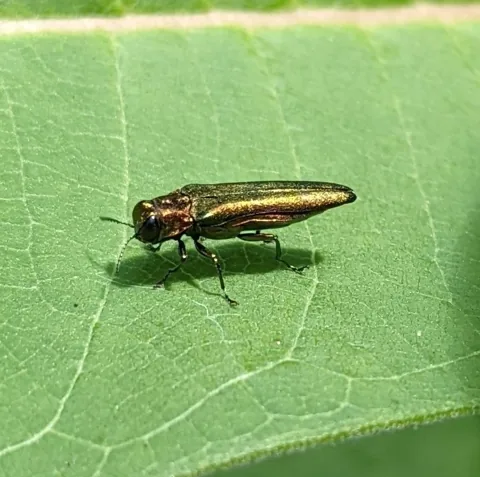 Emerald Ash Borer
Agrilus planipennis
The emerald ash borer is an invasive wood-boring beetle from Asia that has killed tens of millions of North American ash trees. Its larvae feed just under the bark, cutting off the flow of water and nutrients until the tree dies.
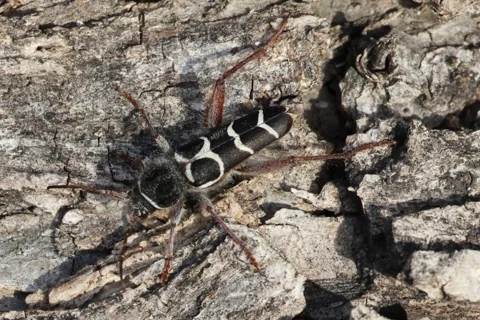 Banded ash borer
Neoclytus caprea
The banded ash borer is a longhorned beetle whose larvae feed under the bark of dead, dying or stressed ash, elm and hickory and in freshly cut logs. Healthy landscape trees are rarely a concern; it is best known as a firewood pest, when adults emerge from cut logs inside homes.
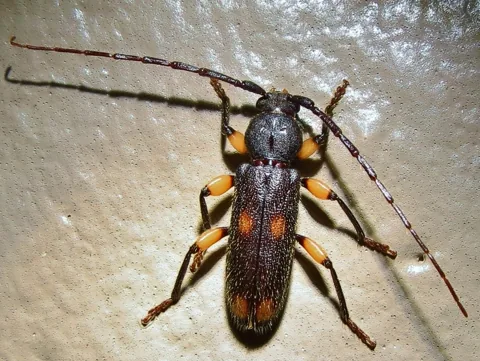 Ash and privet borer
Tylonotus bimaculatus
The ash and privet borer is a native longhorn beetle whose larvae tunnel beneath the bark of ash, privet, elm, hickory and several other hardwoods. It favors trees that are old, drought-injured or otherwise stressed, killing an ash a branch at a time from the top down, and it is the borer most likely to wreck a privet hedge, where it attacks at the base of the plants. In dry regions such as the Great Plains it has been a serious pest of windbreak ash.
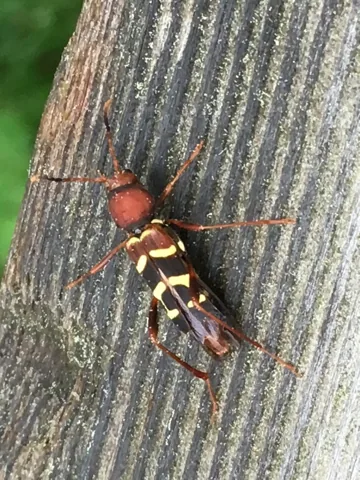 Redheaded Ash Borer
Neoclytus acuminatus
The redheaded ash borer is a slender, wasp-like longhorned beetle whose grubs bore in stressed, dying or dead hardwoods and bark-covered logs; adults sometimes emerge from firewood brought indoors but are harmless to people.
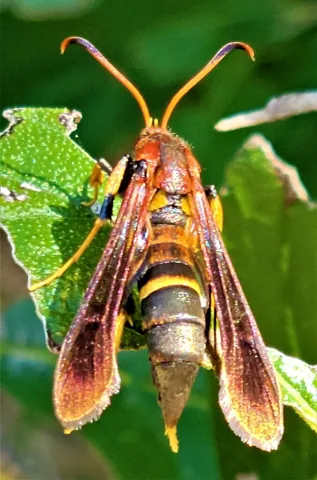 Banded Ash Borer Moth
Podosesia aureocincta
The banded ash clearwing (Podosesia aureocincta) is the late-season twin of the familiar ash/lilac borer. Both are day-flying, wasp-like clearwing moths whose larvae tunnel under the bark of ash, and the adults look so alike that older literature confused their emergence periods until pheromone trapping showed a second species flying in late August and September. Rutgers calls it the last important clearwing borer to become active in the urban landscape each year, and unlike most clearwings, which seek out bark wounds, it will also lay eggs on healthy ash trees.
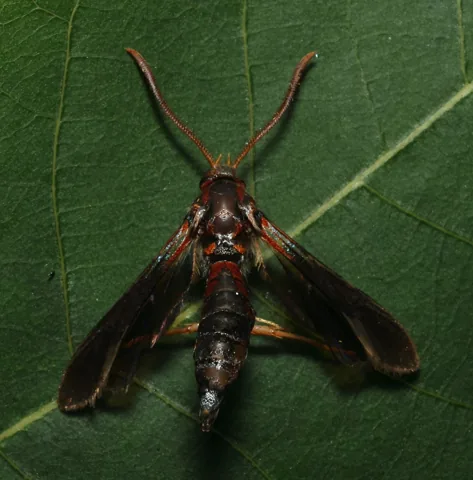 Ash/Lilac Borer
Podosesia syringae
The ash borer, also called the lilac or lilac-ash borer, is a wasp-like clearwing moth whose caterpillars tunnel in ash, lilac, olive and privet. It is not the emerald ash borer.
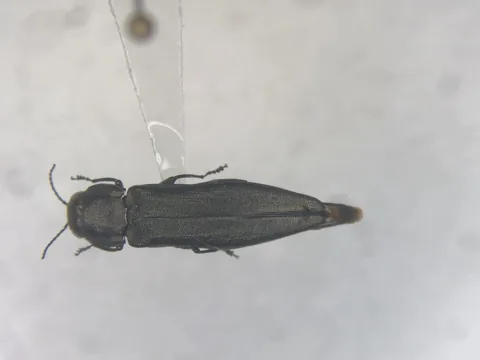 Bronze Birch Borer
Agrilus anxius
The bronze birch borer is a native wood-boring beetle whose larvae tunnel just under birch bark, girdling branches and trunks. It mostly attacks stressed trees, and white-barked European and Asian birches are especially vulnerable.
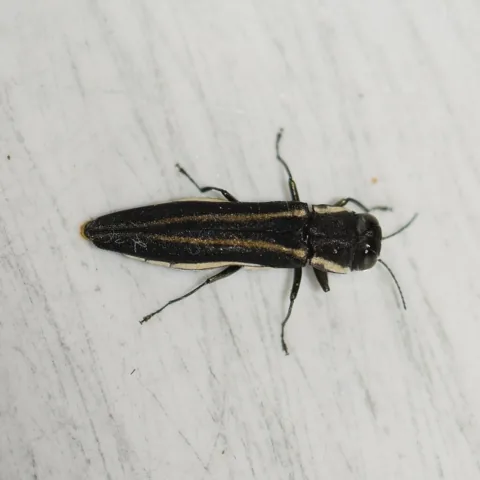 Twolined Chestnut Borer
Agrilus bilineatus
The twolined chestnut borer attacks stressed oaks; dieback starting at the top of the canopy is the classic sign.
Step 1: Make sure it's a true ash
Emerald ash borer attacks true ash trees, genus Fraxinus. White, green and black ash are readily attacked and killed. Several trees with "ash" in the name are not hosts at all.[9][11][12]
- What an ash looks like: compound leaves of 5 to 7 leaflets, leaves and branches in opposite pairs, and clusters of oar-shaped seeds in fall.[2]
- Not affected: mountain ash (American, showy and rowan mountain ash) and prickly ash. Kentucky's EAB fact sheet notes mountain ash is more closely related to roses than to true ash.[9][11]
- Blue ash is attacked but is more resistant than white or green ash, and can live much longer despite infestation, according to University of Kentucky.[11]
- EAB has also been found in white fringetree, but the true ashes are the main concern.[11]
- If you're not sure the tree is an ash or that EAB is the problem, an arborist or your county extension office can confirm it before you spend anything. University of Minnesota notes that drought, compacted soil and girdling roots also cause ash decline, and that bronze birch borer and twolined chestnut borer can be mistaken for EAB.[9][8]
Step 2: Find out how close EAB is
Starting too early wastes money and insecticide; starting too late doesn't work as well. The trouble is that new infestations are hard to see. The multistate bulletin says nearly all EAB infestations were at least four to six years old before they were detected.[1]
- How far beetles spread on their own: most females lay eggs within 100 yards of the tree they emerged from, but a few fly 0.5 miles to 2 or 3 miles. University of Minnesota says EAB generally moves about one-half to one mile a year from infested sites.[1][9]
- How far they travel with people: hundreds of miles, in firewood, other wood products or nursery stock. APHIS says people moving infested firewood, logs or nursery stock drive the beetle's long-distance spread.[9][3]
- Distance thresholds differ. The multistate bulletin: within 30 miles of trees with noticeable EAB damage, consider treating. NC Forest Service: begin when EAB is known to be within 10 to 15 miles. University of Minnesota: within 15 miles is higher risk, and beyond 15 miles you don't need to treat until EAB is confirmed in your area.[1][2][9]
- Maps lag. Federal EAB surveys have ended and state and local surveys vary, so detection maps may not show where EAB really is. City foresters, county extension offices and state agriculture, forestry or natural resources agencies may know the local status.[1]
- As of April 2026, APHIS says EAB has been detected in 38 states and the District of Columbia.[3][9]
Step 3: Judge how much of the canopy is left
Systemic insecticides ride the tree's own plumbing up to the leaves. EAB larvae destroy that plumbing, so a badly damaged tree can't carry enough insecticide into the canopy to be protected. That's why canopy condition is the main test of whether treatment can still work.[1][6]
- The multistate bulletin: if more than 50 to 60 percent of the canopy has been killed, or the canopy is carrying less than half the leaves it should, it's probably too late to save the tree.[1]
- NC Forest Service and University of Minnesota: more than half the canopy thinned or killed means it's too late, or treatment might not work.[2][9]
- Iowa State: a tree needs less than 50 percent canopy thinning or less than 30 percent dead branches to be a treatment candidate. Once the whole crown has small leaves and the only large leaves are on suckers in the middle of the tree, it's past saving.[10]
- Minnesota Department of Agriculture notes that some trees with more than 50 percent decline can survive if treated, but branches EAB has killed don't come back, so what's left may not be worth the investment.[6]
- Where to look: dieback usually starts in the top third of the canopy. Other signs are woodpecker flecking on the bark, sprouts on the lower trunk, vertical bark splits and small D-shaped exit holes about 1/8 inch wide.[11][9][7][3]
- Expect a lag. A tree that is already declining when treatment starts may keep getting worse the first year. If treatment works, the canopy usually begins to improve in the second year.[1][2]
- Trees declining from other causes, such as other insects or diseases, should be removed rather than treated, according to Iowa State, because preventing EAB won't reverse that decline.[10]
Step 4: Decide whether the tree is worth protecting
University of Kentucky's rule of thumb: if the tree is relatively healthy and valuable to you, treating may be cost-effective, and it is currently the only way to protect ash from EAB. If it is badly damaged, not valuable, or has defects such as girdling roots, multiple leaders or storm damage, removal and replacement may be the better choice.[11]
- Big trees take many years to replace. A large ash gives shade, stormwater capture and looks that a new tree won't provide for many years, and removal of urban trees can be expensive.[11][9][1]
- Cost studies favor treatment. The multistate bulletin says economic analyses have repeatedly found treating landscape ash with effective systemic insecticides costs much less than removing them, and the advantage grows now that one emamectin benzoate injection can last up to three years.[1]
- Sentiment counts. The bulletin notes that not every tree decision is about economics, and people's attachment to a tree is a fair reason to protect it.[1]
- Small or young trees are easier to replace. University of Kentucky says a recently planted ash may be simpler to swap for another species.[11]
- A healthy ash doesn't have to come down. University of Minnesota sees no reason to remove a healthy ash you want to keep, but strongly recommends against planting more ash.[9]
- Woodlots are different. University of Kentucky says the cost of repeated treatment makes it impractical for most woodland owners, who are better served by working with a forester on harvest timing and regeneration.[11][8]
- A certified arborist can help decide whether a tree is worth treating, Wisconsin DNR says.[8]
Step 5: Choose a treatment
The multistate bulletin groups EAB treatments into four kinds: soil drenches or soil injections, trunk injections, sprays on the lower trunk, and cover sprays. Some products are sold to homeowners; others are for professional applicators only. How well each works has been tested in multi-year university trials.[1][2]
- Imidacloprid soil drench (homeowner and professional): mixed results. It protected trees in some trials and failed in others, but it's the only option for many homeowners who don't hire a professional. The bulletin says to use the highest labeled rate, applied at the base of the trunk. Homeowner products allow one application a year, as a drench or watered-in granules, not as a soil injection.[1]
- Dinotefuran (soil drench, homeowner granules, or a professional basal trunk spray): in Ohio State trials on trees up to 22 inches across, it protected trees at the highest labeled rate but less well at lower rates. It has to be applied every year.[1]
- Emamectin benzoate trunk injection (professional): a single injection in mid-May or early June gave excellent control for up to three years in several studies, even at peak beetle numbers, and outperformed other systemics in side-by-side trials. The NC Forest Service table lists the injection product it names as a restricted-use pesticide.[1][2]
- Azadirachtin trunk injection (professional): works differently from the others: leaves weren't acutely toxic to adult beetles, but mature females laid fewer viable eggs and most larvae died young. The bulletin says it should protect trees for one to two years, with annual treatment needed when EAB numbers are high.[1]
- Imidacloprid trunk injection (professional): less effective than emamectin benzoate in the bulletin's trials, even when applied every year.[1]
- Cover sprays of the trunk, branches and leaves: possible, but the bulletin doesn't recommend them because of drift, coverage problems and effects on other species. They don't touch larvae already under the bark.[1][2]
- Tree size and doing it yourself: University of Minnesota says homeowners should treat only trees smaller than 15 inches in diameter and leave larger ash to a professional arborist. The bulletin notes that some imidacloprid products allow a double rate on trees over 15 inches; in an Ohio State study, spring drenches protected trees 15 to 22 inches across during peak EAB pressure.[9][1]
- Measuring diameter: measure around the trunk at 4.5 feet above the ground and divide by 3.14 (NC Forest Service) or by 3 (University of Minnesota) to get the diameter at breast height.[2][9]
- For how to mix and pour a drench, see the systemic insecticide guide. Whatever you use, the label's rate, frequency and per-acre limits are the law.[1][2]
When to treat
University studies have consistently found spring treatments work better than the same treatments in fall. The goal is to have insecticide in the leaves when adult beetles feed and in the bark when young larvae hatch.[1][10]
- Imidacloprid soil drench: early to mid spring. It takes four to six weeks to move through the tree; in the upper Midwest the bulletin's window is mid-March to late April, earlier in the south.[1][2]
- Dinotefuran soil application: 2 to 3 weeks later than imidacloprid, since it moves faster. Basal trunk sprays: late May to mid-June in much of the upper Midwest.[1]
- Trunk injections: after the tree has leafed out but before females lay eggs, typically mid-May to mid-June in the upper Midwest. University of Minnesota gives May through late September for that state, with late summer and fall injections giving somewhat lower control.[1][9]
- Other single windows: Iowa State says mid-April to mid-May, and Penn State says May or early June.[10][12]
- A natural cue: first adult emergence lines up with black locust bloom, at about 450 to 550 growing degree days (base 50°F from January 1).[1]
- Found infestation in midsummer? A fall treatment still helps, but less. The bulletin says a September emamectin benzoate injection or a double-rate imidacloprid drench in October or early November will generally control EAB the next summer, though in a Purdue study trees injected in September thinned unacceptably compared with June-treated trees.[1]
- Water first in dry weather. Drought slows uptake. Soil should be moist but not waterlogged, and injections go best on a morning when the soil is moist.[1][2]
How long you'll need to keep treating
Treatment doesn't end once the tree looks healthy. Wisconsin DNR and Iowa State say treatments typically have to be repeated for the life of the tree, and Iowa State warns that a tree left untreated past the protection window is open to infestation again.[8][10]
- Intervals by source: University of Minnesota says every 2 or 3 years; Iowa State says every 1 to 2 years depending on the product; the multistate bulletin's trials found up to 3 years for emamectin benzoate, 1 to 2 for azadirachtin, and every year for imidacloprid and dinotefuran. NC Forest Service says to retreat annually with an imidacloprid drench.[9][10][1][2]
- The local wave passes. The bulletin says that as EAB peaks, most untreated ash in an area die over about 3 to 5 years, and the beetle population then drops sharply but doesn't vanish.[1]
- After the wave, some owners pause treatment or stretch the interval. The bulletin says that's reasonable only with regular checks of the tree's condition, so treatment can restart as soon as local EAB activity rises.[1]
- Neighbors matter. University of Minnesota cites a finding that when communities treat 50 percent of their ash with emamectin benzoate or azadirachtin, nearby untreated ash keep healthier crowns.[9]
- Parasitic wasps released by APHIS and state agencies are a long-term effort, not a substitute for treating your tree. University of Minnesota says it is still unclear whether they can slow EAB's spread.[3][8][9]
Treating without harming bees
Most homeowner EAB products are neonicotinoids. University of Minnesota says the ones sold in garden centers are highly toxic to nectar-feeding bees and butterflies, so where and when you apply them matters.[9][1]
- Apply soil treatments just after the ash flowers. Male ash trees can be a pollen source for honey bees; ash bloom lasts a few days in spring just before the leaves come out.[1]
- No soil treatment where flowering plants grow over the roots. The bulletin says to remove those plants or switch to a trunk injection so the insecticide isn't taken up by flowers bees visit.[1]
- Protect water. Skip soil applications on very sandy, low-organic soils, where the water table is shallow, or where runoff could reach gutters, ditches or ponds. Don't apply to saturated soil where puddles could wash away.[1]
- Rake mulch and leaf litter back from the trunk before a drench, because imidacloprid binds to organic matter. NC Forest Service says to clear 1 to 2 feet around the base and rake it back after the solution soaks in.[1][2]
- For bloom timing, drift and label bee warnings across all garden spraying, see the pollinator guide.[1]
If you remove the tree: do it before it dies
Removal is a valid choice, and timing is the main safety issue. University of Minnesota says it's easier and cheaper to remove an ash while it's alive; once dead, the branches turn brittle and the tree is harder and more dangerous to cut down. Minnesota's management guidelines and Wisconsin DNR say the same, and Iowa State says dead ash branches fall and endanger people and property.[9][6][8][10]
- Don't wait. Iowa State says to remove a tree too damaged to treat as soon as possible. University of Minnesota adds that EAB carries decay fungi that can rot branches quickly.[10][9]
- Hire it out. Iowa State recommends an arborist for removing ash on private property, and University of Kentucky says EAB-killed ash fall apart rapidly and create extremely hazardous conditions.[10][11]
- Season: University of Minnesota says removal is best from November to April, outside the beetles' active period, to lower the chance of spreading EAB with the wood.[9]
- Wood handling differs by place. Minnesota's rules: cut ash, even uninfested, may not leave quarantined counties, and chipping to no more than 1 inch in two dimensions kills the larvae. Iowa State says ash doesn't need to be treated or chipped, but firewood should be used on your own property.[9][10]
- Federal rules ended, state rules didn't. APHIS removed its domestic EAB quarantine effective January 14, 2021, but Minnesota still regulates ash material, and Wisconsin DNR still asks people to buy and burn firewood locally.[3][5][8]
- Firewood: larvae can survive up to two years in dead wood, according to Wisconsin DNR. Iowa State says beetles may emerge from ash firewood brought indoors, especially the first year; they won't infest anything in the house and can be vacuumed up. Don't treat firewood with insecticide.[8][10]
- Replant with something other than ash, and mix species so one new pest can't take out every tree again.[11][9]
Hiring an arborist or applicator
Most of the longest-lasting EAB treatments can only be applied by licensed pesticide applicators, and large trees and dead ash call for professional removal.[10][1][9]
- Wisconsin DNR suggests a certified arborist, who can help decide whether trees are worth treating and what other options exist.[8]
- University of Minnesota's advice: ask for certificates of insurance and local references, get at least two estimates, and don't rush because you're promised a discount.[9]
- Ask which active ingredient, rate and retreatment schedule they plan, and match the answer to the trial results above.[1]
- Our guide to finding a pest control professional covers license checks and red flags that apply to tree applicators too.[10]
Common questions
- How long will an untreated ash tree live once EAB arrives?
- Sources differ. University of Kentucky says white and green ash usually survive 7 to 10 years, but can die in 1 to 2 years when beetle numbers are high. Iowa State says death typically comes in 2 to 4 years without treatment, though decline can run anywhere from 1 to 5 years; University of Minnesota says trees often die in about four years, as little as two; Penn State says 3 to 4 years of heavy infestation. Minnesota DNR says death often takes five or more years after infestation in central and southern Minnesota.[11][10][9][12][7]
- My ash looks healthy. Is it too early to treat?
- Not if EAB is close. Lightly infested trees usually show few or no symptoms, and the multistate bulletin and Iowa State say preventive treatment works best before damage is visible. If EAB is far away, University of Minnesota says you can wait until it's confirmed in your area.[1][10][9]
- Will my tree recover after treatment?
- A tree with light to moderate damage often can, but slowly. The canopy may keep declining the first year and usually starts improving the second year if treatment is working. Branches already killed by EAB don't come back.[1][2][6]
- Can I use wood from an EAB-killed ash?
- Yes. University of Minnesota says EAB-killed ash can still be used for outdoor structures, benches, tables and paneling. Larval tunnels stay just under the bark, though University of Kentucky notes other insects and fungi quickly lower the timber value of standing dead ash. Keep firewood local.[9][11][8]
- Should I report EAB?
- Yes, where it hasn't been confirmed. APHIS has a national report form, and state agencies such as the Minnesota Department of Agriculture take reports too. Early reports can give neighbors time to protect lightly infested trees.[3][5][9]
- Does treating my tree keep EAB out of the neighborhood?
- No single tree stops it, but University of Minnesota cites a finding that communities treating half their ash with emamectin benzoate or azadirachtin helped nearby untreated trees keep their crowns. A Forest Service researcher describes surveillance, insecticides and removing low-value trees together as a cost-effective way to protect high-value ash.[9][4]
Photo credits
- Emerald Ash Borer: Christine Stone, public domain (CC0), via iNaturalist
- Banded ash borer: (c) Isaac Ethington, some rights reserved (CC BY) — via iNaturalist, CC BY 4.0
- Ash and privet borer: (c) Annika Lindqvist, some rights reserved (CC BY) — via iNaturalist, CC BY 4.0
- Redheaded Ash Borer: wcmorton, public domain (CC0), via iNaturalist
- Banded Ash Borer Moth: (c) johnyochum, some rights reserved (CC BY) — via iNaturalist, CC BY 4.0
- Ash/Lilac Borer: (c) David George, some rights reserved (CC BY) — via iNaturalist, CC BY 4.0
- Bronze Birch Borer: Nick Bédard, public domain (CC0), via iNaturalist
- Twolined Chestnut Borer: (c) Douglas Hooper, some rights reserved (CC BY) — via iNaturalist, CC BY 4.0
Sources
- North Central IPM Center (copy hosted by the New Jersey Department of Agriculture), “Insecticide Options for Protecting Ash Trees from Emerald Ash Borer, Third Edition (Herms, McCullough, Sadof, Smitley, Miller and Cranshaw, 2019; North Central IPM Center bulletin).” nj.gov/agriculture/divisions/pi/pdf/eabinsecticidefactsheet.pdf (accessed 2026-11-10)
- N.C. Forest Service, Forest Health Branch, “Emerald Ash Borer Insecticide Guide (September 2015).” ncagr.gov/divisions/nc-forest-service/EAB_InsecticideGuide/download (accessed 2026-11-10)
- USDA Animal and Plant Health Inspection Service, “Emerald Ash Borer (last modified April 23, 2026).” www.aphis.usda.gov/plant-pests-diseases/eab (accessed 2026-11-10)
- USDA Forest Service, Research & Development, “Fighting invasive emerald ash borers with woodpeckers and citizen scientists (May 24, 2022).” www.fs.usda.gov/about-agency/features/fighting-invasive-emerald-ash-borers-woodpeckers-and-citizen-scientists (accessed 2026-11-10)
- Minnesota Department of Agriculture, “Emerald Ash Borer.” www.mda.state.mn.us/plants-insects/emerald-ash-borer (accessed 2026-11-10)
- Minnesota Department of Agriculture, “Guidelines to Slow the Growth and Spread of Emerald Ash Borer (EAB Management Guidelines).” www.mda.state.mn.us/sites/default/files/inline-files/eabmgmtguidelines.pdf (accessed 2026-11-10)
- Minnesota Department of Natural Resources, “Emerald ash borer (EAB).” www.dnr.state.mn.us/invasives/terrestrialanimals/eab/index.html (accessed 2026-11-10)
- Wisconsin Department of Natural Resources, “Emerald Ash Borer (Forest Health).” dnr.wisconsin.gov/topic/foresthealth/emeraldashborer (accessed 2026-11-10)
- University of Minnesota Extension, “Emerald ash borer in Minnesota (reviewed 2026).” extension.umn.edu/garden-and-home/yard-and-garden/yard-and-garden-insects/emerald-ash-borer (accessed 2026-11-10)
- Iowa State University Extension and Outreach, “Emerald Ash Borer (Yard and Garden).” yardandgarden.extension.iastate.edu/encyclopedia/emerald-ash-borer (accessed 2026-11-10)
- University of Kentucky Entomology, “ENTFACT-453: Emerald Ash Borer (EAB) FAQs for Kentuckians (revised 3/26).” entomology.mgcafe.uky.edu/ef453 (accessed 2026-11-10)
- Penn State Extension, “Emerald Ash Borer (updated October 30, 2025).” extension.psu.edu/emerald-ash-borer (accessed 2026-11-10)