On this page
How to identify it
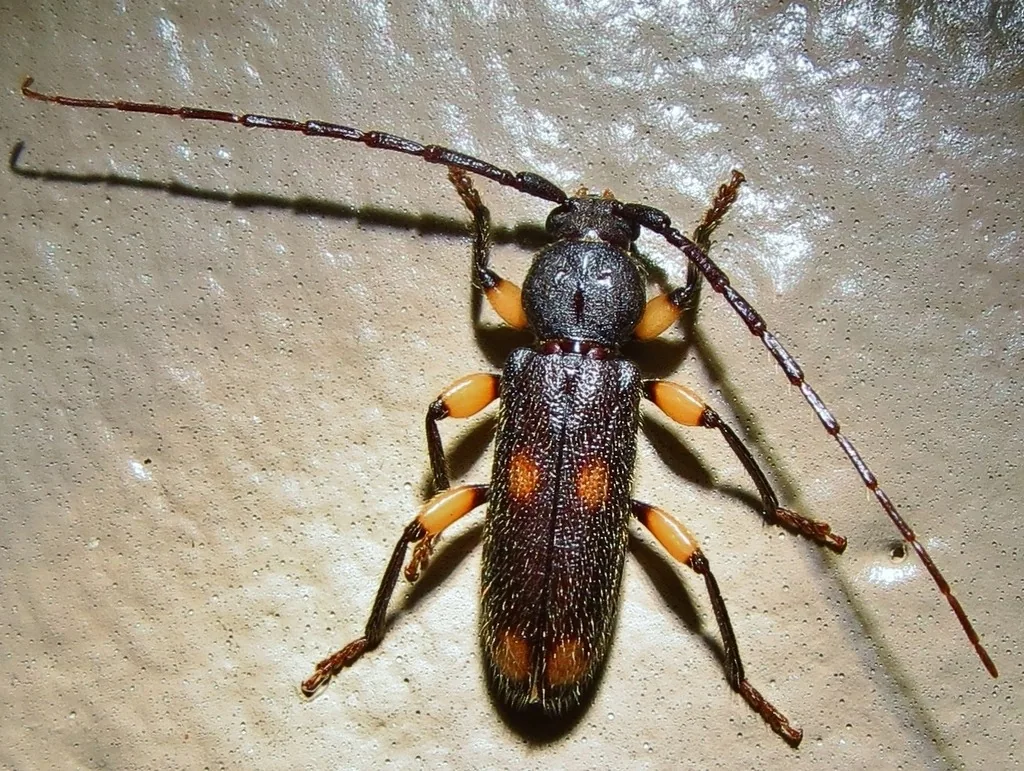
- Adults are elongate, robust, somewhat flattened longhorn beetles 9.5 to 18 mm long, dark brown, typically with a pale spot in the middle and another near the tip of each wing cover. The legs are pale with yellowish thighs. Male antennae are stout and reach slightly past the wing-cover tips; female antennae are slender and reach only their outer third.[1]
- Larvae are elongate, slender, nearly cylindrical grubs with a firm, shiny skin sparsely covered in short, fine, light yellow hairs. The head is wider than long, the mouthparts greenish brown with black jaws, and the thoracic legs are very short.[1]
- Sap oozing from the bark marks the point of attack. Peel the bark and you find broad, meandering mines packed with granular frass, because the larvae eject little or none. Emerging adults leave oval exit holes 4 to 6 mm across, and ash sawn for lumber may show clusters of larval holes.[1]
Look-alikes
| Look-alike | How to tell them apart |
|---|---|
| Redheaded ash borer and banded ash borer (Neoclytus) | The redheaded ash borer is another native longhorn that prefers ash, but its wing covers carry four narrow yellow bands of fine hairs rather than two pale spots each, and the ash and privet borer is the one that also attacks privet at the base of the plant.[1] |
| Emerald ash borer | The ash and privet borer is a native longhorn beetle, dark brown with pale spots, and although it sometimes attacks healthy trees it favors ash that is stressed, weakened or injured. The invasive emerald ash borer has its own page.[1][2] |
| Carpenterworms and clearwing borers | Infestations of the ash and privet borer are often found alongside these other borers (cossid and sesiid moths), so a declining ash may hold more than one.[1] |
Where it lives
Native to eastern North America, the beetle ranges from New York south to Florida and west to North Dakota and Arizona, and into eastern Canada. Its hosts are ash, privet, elm, hickory, black walnut, butternut, yellow-poplar and birch, with green, black and velvet ash and privet preferred. It is economically important in dry areas such as the Great Plains, where it has been particularly troublesome in windbreaks.[1][2]
Biology and life cycle
Adults emerge in May and are present into early August. Males release a pheromone, identified in 2015 as (2S,4E)-2-hydroxyoct-4-en-3-one, that draws in adults of both sexes; in field tests it attracted no other longhorn species in significant numbers, and its chemistry is so far unique within its subfamily.[1][2]
Females lay eggs beneath bark scales on living or dying ash, or at the bases of privet plants. The larvae feed first in the phloem, then bore deeper into the cambium and finally the sapwood; in privet they mine beneath the bark and in the wood. The mines are extensive and meander in different directions, with the frass packed behind the larva rather than pushed out.[1]
Pupal cells are built in or beneath the bark, sometimes near the surface of the sapwood. Two years are needed to complete a generation.[1]
The Canadian Forest Service has grown a cell line from this beetle's larvae to test insect growth regulators of the ecdysone-agonist type against wood-boring longhorns.[3]
Damage and signs
- In ash the borer usually attacks and kills large branches first, and the infestation then works downward, often on one side of the trunk. Old and drought-injured trees gradually die branch by branch, especially in parks and windbreaks, and a single larva can kill a small tree.[1]
- In privet the attacks are nearly always around the base of the plant, and privet hedges can suffer severely when the beetles are abundant.[1]
- The beetle sometimes attacks healthy trees but favors those that are stressed, weakened or injured, and it is often found together with other borers.[1]
Health risk
A wood-boring beetle; none of these sources describes any risk to people.[1][2]
Control
Prevention
Because the borer is most apt to attack stressed or weakened trees, follow cultural practices that keep ash and privet vigorous, particularly where drought stress is common, as in Great Plains windbreaks.[1]
Biological control
Nothing is known of this borer's natural enemies.[1]
Common questions
- Why is my ash tree dying one branch at a time, with sap oozing from the bark?
- That pattern, large branches dying first and the trouble working downward, often on one side of the trunk, with sap at the attack points, fits the ash and privet borer on a stressed or drought-injured tree. Peeling bark reveals broad, frass-packed, meandering mines, and the adults leave oval exit holes 4 to 6 mm across.[1]
- What is boring into the base of my privet hedge?
- The ash and privet borer attacks privet nearly always around the base of the plant, mining under the bark and into the wood, and hedges suffer severely when the beetles are abundant.[1]
- Is this the emerald ash borer?
- Not if the beetle is a dark brown longhorn with pale spots and yellowish legs, 9.5 to 18 mm long, on an old or drought-stressed tree: that is the native ash and privet borer, which favors weakened trees and leaves oval exit holes 4 to 6 mm across.[1][2]
Sources
- USDA Forest Service, “Guide to Insect Borers in North American Broadleaf Trees and Shrubs, Agriculture Handbook AH-706 (J. D. Solomon, 1995), Tylonotus bimaculatus account, pp. 413-415.” research.fs.usda.gov/treesearch/22150 (accessed 2026-11-10)
- Journal of Chemical Ecology (Springer), “Zou, Millar, Blackwood, Van Duzor, Hanks, Mongold-Diers, Wong and Ray (University of California, Riverside). (2S,4E)-2-Hydroxy-4-octen-3-one, a male-produced attractant pheromone of the cerambycid beetle Tylonotus bimaculatus. Journal of Chemical Ecology 41: 670-677 (2015), doi:10.1007/s10886-015-0603-9.” doi.org/10.1007/s10886-015-0603-9 (accessed 2026-11-10)
- In Vitro Cellular and Developmental Biology - Animal (Springer), “Wen, Caputo, Hooey, Bowman, Pinkney, Krell, Arif and Doucet (Canadian Forest Service and University of Guelph). Establishment of a cell line from the ash and privet borer beetle Tylonotus bimaculatus Haldeman and assessment of its sensitivity to diacylhydrazine insecticides. In Vitro Cellular and Developmental Biology - Animal 51: 905-914 (2015), doi:10.1007/s11626-015-9917-8.” doi.org/10.1007/s11626-015-9917-8 (accessed 2026-11-10)
- iNaturalist, “Tylonotus bimaculatus taxon page (order and family).” www.inaturalist.org/taxa/233130 (accessed 2026-11-10)