On this page
How to identify it
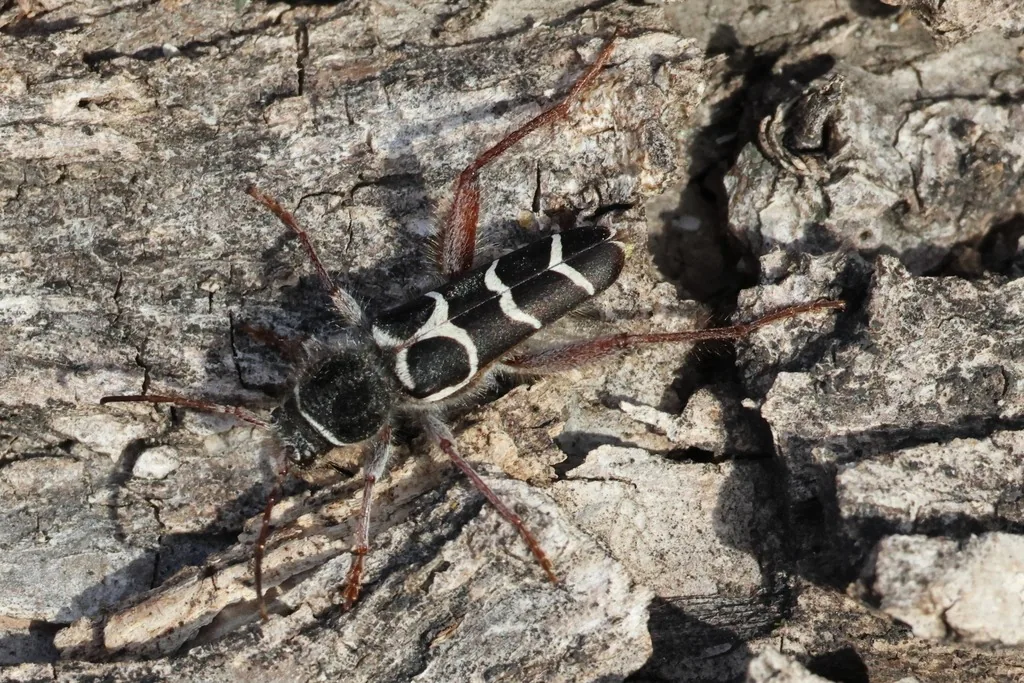
- Adults are 1/2 to 1 inch long, dark brown to almost black, with a line of white or yellowish hairs on the thorax and four bands of the same color across the wing covers; the first two bands nearly form circles.[2][1]
- Like other longhorned beetles, they have long antennae and a cylindrical body.[3][2]
- The larvae are creamy white roundheaded borers, widest just behind the head, up to about 1 1/4 inches long. Their tunnels are oval and packed with coarse, sawdust-like frass, and new adults chew oval exit holes through the bark.[3][1]
Look-alikes
| Look-alike | How to tell them apart |
|---|---|
| Redheaded ash borer | A close relative, 1/2 to 3/4 inch long, that prefers ash, oak and hackberry and stays active over a long season, so ash may need protecting from early spring until autumn.[3] |
| Emerald ash borer | Its damage can be confused with banded ash borer damage, but emerald ash borer is a metallic-green, 1/2-inch flatheaded borer that attacks ash of all ages, and flatheaded borers leave D-shaped exit holes rather than oval ones.[1][3] |
Where it lives
It occurs in eastern Canada and through most of the United States.[2]
Biology and life cycle
Hosts are ash, hickory, elm and mesquite, and occasionally white oak. It is drawn to dead, dying, diseased or stressed trees and to freshly felled trees and cut logs, and generally won't attack a healthy tree.[2][3][1]
Adults emerge in early spring and lay eggs in bark crevices. Ash logs cut in fall or winter are especially likely to be attacked the following spring.[2][3]
Larvae feed under the bark, then bore into the sapwood for the rest of the summer, pupate in the fall, and emerge as adults the next spring. There is usually one generation a year, but in sawed, stored and dried wood the cycle can take several years.[2][1]
Damage and signs
Health risk
It is a wood-boring beetle; Utah State and Nebraska Extension mention no risk to people, and indoors it is only a nuisance.[1][3]
Control
Prevention
Store ash firewood outdoors or in an unheated garage, and let any insects finish their life cycle outside before bringing the wood in. In late winter, adults can emerge from infested firewood stored indoors.[3][1]
Keep trees healthy, and prune out infested or damaged wood.[1][2]
Pesticides
On trees with an ongoing infestation, Utah State lists a carbamate or pyrethroid bark spray on the trunk and large scaffold limbs in spring, before egg laying.[1]
Common questions
- Why are long-horned beetles crawling out of my firewood indoors?
- They may be banded ash borers, which emerge from infested ash firewood stored indoors, often in late winter. Store firewood outdoors or in an unheated garage.[1][3]
- Will they infest my furniture or the house framing?
- No. They don't infest structural wood or furniture and are only a nuisance indoors.[1]
- Is my ash tree in danger from banded ash borers?
- Not if it is healthy. The beetle goes after dead, dying, diseased or stressed trees and cut logs, and is rarely a major concern for healthy landscape trees.[3][2]
Sources
- Utah State University Extension, Integrated Pest Management, “Banded Ash Borer (Ornamental Pest Guide).” extension.usu.edu/planthealth/ipm/ornamental-pest-guide/arthopods/wood-borers/banded-ash-borer (accessed 2026-11-08)
- Utah State University Extension, “Banded Ash Borer, Fact Sheet No. 11 (J. B. Karren, revised May 2000).” extension.usu.edu/pests/uppdl/files/factsheet/bandedas.pdf (accessed 2026-11-08)
- University of Nebraska-Lincoln Extension, “Insect Borers of Shade Trees and Woody Ornamentals, EC1580 (J. A. Kalisch and F. P. Baxendale, 2010).” extensionpubs.unl.edu/publication/ec1580/2010/pdf/view/ec1580-2010.pdf (accessed 2026-11-08)
- iNaturalist, “Neoclytus caprea taxon page (order and family).” www.inaturalist.org/taxa/225593 (accessed 2026-11-08)