On this page
How to identify it
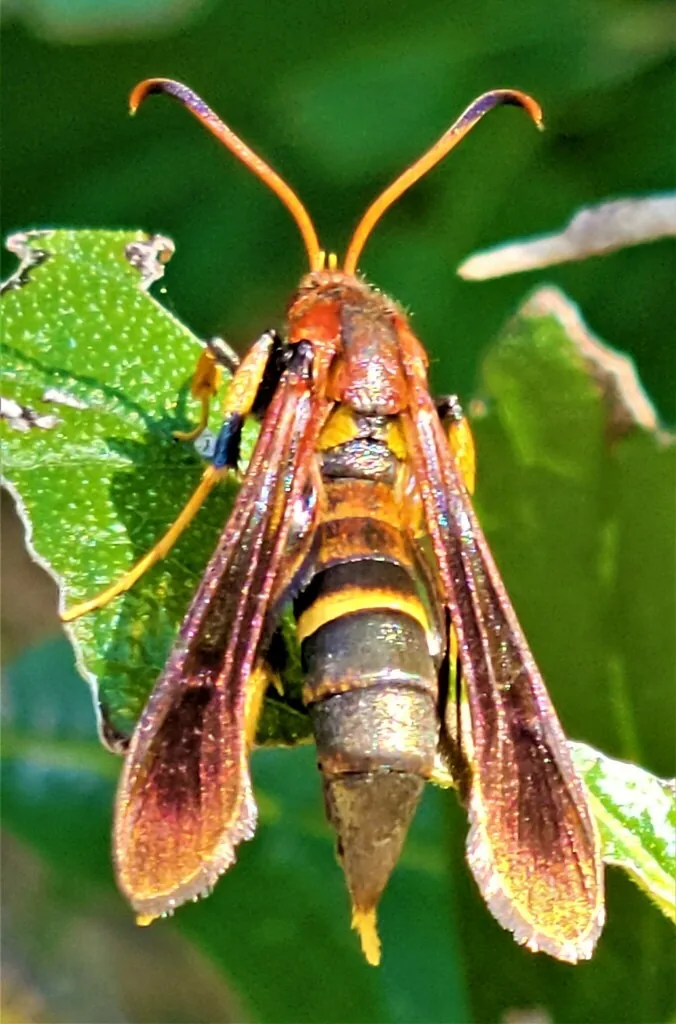
- A wasp-like, day-flying clearwing moth with mostly opaque forewings, very similar to the lilac borer except for a single narrow yellow band on the abdomen.[1][2]
- Sources place the band a little differently. NC State describes a narrow gold band around the fourth abdominal segment and SDSU a yellow partial stripe toward the end of the abdomen, while Nebraska Extension describes a mostly brownish-black body with a single bright orange-yellow band at the middle segment of the abdomen.[2][3][4]
- Flight period is the surest separator. Rutgers says banded ash clearwing adults usually fly in September and as late as October, NC State and Nebraska Extension say late August into September, and the ash/lilac borer flies mainly in spring (May and June per Rutgers, April and May per NC State), so the two are never on the wing together.[1][2][4]
- Signs on the tree are round emergence holes (the emerald ash borer's are D-shaped), pupal skins left behind at emergence in September, and granular frass that the larva pushes out of an opening it keeps to the outside of the stem, collecting as dust at the base of the tree.[3][1]
Look-alikes
| Look-alike | How to tell them apart |
|---|---|
| Ash/lilac borer | Same genus and nearly the same moth, but it emerges in spring and is equally at home in lilac and ash (Nebraska adds privet). Nebraska Extension describes its body as crossed by yellow and black bands, rather than the single band of the banded ash clearwing. The banded ash clearwing flies in late summer and fall and prefers ash, especially green ash.[1][2][3][4] |
| Emerald ash borer | A beetle whose adults cut D-shaped exit holes; clearwing borers leave round holes and push frass out of them.[3] |
| Banded ash borer (beetle) | The Forest Service and Nebraska Extension use the name banded ash borer for the longhorned beetle Neoclytus caprea, which Nebraska says attacks dead, dying or stressed ash, elm or hickory and freshly cut logs. The banded ash clearwing is a moth with partially transparent wings that mimics a wasp.[5][4][1] |
Where it lives
Extension sources report it from the urban landscape (Rutgers, New Jersey), from Nebraska, and from eastern South Dakota, where SDSU says it occurs only in the east while the ash/lilac borer is found statewide. Public records are sparse: GBIF holds about 65 U.S. records since 1990, all of its worldwide records, with the most from Texas and Minnesota.[1][4][3][6]
Biology and life cycle
Adults emerge in late summer and fall and fly by day, mimicking wasps. Rutgers says females lay eggs on ash including healthy trees, not only on wounded bark as most clearwings do; Nebraska Extension says eggs go only on the bark of the lower trunks of green and white ash.[1][2][4]
After hatching, the caterpillars bore through the bark and feed in the branches and trunk. They overwinter as partly grown larvae, keep feeding and tunneling until midsummer, and there is one generation a year.[4]
The larvae tunnel under the bark for most of the year, where most insecticides cannot reach them, and keep an opening to the outside through which they clean out frass and sawdust. The adult emerges through a round hole, leaving its pupal skin behind.[1][3]
Pheromone lures attract the males to sticky wing traps, which show whether the borer is present and when egg-laying adults first emerge. NC State's account says pheromone trials are what revealed this species as a separate late-flying borer.[1][2]
Damage and signs
- Clearwing borers are among the most damaging insect pests of shade trees and shrubs. Rutgers pictures a green ash showing severe symptoms by the time the damage is obvious, when traps are no longer of use.[1]
- Sources disagree on hosts. SDSU says it infests only ash, with green ash its favorite, and Nebraska Extension lists green and white ash; NC State says it is thought to infest lilac too.[3][4][2]
- Larval tunnels under the bark accumulate frass and sawdust that the larva cleans out through its opening.[1]
Health risk
None of the sources mentions any effect on people; the adult resembles a wasp but is a moth.[1][3][4]
Control
Prevention
Keep trees growing vigorously: Nebraska Extension says well-watered, fertilized trees protected from other pests and injury are generally less susceptible to borers, especially in the first two or three years after planting and during drought.[4]
Traps and physical control
Hang pheromone-baited sticky wing traps and check them weekly to confirm the borer is present and to catch first emergence; because the banded ash clearwing flies in September and October, moths in a trap at that time are this species and not the ash/lilac borer. Prune out and destroy heavily infested stems.[1][2]
Pesticides
Protect the trunk with a long-residual bark spray timed to egg-laying, so young larvae die as they try to tunnel in. SDSU recommends a trunk application of an insecticide containing permethrin and labeled for the use, applied in late summer while adults are laying eggs rather than in spring, and NC State says protective sprays for this species would need to go on in mid-August. Larvae already under the bark are out of reach.[3][2][1]
Common questions
- How do I tell banded ash clearwing from ash/lilac borer?
- By the calendar and the band: the banded ash clearwing flies from late August into October and carries a single narrow yellow band on the abdomen, while the ash/lilac borer flies in spring.[1][2][4]
- When should ash trunks be sprayed for it?
- In late summer, around mid-August, as the adults emerge and lay eggs; spring sprays aimed at the ash/lilac borer come too early for this species.[2][3]
- Is this the same as the banded ash borer?
- No. The banded ash borer is the beetle Neoclytus caprea; the banded ash clearwing is a wasp-mimicking moth whose larvae tunnel under ash bark.[5][4][1]
Sources
- Rutgers Cooperative Extension Plant & Pest Advisory (Rutgers New Jersey Agricultural Experiment Station), “Identifying Clearwing Moth Borers in Pheromone Traps (S. K. Rettke), Plant & Pest Advisory.” plant-pest-advisory.rutgers.edu/identifying-clearwing-moth-borers-in-pheromone-traps/ (accessed 2026-11-11)
- NC State Extension, “Lilac Borer / Ash Clearwing Borer.” content.ces.ncsu.edu/lilac-borer-ash-clearwing (accessed 2026-11-11)
- South Dakota State University Extension, “Tree Pest Alert, Volume 23, Number 26 (August 13, 2025; PDF).” extension.sdstate.edu/sites/default/files/2025-08/S-00014-170.pdf (accessed 2026-11-11)
- University of Nebraska-Lincoln Extension, “EC1580: Insect Borers of Trees and Shrubs (2010).” extensionpubs.unl.edu/publication/ec1580/2010/pdf/view/ec1580-2010.pdf (accessed 2026-11-11)
- USDA Forest Service, “Eastern Forest Insects, Miscellaneous Publication 1175 (W. L. Baker, 1972; scanned copy).” archive.org/details/easternforestins1175bake (accessed 2026-11-11)
- Global Biodiversity Information Facility (GBIF), “Podosesia aureocincta: U.S. occurrence records since 1990 by state (GBIF occurrence search).” api.gbif.org/v1/occurrence/search?taxonKey=1941313&country=US&hasGeospatialIssue=false&occurrenceStatus=PRESENT&year=1990%2C2026&facet=stateProvince&facetLimit=400&limit=0 (accessed 2026-11-11). Exact count at access: 65 U.S. records since 1990 (Texas 27, Minnesota 19); all 65 worldwide records are from the United States.
- iNaturalist, “Podosesia aureocincta taxon page (order and family).” www.inaturalist.org/taxa/495370 (accessed 2026-11-10)