On this page
How to identify it
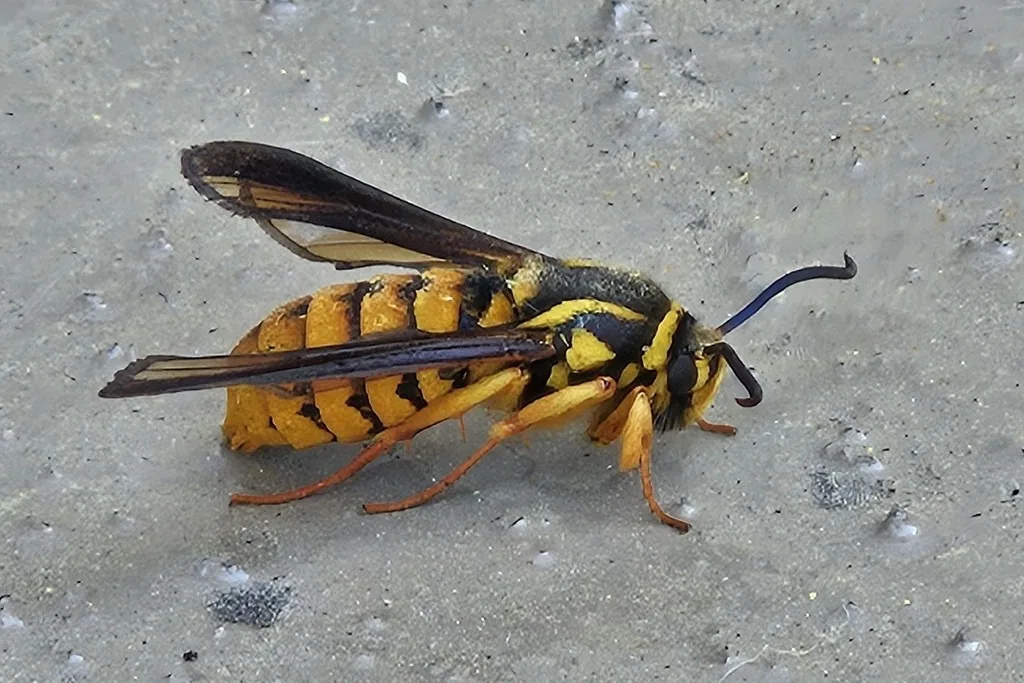
- Adult males are over an inch long and bear a remarkably close resemblance to a yellowjacket wasp; the prominent yellow markings and striking yellow abdomen set this species apart from the other clearwings caught in traps and make identification easy.[1]
- Like other clearwings it is a day flier with at least partly transparent wings marked with dark lines along the veins, and it mimics wasps in behavior as well as looks. Paranthrene species are color-polymorphic, and some color forms were once described as separate species.[1][3]
- Larval galleries are in solid trunk wood, up to 2 inches long, entering 1 to 2 feet above the ground and then running 2 to 3 inches straight up the center of the trunk.[2]
Look-alikes
| Look-alike | How to tell them apart |
|---|---|
| Ash/lilac borer | Also caught in the same May traps, but the least distinctive clearwing, with mostly opaque brown forewings and none of the oak clearwing's striking yellow abdomen.[1] |
| Yellowjackets | The mimicry is close enough that Rutgers compares trapped males directly to a yellowjacket; clearwing moths mimic wasps to avoid predators, and their wings are at least partly transparent with dark markings along and between the veins.[1] |
Where it lives
The Forest Service's 1972 manual gave its range as Nova Scotia to Maryland, Illinois and the Lake States, in natural oak stands and in nursery stock, recorded from black, red and pin oaks. Rutgers catches it in spring pheromone traps in New Jersey landscapes.[2][1]
Biology and life cycle
Adults are among the earliest clearwings to appear in spring, captured in pheromone wing traps during May in New Jersey; they are day-flying wasp mimics.[1][3]
The larvae bore into the solid wood of the trunk 1 to 2 feet above the ground and then tunnel upward 2 to 3 inches in the center of the trunk, constructing galleries up to 2 inches long; there are generally one to four larvae per tree. Like other clearwing larvae they spend most of the year under the bark, out of reach of most insecticides.[2][1]
It, or a closely related species, has been found infesting both natural oak growth and 2- to 5-inch nursery stock on Long Island.[2]
A 2024 multi-gene study of all North American Paranthrene found P. simulans polyphyletic and showed that the genus's color variants are a poor guide to species boundaries.[3]
Damage and signs
Health risk
None of the sources mentions any effect on people; the adult only looks like a yellowjacket.[1][3]
Control
Prevention
No control is described for this species; Rutgers treats it as an easily recognized trap catch rather than a target, so the main job is not to mistake it for a damaging borer when it shows up in May traps.[1]
Traps and physical control
Pheromone-baited sticky wing traps catch the males and tell a landscape manager which clearwings are present and when they emerge; the oak clearwing's yellow abdomen makes it the easiest species in the trap to name.[1]
Pesticides
For clearwing borers in general, Rutgers advises timing a long-residual bark spray such as a pyrethroid to first emergence so that hatching larvae are killed before they tunnel in; larvae already in the wood are out of reach.[1]
Common questions
- Is that yellowjacket on my oak actually a moth?
- Possibly. Male red oak clearwings are over an inch long and look remarkably like yellowjacket wasps, but they are day-flying moths, wasp mimics with partly transparent wings marked along the veins.[1]
- Does the oak clearwing kill trees?
- Rutgers does not consider it a major landscape pest; the Forest Service describes small galleries in the trunk wood, usually from only one to four larvae per tree.[1][2]
- Why does it turn up in my clearwing traps?
- Clearwing species share similar pheromones, so lures sold for other borers also attract the oak clearwing, which is one of the earliest species to fly in spring.[1]
Sources
- Rutgers Cooperative Extension Plant & Pest Advisory (Rutgers New Jersey Agricultural Experiment Station), “Identifying Clearwing Moth Borers in Pheromone Traps (S. K. Rettke), Plant & Pest Advisory.” plant-pest-advisory.rutgers.edu/identifying-clearwing-moth-borers-in-pheromone-traps/ (accessed 2026-11-10)
- USDA Forest Service, “Eastern Forest Insects, Miscellaneous Publication 1175 (W. L. Baker, 1972; scanned copy).” archive.org/details/easternforestins1175bake (accessed 2026-11-10)
- PLoS One (via NCBI PubMed), “Aposematic color polymorphism is a poor indicator of species boundaries in North American Paranthrene (Lepidoptera: Sesiidae) as evidenced by a multi-gene phylogeny (W. H. Smith III, W. H. Taft and A. I. Cognato, 2024) (abstract).” pubmed.ncbi.nlm.nih.gov/39602370/ (accessed 2026-11-10)
- iNaturalist, “Paranthrene simulans taxon page (order and family).” www.inaturalist.org/taxa/227053 (accessed 2026-11-10)