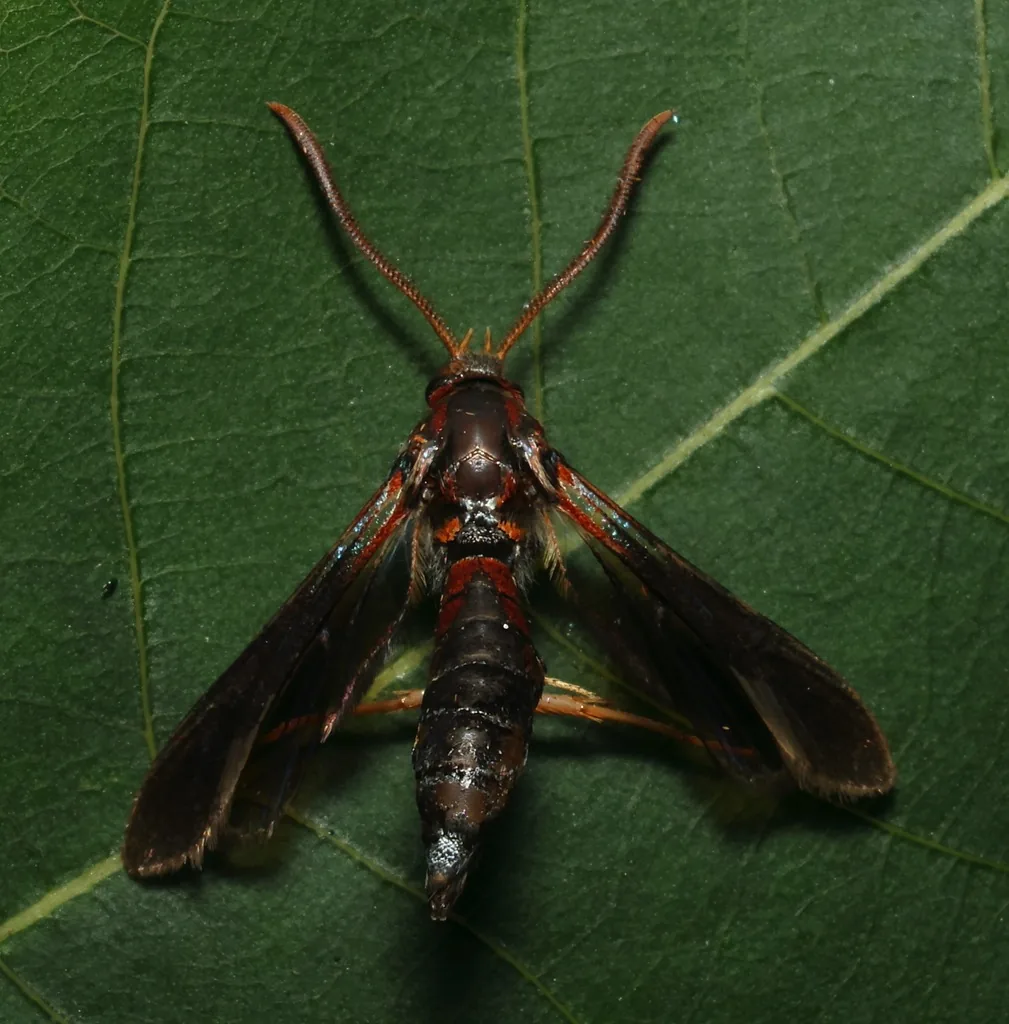
How to identify it
- Adults have long, narrow front wings and partly clear hind wings, and they look and act like paper wasps.[1]
- In the West, the male has long brownish legs and a black body with narrow yellow bands.[1]
- Larvae are 1 to 1-1/2 inches long with a dark brown head and whitish to pink body.[1]
- Sawdust-like frass at tunnel openings and empty brownish pupal cases sticking out of bark are typical signs.[1]
Look-alikes
| Look-alike | How to tell them apart |
|---|---|
| Emerald ash borer | The emerald ash borer is a beetle, not a moth, and has caused extensive damage in the upper Midwest and East.[1] |
| Paper wasps | Clearwing moths mimic wasps in color and behavior, running about while fluttering their wings.[1] |
Where it lives
It occurs throughout the United States but varies in look and behavior by region. In California it's mainly in the Central Valley, attacking trunks and limbs within 5 to 10 feet of the ground.[1]
Biology and life cycle
Adults live about a week; females lay tiny eggs in bark cracks and wounds.[1]
Eggs hatch in one to four weeks, and larvae bore into bark and wood, then pupate beneath the bark.[1]
It has one generation a year.[1]
Damage and signs
Health risk
The larvae feed only inside trees; UC IPM mentions no risk to people.[1]
Control
Prevention
Keep trees vigorous with deep watering at the drip line, avoid trunk wounds, and whitewash young trunks with diluted interior latex paint in hot areas.[1]
Traps and physical control
Prune out infested branches outside the flight season, and kill larvae by probing tunnels with a stiff wire.[1]
Biological control
Steinernema nematodes applied to tunnels can kill clearwing larvae.[1]
When to call a professional
For high-value trees, bark sprays timed to egg-laying adults may reduce attacks; effective borer insecticides are mostly for licensed applicators.[1]
Common questions
- Is the ash borer the same as the emerald ash borer?
- No. The ash borer is a clearwing moth; the emerald ash borer is a beetle.[1]
- Why is sawdust coming out of my lilac?
- Sawdust-like frass at tunnel openings is a classic sign of clearwing borer larvae such as the lilac borer.[1]
- Can insecticides save a heavily infested tree?
- No. They have little effect on borers already inside; they only help protect healthy trees.[1]
Sources
- University of California Statewide IPM Program, “Pest Notes: Clearwing Moths (Publication 7477).” ipm.ucanr.edu/PMG/PESTNOTES/pn7477.html (accessed 2026-10-06)
- iNaturalist, “Podosesia syringae taxon page (order and family).” www.inaturalist.org/taxa/228454 (accessed 2026-10-06)