The short answer
Bark beetle profiles
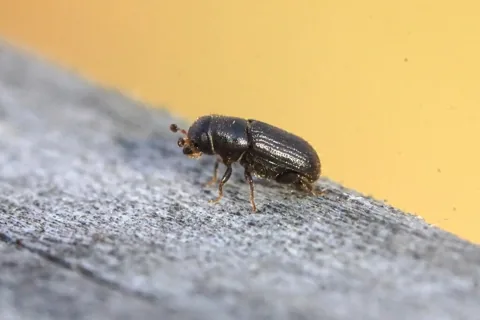 Pine Bark Beetles
Dendroctonus frontalis and Ips species (I. calligraphus, I. grandicollis, I. avulsus)
Pine bark beetles are tiny beetles that breed in the inner bark of pines. The southern pine beetle and three Ips engraver beetles are the main tree-killing species in the Southeast, and once beetles successfully colonize a pine, the tree can't be saved.
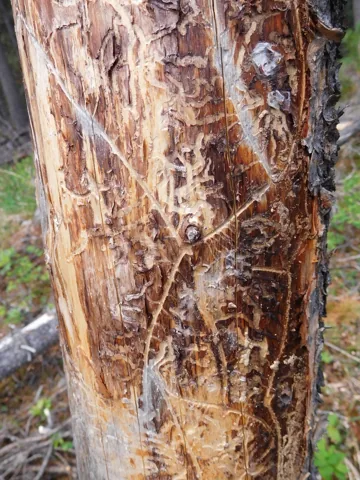 Pine Engraver
Ips pini
The pine engraver is a small bark beetle that breeds in freshly cut pine material and attacks stressed or newly planted pines, killing tops or whole trees; it almost never attacks healthy pines in years with normal rainfall.
No photo yet
Western Pine Beetle
Dendroctonus brevicomis
The western pine beetle is a native bark beetle that attacks the trunks of ponderosa pines, killing trees weakened by drought, fire, disease or crowding, often in groups.
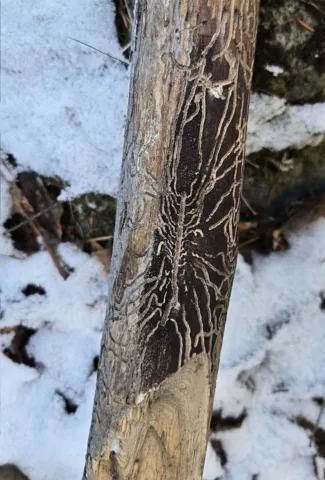 Douglas-fir Beetle
Dendroctonus pseudotsugae
The Douglas-fir beetle is a native bark beetle that breeds in windthrown, fire-scorched or weakened Douglas-firs; when downed or damaged trees are plentiful, populations build and spill over into healthy trees, killing them in groups.
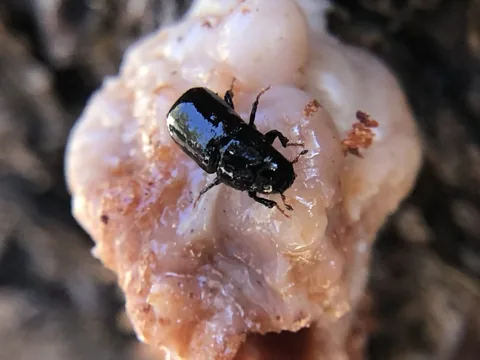 Mountain Pine Beetle
Dendroctonus ponderosae
Mountain pine beetle is a native bark beetle of western North America whose outbreaks can kill millions of pines.
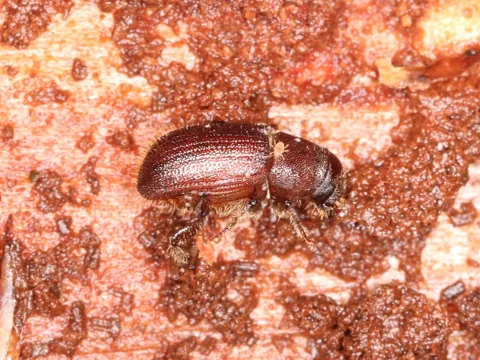 Red Turpentine Beetle
Dendroctonus valens
Red turpentine beetles attack the lower trunk of pines, even near the root collar and below ground.
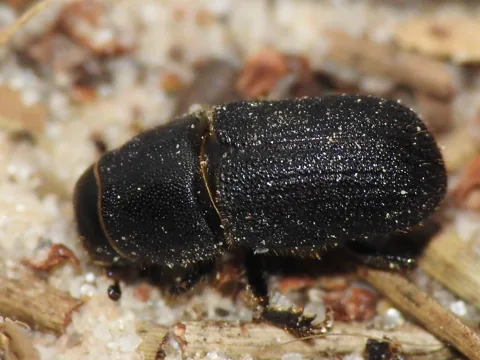 Black Turpentine Beetle
Dendroctonus terebrans
Reddish pitch tubes on the lower few feet of a pine trunk often mean black turpentine beetles; numerous attacks can kill the tree.
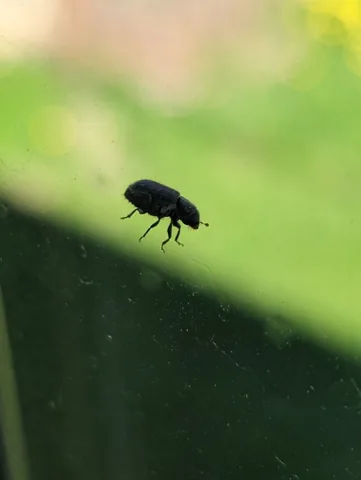 Spruce Beetle
Dendroctonus rufipennis
The spruce beetle is a native bark beetle and a major cause of spruce death in North America, especially in Alaska and the Rocky Mountains.
Signs of a bark beetle attack
Look for yellow, orange or reddish-brown boring dust in the bark crevices and at the base of the tree, small shot-hole exit holes in the bark, and needles turning yellow to red.[3]
Telling the beetles apart by their tunnels
Peeling back a piece of bark from a dying tree shows the gallery pattern, which differs by species.[5][7]
- Pine engravers (Ips beetles) leave branching tunnels etched into the inner bark and often attack the tops of trees or small material.[3][1][4]
- Western pine beetles cut winding, criss-crossing galleries in ponderosa pine.[5]
- Douglas-fir beetles lay eggs in niches alternating on opposite sides of a gallery that runs along the trunk.[7]
Which trees are at risk
Newly planted trees and trees stressed by drought, root injury, soil compaction or disease are attacked first; during outbreaks the beetles can kill healthier trees too.[1][2][5]
Protecting landscape trees
Prevention works far better than treatment, because a tree that bark beetles have colonized usually can't be saved.[1][3]
- Water trees during drought and avoid root injury and soil compaction.[1]
- Don't leave fresh pine slash or firewood near live pines through spring and summer, and remove infested trees before new beetles emerge.[2][5]
- Thin crowded stands of pine and Douglas-fir to keep the remaining trees vigorous.[5][6]
- Preventive trunk sprays on valuable trees, or MCH repellent pouches for Douglas-fir, must go on before the beetles fly in spring.[5][3][6]
Common questions
Photo credits
- Pine Bark Beetles: (c) Matt Pelikan, some rights reserved (CC BY) — via iNaturalist, CC BY 4.0
- Pine Engraver: Dezene Huber, public domain (CC0), via iNaturalist
- Douglas-fir Beetle: Megan Blackmore, public domain (CC0), via iNaturalist
- Mountain Pine Beetle: (c) Justin Paulin, some rights reserved (CC BY) — via iNaturalist, CC BY 4.0
- Red Turpentine Beetle: (c) Jake McCumber, some rights reserved (CC BY) — via iNaturalist, CC BY 4.0
- Black Turpentine Beetle: (c) Sam Kieschnick, some rights reserved (CC BY) — via iNaturalist, CC BY 4.0
- Spruce Beetle: (c) Alexandria 'Alex' Wenninger, some rights reserved (CC BY) — via iNaturalist, CC BY 4.0
Sources
- Colorado State University Extension, “Ips Beetles (Fact Sheet 5.558, W. Cranshaw; copy hosted by Utah State University).” extension.usu.edu/pests/uppdl/files/factsheet/05558.pdf (accessed 2026-10-17)
- Wisconsin DNR Forest Health Protection (hosted by UW Forestry Extension), “The Pine Engraver Bark Beetle (Ips pini) in Northern Wisconsin (FHP-2).” forestry.extension.wisc.edu/files/2017/09/FHP-2.pdf (accessed 2026-10-17)
- Montana State University Extension (Urban IPM), “Engraver Beetles (Ips spp.).” urbanipm.montana.edu/entomology/resources/fact-sheets/engraver-beetles.html (accessed 2026-10-17)
- Oregon Department of Forestry, “Ips beetles (Forest Health Fact Sheet).” oregon.gov/odf/documents/forestbenefits/ips.pdf (accessed 2026-10-17)
- Oregon Department of Forestry, “Western Pine Beetle (Forest Health Fact Sheet, March 2017).” egov.oregon.gov/odf/Documents/forestbenefits/Western%20Pine%20Beetle.pdf (accessed 2026-10-17)
- Idaho Department of Lands, “Douglas-fir Beetle (Forest Pest Fact Sheet, 2020).” www.idl.idaho.gov/wp-content/uploads/sites/2/2020/03/2016-single-pest-fact-sheet-Douglas-fir-Beetle_3_19_2020.pdf (accessed 2026-10-17)
- USDA Forest Service, “Douglas-fir Beetle (Forest Insect & Disease Leaflet 5, rev. February 2014; M. M. Furniss and S. J. Kegley; copy hosted by Montana DNRC).” dnrc.mt.gov/_docs/forestry/Forestry_Assistance/Forest_Pests/Douglas-firBeetle-FIDL.pdf (accessed 2026-10-17)
- USDA Forest Service (DecAID), “Douglas-Fir Beetle (DecAID Advisor species account).” apps.fs.usda.gov/decaid/views/douglas_fir_beetle.html (accessed 2026-10-17)