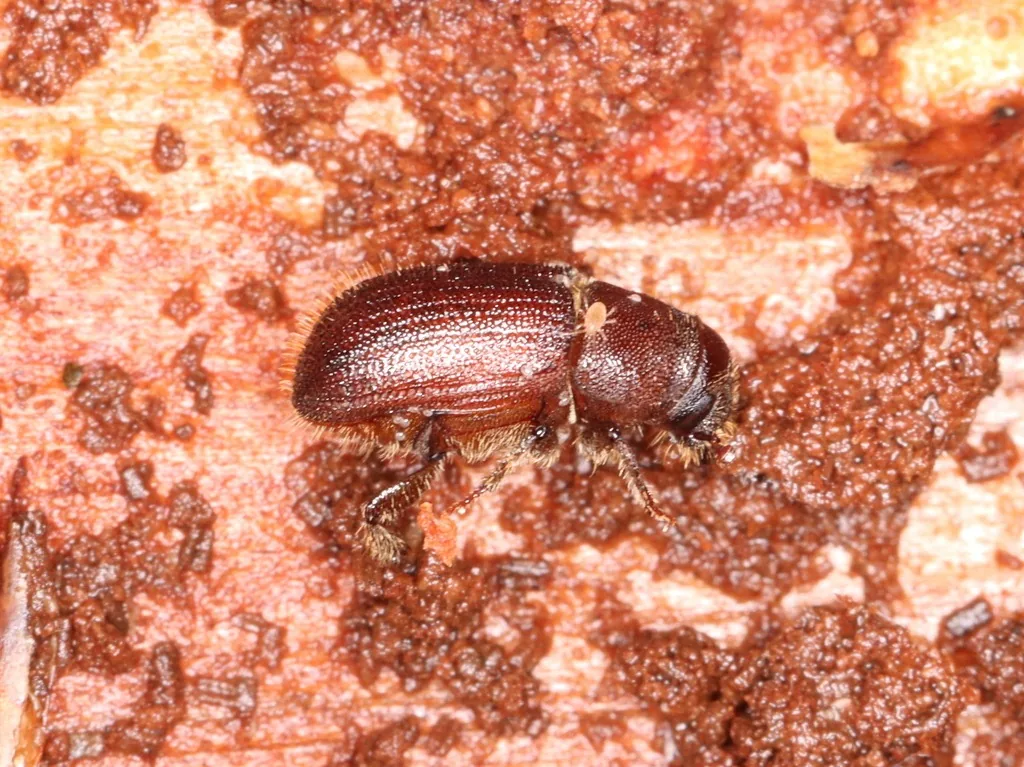
How to identify it
Look-alikes
| Look-alike | How to tell them apart |
|---|---|
| Engraver beetles | Engravers usually attack near the top of large pines, have a spiny rear end and push out dry boring dust.[1] |
Where it lives
It's one of the main bark beetles in pines in California landscapes and at the wildland-urban interface.[1]
Biology and life cycle
Adults mine wide, cave-like galleries that run down the stem, packing them with sawdust-like frass.[1]
Larvae feed as a group in roughly the same direction as the gallery.[1]
Damage and signs
- It infests pines and rarely larch, spruce or white fir, and doesn't attack redwoods or atlas cedars.[1]
Health risk
It feeds on plants; UC IPM mentions no risk to people.[1]
Control
Prevention
Keep trees vigorous: avoid root and trunk injury and soil compaction, and in drought water infrequently rather than in frequent shallow doses.[1]
Sanitation
Remove heavily attacked trees and chip, burn or haul infested wood quickly; never pile it next to live trees.[1]
Common questions
Sources
- University of California Statewide IPM Program, “Bark Beetles (Pest Notes).” ipm.ucanr.edu/home-and-landscape/bark-beetles/ (accessed 2026-10-06)
- iNaturalist, “Dendroctonus valens taxon page (order and family).” www.inaturalist.org/taxa/218223 (accessed 2026-10-06)