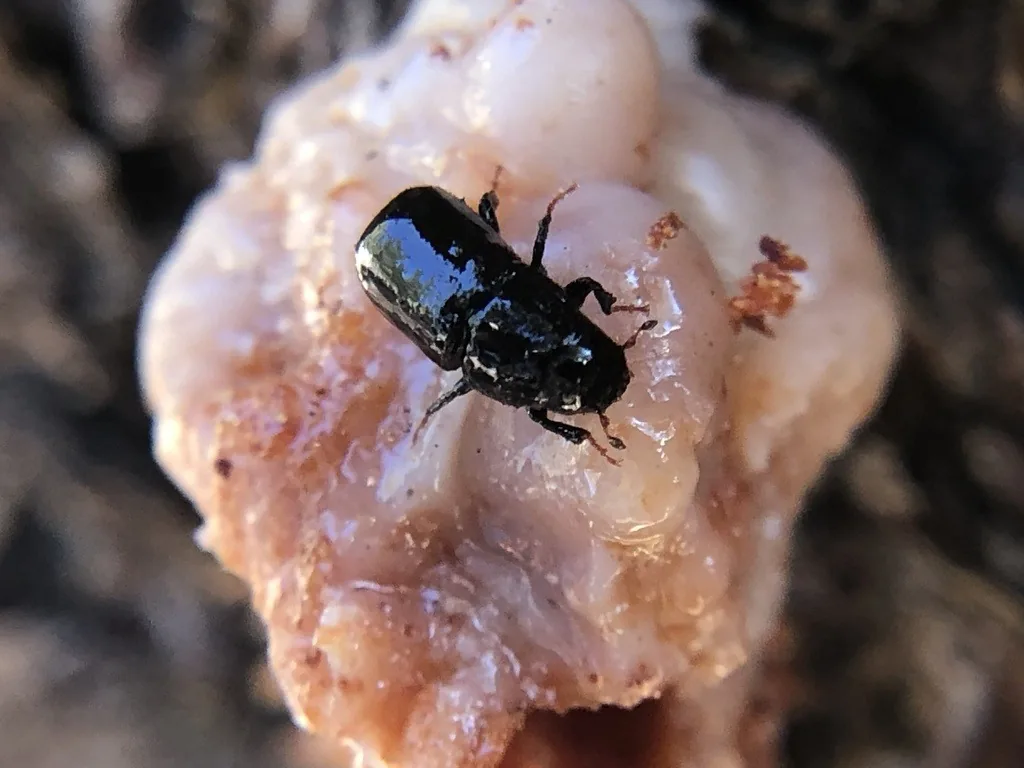
How to identify it
- Popcorn-shaped masses of resin called pitch tubes, brown, pink or white, form on the trunk where beetles bore in.[1]
- Boring dust collects in bark crevices and at the tree base, and the crown turns yellow to red about 8 to 10 months after a successful attack.[1]
- Under the bark you'll find vertical egg galleries and blue-gray stained sapwood.[1]
Look-alikes
| Look-alike | How to tell them apart |
|---|---|
| Ips (engraver) beetles | Ips have a sharply spined rear end; Dendroctonus beetles such as mountain pine beetle have a gently curved one.[1] |
| Red turpentine beetle | A relative that attacks injured pines, mostly the lower trunk and root collar.[1][2] |
Where it lives
It's native to western North America; in California it attacks lodgepole and sugar pines, especially at high elevations.[1][2]
Biology and life cycle
Adults leave dead trees in late summer and mass-attack large living pines; each pair lays about 75 eggs in a vertical gallery.[1]
Larvae overwinter under the bark using glycerol as antifreeze; there's one generation a year in Colorado.[1]
Beetles carry bluestain fungi that help kill the tree.[1]
Damage and signs
Health risk
It attacks pines; CSU Extension mentions no risk to people.[1]
Control
Prevention
Thinning crowded stands to well-spaced, healthy trees is the long-term remedy; stressed trees are attacked first.[1]
Sanitation
Peel, burn, chip or bury infested logs before beetles emerge in summer, and don't bring infested firewood near pines.[1]
When to call a professional
Preventive bark sprays applied in early summer can protect high-value green trees for one beetle flight; a licensed applicator can help.[1]
Common questions
Sources
- Colorado State University Extension, “Mountain Pine Beetle (Fact Sheet 5.528).” extension.colostate.edu/resource/mountain-pine-beetle/ (accessed 2026-10-06)
- University of California Statewide IPM Program, “Bark Beetles (Pest Notes).” ipm.ucanr.edu/home-and-landscape/bark-beetles/ (accessed 2026-10-06)
- iNaturalist, “Dendroctonus ponderosae taxon page (order and family).” www.inaturalist.org/taxa/53543 (accessed 2026-10-06)