On this page
How to identify it
- Look for reddish-brown boring dust collecting in bark crevices and for pitch streamers on the trunk, usually most plentiful midway up the tree; attacks often don't start until 11 to 15 feet above the ground.[3]
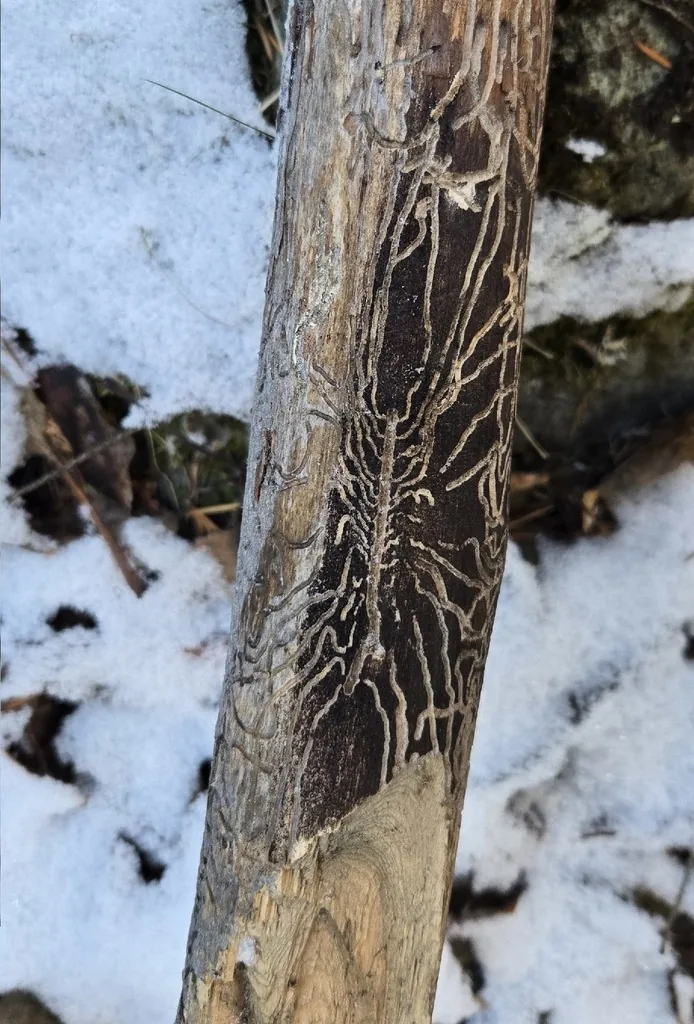
- Under the bark, eggs are laid in niches alternating on opposite sides of the egg gallery, with larval galleries etched into the inner bark on both sides, a distinctive pattern.[2]
- On trees killed earlier, pouch fungi may grow out of the beetle exit holes.[3]
Where it lives
Native to western North America and found throughout the range of Douglas-fir, including all of Oregon, Washington and Idaho.[2][3][1]
Biology and life cycle
There is one generation a year, and most tree deaths come from the spring flight.[1][3]
Larvae feeding in the phloem girdle the tree, and once a tree is infested it can't be saved.[1]
Populations usually build in freshly downed trees for one or two years after a blowdown or fire and then attack standing trees; without new fresh material they subside to normal levels by about the fourth year.[3][1]
Damage and signs
Health risk
It attacks trees only; none of the sources reports any harm to people or pets.[1]
Control
Prevention
Pouches of MCH, a naturally occurring beetle repellent, stapled to trees in spring before the beetle flight have proven very effective at protecting high-value trees.[1]
Thinning crowded, older Douglas-fir stands reduces their susceptibility.[1]
Sanitation
Remove or process windthrown, damaged and beetle-infested Douglas-firs before the next spring flight, since the beetle is strongly attracted to downed trees with green inner bark.[1]
Common questions
- Why are Douglas-firs dying near me a year or two after a windstorm?
- Douglas-fir beetles breed in trees blown down by wind and then attack nearby standing trees in the following one or two years.[3][1]
- How can I protect my Douglas-firs?
- Clean up windthrown and infested trees before the spring beetle flight, and put MCH repellent pouches on valuable trees before the beetles fly.[1]
Sources
- Idaho Department of Lands, “Douglas-fir Beetle (Forest Pest Fact Sheet, 2020).” www.idl.idaho.gov/wp-content/uploads/sites/2/2020/03/2016-single-pest-fact-sheet-Douglas-fir-Beetle_3_19_2020.pdf (accessed 2026-10-17)
- USDA Forest Service, “Douglas-fir Beetle (Forest Insect & Disease Leaflet 5, rev. February 2014; M. M. Furniss and S. J. Kegley; copy hosted by Montana DNRC).” dnrc.mt.gov/_docs/forestry/Forestry_Assistance/Forest_Pests/Douglas-firBeetle-FIDL.pdf (accessed 2026-10-17)
- USDA Forest Service (DecAID), “Douglas-Fir Beetle (DecAID Advisor species account).” apps.fs.usda.gov/decaid/views/douglas_fir_beetle.html (accessed 2026-10-17)
- iNaturalist, “Dendroctonus pseudotsugae taxon page (order and family).” www.inaturalist.org/taxa/48905 (accessed 2026-10-06)