On this page
How to identify it
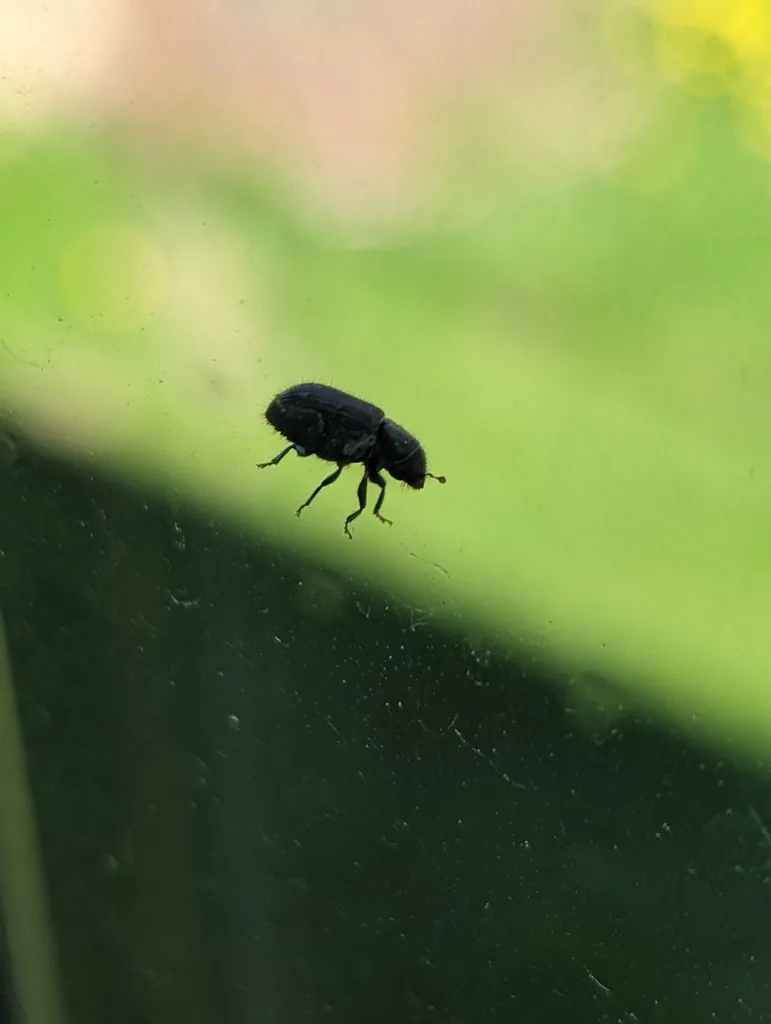
- Adults are cylindrical, 1/8 to 1/4 inch long and dark brown to black with reddish-brown or black wing covers; many other bark beetles look much the same.[1]
- The first signs are reddish-brown boring dust in bark crevices and at the base of the tree, plus creamy to reddish pitch tubes or streams of resin on the trunk.[1][2]
- Woodpeckers flaking off bark and needles that fade to yellowish-green and drop the year after attack also point to infestation.[1][2]
Where it lives
Transcontinental, from Alaska to Newfoundland and through the Rocky Mountains; populations in New England and eastern Canada have stayed low in recent decades.[1]
Biology and life cycle
The life cycle takes one to three years depending on temperature, most often two; in Colorado a two-year cycle is most common in spruce above 9,000 feet.[1][2]
Adults fly from about May through August to attack new trees, and females release pheromones that draw mass attacks able to overwhelm healthy trees.[1][2]
Outbreaks often start in windthrown or felled spruce, then shift to standing live trees once the downed wood is used up.[1][2]
Damage and signs
- All North American spruces are hosts, with large, mature trees preferred; in Colorado it attacks Engelmann spruce and occasionally Colorado blue spruce.[1][2]
- Recent warm, dry decades have driven large outbreaks in Alaska, western Canada and the Rocky Mountains, killing great numbers of spruce.[1][2]
Health risk
Control
Prevention
Packets of MCH, the beetle's anti-aggregation pheromone, can reduce attacks on standing spruce, though they work less well when beetle numbers are high.[1][2]
Sanitation
Remove windthrown spruce, infested trees and large slash promptly so beetles can't build up in them.[1][2]
Biological control
Woodpeckers can destroy up to 99 percent of the brood in a standing tree, and checkered beetles, long-legged flies and parasitoid wasps also attack it.[1]
Pesticides
Preventive bark sprays of registered pyrethroids can protect individual trees; the Colorado State Forest Service recommends spraying only high-value trees near homes, businesses or recreation sites.[2]
Common questions
- How can I tell if spruce beetles are attacking my spruce?
- Look for reddish boring dust in bark cracks and at the trunk base, pitch tubes, and bark flaked off by woodpeckers.[1][2]
- Can I protect a spruce near my house?
- Yes; preventive bark sprays or MCH pheromone packets can protect individual high-value trees before they are attacked.[1][2]
Sources
- USDA Forest Service (Forest Insect & Disease Leaflets), “Spruce Beetle (FIDL 127, April 2026).” www.fs.usda.gov/foresthealth/docs/fidls/FIDL-127-SpruceBeetle.pdf (accessed 2026-10-16)
- Colorado State Forest Service, “Spruce Beetle (Common Forest Insects and Diseases).” csfs.colostate.edu/forest-management/common-forest-insects-diseases/spruce-bark-beetle/ (accessed 2026-10-16)
- iNaturalist, “Dendroctonus rufipennis taxon page (order and family).” www.inaturalist.org/taxa/218221 (accessed 2026-10-06)