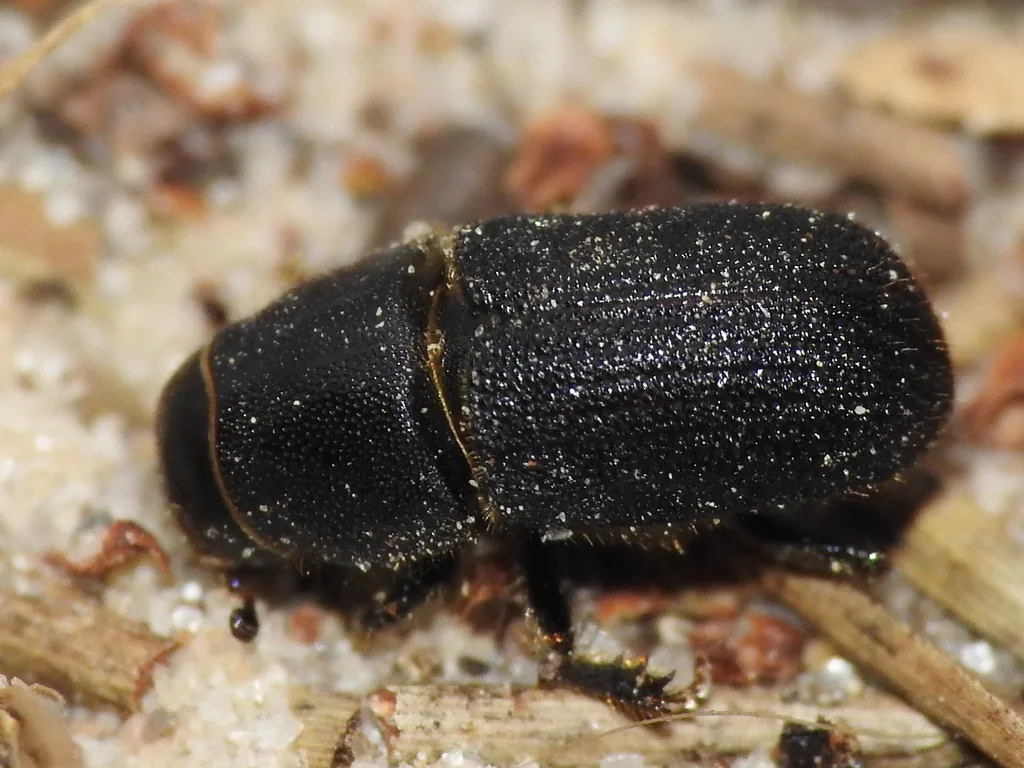
How to identify it
Look-alikes
| Look-alike | How to tell them apart |
|---|---|
| Southern pine beetle | Similar in shape but only 2 to 3 mm long.[1] |
Where it lives
It occurs from coastal New Hampshire south through Florida and west to Texas and Missouri.[1]
Biology and life cycle
Females bore through the bark at the lower trunk and are joined by males; they're strongly drawn to pine odors and fresh stumps.[1]
Damage and signs
- Light attacks kill patches of phloem, but many attacks per tree kill it; logging and thinning often trigger infestations.[1]
Health risk
It attacks pines; UF/IFAS mentions no risk to people.[1]
Control
Prevention
Keep pines healthy, avoid root and trunk injuries, and keep fresh pine firewood and slash away from live pines.[1]
When to call a professional
Trees with fewer pitch tubes than their diameter in inches are more likely to survive and may be candidates for treatment; ask your local Extension office.[1]
Common questions
Sources
- University of Florida IFAS Extension (Featured Creatures), “Black Turpentine Beetle, Dendroctonus terebrans (EENY-356).” edis.ifas.ufl.edu/publication/IN636 (accessed 2026-10-06)
- iNaturalist, “Dendroctonus terebrans taxon page (order and family).” www.inaturalist.org/taxa/218222 (accessed 2026-10-06)