The short answer
- Turn a speckled leaf over. Lace bugs leave dark, varnish-like specks of excrement and cast nymph skins under the leaf, along with the spiny nymphs and lacy adults. Spider mites don't leave those specks.[1][3][9]
- Most lace bug damage is cosmetic. UC IPM says it doesn't seriously harm plants, and the University of Minnesota says the best option in most cases is to tolerate it. Stippled leaves stay stippled, so any treatment only protects new growth.[1][2]
- If you do treat, start in spring when nymphs first show up. On shrubs, a strong stream of water at the leaf undersides, or insecticidal soap or horticultural oil sprayed so it wets the undersides, works on nymphs and adults. Repeat as new eggs hatch, because none of these kill the eggs.[1][2][3][9]
- Systemic insecticides such as imidacloprid and dinotefuran work, but they are very toxic to bees and can set off spider mite outbreaks. Apply them only after the plant has finished flowering. Minnesota advises avoiding them when possible.[2][1][14]
Lace bug profiles
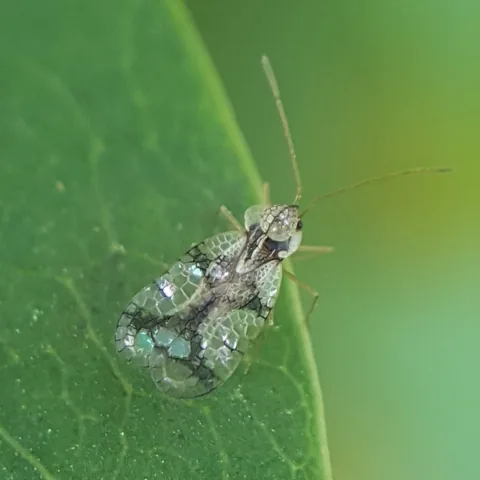 Lace Bugs
Stephanitis pyrioides
Lace bugs are small sap-feeding bugs with lacy wings that live under the leaves of trees and shrubs. Their feeding bleaches and stipples leaves, but the damage is mostly cosmetic and rarely threatens plant health.
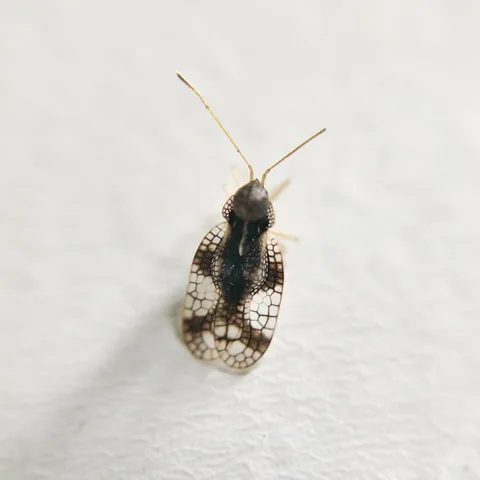 Andromeda Lace Bug
Stephanitis takeyai
The andromeda lace bug is a small, showy lace bug, marked black and clear, that feeds under the leaves of Japanese andromeda (Pieris japonica), turning the tops yellow to gray with stippling.
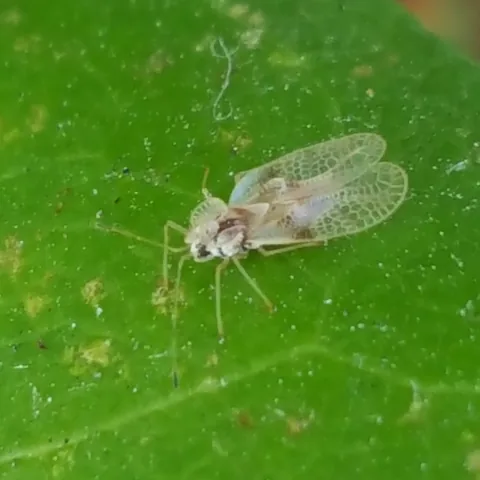 Rhododendron Lace Bug
Stephanitis rhododendri
The rhododendron lace bug is a tiny, pale insect with lacy wings that feeds on the undersides of rhododendron and mountain laurel leaves, leaving pale speckles on top and black tar-like spots and shed skins underneath.
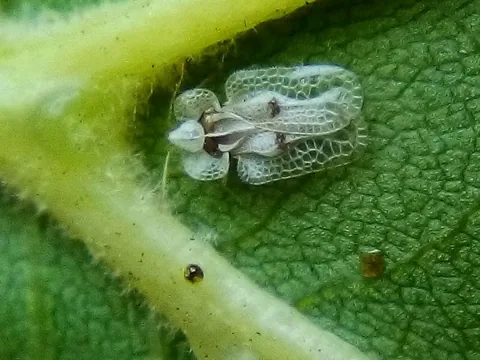 Sycamore Lace Bug
Corythucha ciliata
The sycamore lace bug is a tiny, whitish, lacy-winged insect that feeds under sycamore leaves, stippling them white or yellow and leaving black varnish-like specks of excrement; heavy feeding turns leaves white or bronze and can drop them by late summer.
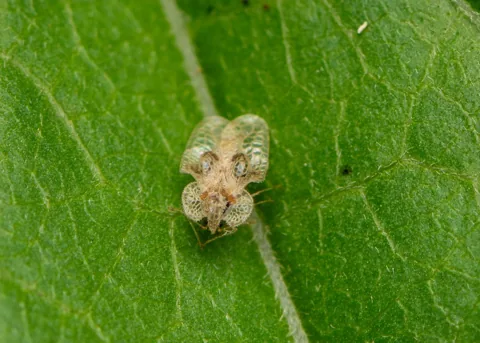 Oak Lace Bug
Corythucha arcuata
The oak lace bug is a small lace bug that feeds on the undersides of oak leaves, leaving the upper surface speckled with pale spots that can merge into bleached, white patches by late summer.
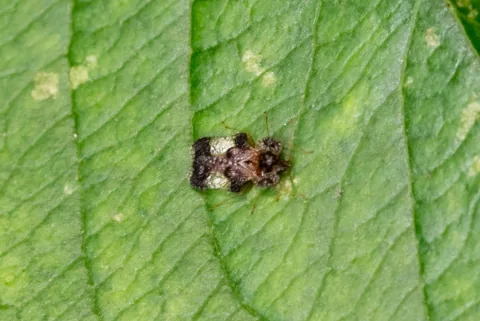 Hawthorn Lace Bug
Corythucha cydoniae
The hawthorn lace bug is a tiny insect with lacy, brown-spotted wings that feeds under the leaves of pyracantha, cotoneaster and hawthorn, leaving pale spots on top and dark specks of excrement below.
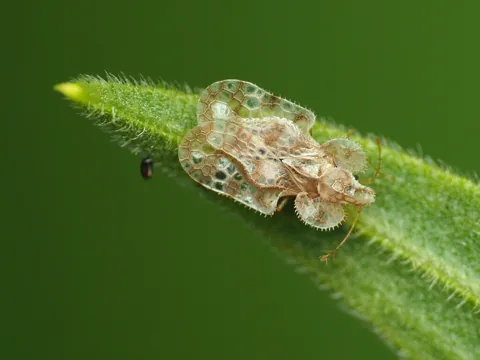 Chrysanthemum lace bug
Corythucha marmorata
The chrysanthemum lace bug is a tiny, lacy-winged bug that sucks sap from asters, mums, goldenrod, sunflowers and other aster-family plants, leaving leaves pale-speckled and spotted with tar-like droplets.
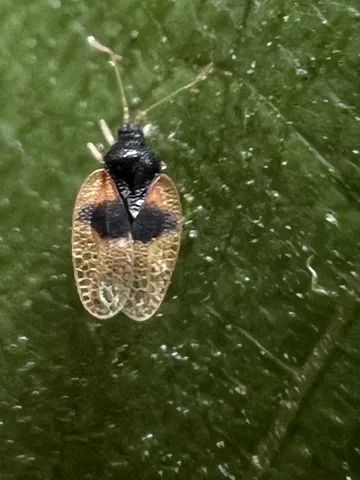 Avocado Lace Bug
Pseudacysta perseae
Avocado lace bugs feed in groups under avocado leaves. Low numbers are harmless, but heavy feeding browns and drops leaves, which can sunburn fruit and hurt later yields. Since reaching Hawaii it has become a pest across the islands.
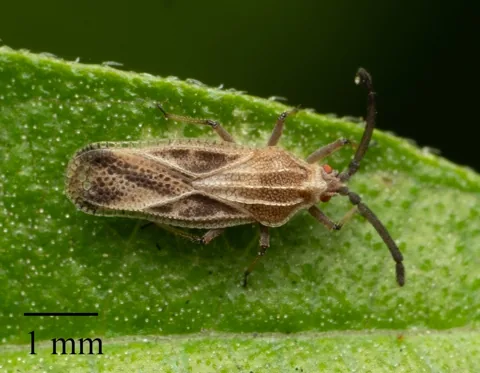 Lantana Lace Bug
Teleonemia scrupulosa
Lantana leaves that turn pale and speckled, then brown and dry from the tips, with dark specks of excrement on the undersides, usually mean lantana lace bugs. Adults and nymphs feed under the leaves and also attack flower buds.
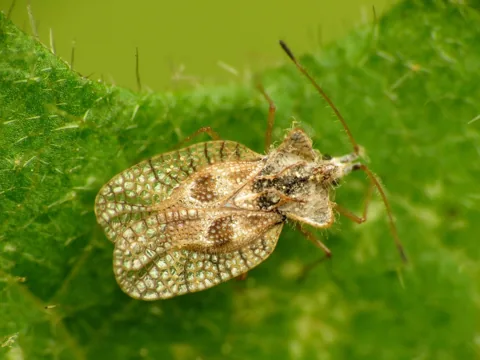 Eggplant lace bug
Gargaphia solani
The eggplant lace bug is one of the two common insect pests of eggplant named by NC State Extension, along with the eggplant flea beetle. Grayish to light brown adults with lacelike wings gather in herds with their spiny yellow nymphs on the undersides of leaves, and the tops of infested leaves show roughly circular discolored patches. Besides eggplant it feeds on potato, tomato, horsenettle and other nightshade-family plants, and has been recorded on cotton, sunflower and sage.
Check the undersides first
Lace bug feeding causes small white or yellow speckles on the upper leaf surface. As feeding goes on, leaves can turn almost white, bleached or bronzed, and heavy damage can make leaves drop early. Damage is most noticeable from mid to late summer.[2][1][3][11]
Several other pests also speckle leaves, so the leaf underside is what settles it.[1][6]
- Lace bugs: dark, shiny, tar-like specks of excrement, cast skins, spiny dark nymphs and lacy-winged adults, often grouped together under the leaf. Clemson describes the underside as looking fly-specked.[1][9][11]
- Spider mites: stippling but no dark specks. UC IPM says you may also see mite cast skins and fine silk webbing; a magnifying lens helps.[1][3][6]
- Thrips: injury that looks similar, but NC State calls lace bug injury coarser.[3][6]
- Rhododendron lace bug spots are larger than mite spots when you look closely, and come with cast skins and bigger fecal spots underneath.[5]
- On oaks, Rutgers notes that from a distance lace bug stippling can look like oak spider mites or leaf scorch. Check the leaf undersides to be sure.[12]
Which lace bug do you have?
Most lace bugs feed on one plant or a few closely related ones, so the plant they're on is the best clue to the species. Adults are about 1/8 inch long or a little smaller.[1][13][3][8]
Rutgers sorts them into two groups that matter for timing. Stephanitis species (azalea, andromeda and rhododendron lace bugs) feed on broadleaf evergreens, have oval wings and spend the winter as eggs inside the leaves. Corythucha species (sycamore, oak, hawthorn and others) feed on deciduous plants, have rectangular wings and spend the winter as adults under bark or in leaf litter.[12][3][10][6]
- Azalea lace bug (Stephanitis pyrioides): evergreen azaleas are most likely to be hit, but deciduous azaleas and mountain laurel are attacked too. NC State gives the adult length as 1/8 inch and UMass as about 1/10 inch. Up to 90 eggs have been found in a single leaf, and UMass reports up to 300 eggs per female.[3][8]
- Andromeda lace bug (Stephanitis takeyai): mainly on Japanese andromeda (Pieris japonica), where it can do severe damage, especially in full sun. NC State reports at least four generations a year in North Carolina and UMass three to four in New England.[4][9]
- Rhododendron lace bug (Stephanitis rhododendri): feeds on many rhododendrons as well as mountain laurel. Eggs hatch from late April through May, and there are one to three generations a year depending on altitude, climate and season length.[5]
- Sycamore lace bug (Corythucha ciliata): adults spend the winter under the flaking bark of the sycamore itself. Development from egg to adult takes about 30 days, with two or more generations a year and up to five in warmer areas. Heavy infestations can make sycamores drop leaves in late summer.[10][13]
- Oak lace bug (Corythucha arcuata): Rutgers says infestations are often most pronounced on white oaks. Females lay 30 to 50 black, spike-like eggs in a circle 3/4 inch across or less on the leaf underside, and there are typically 3 or 4 generations a year there.[12]
- Hawthorn lace bug (Corythucha cydoniae): on pyracantha, cotoneaster and hawthorn, and sometimes quince, serviceberry, apple, pear and oak. At least four generations a year in North Carolina. NC State says it should not be difficult to control.[6]
- Chrysanthemum lace bug (Corythucha marmorata): on mums, asters, goldenrod, sunflower and other aster-family plants. Females lay eggs along the larger leaf veins in groups of 4 to 75.[7]
- Eggplant lace bug (Gargaphia solani): on eggplant, potato, tomato and horsenettle in the vegetable garden.[13]
Do you need to treat?
Usually not. Healthy, mature trees and shrubs tolerate lace bugs, and UC IPM says the feeding is not a serious threat to plant health. Heavy feeding over several years can slow the growth of new transplants.[2][1]
Large trees are the clearest case for leaving them alone. Rutgers says spraying oak lace bugs is generally not necessary because tall oaks need large spray volumes and the damage is mainly aesthetic. UMass says sycamores on good sites often get only cosmetic damage that needs no management.[12][10]
- Shrubs in hot, sunny spots are the exception worth watching. UMass says azaleas in full sun can be killed by heavy infestations, and andromeda in full sun is damaged most.[8][9]
- Clemson notes that early leaf drop can leave azaleas more open to some dieback diseases.[11]
- UMass says several years of severe sycamore lace bug damage combined with other stresses may lead to tree death, more likely on poor sites. Heavy infestations are more common in urban areas.[10]
When to check and when to act
Act early in the season. Insecticides won't restore stippled leaves; they only protect growth that hasn't been damaged yet. The spring generations do the most damage on azalea and rhododendron, and good control of the first generation cuts later problems.[1][3][5][11]
- UC IPM: if damage was bad last year, inspect plants about once a week from late winter, and act when nymphs become abundant and before damage is extensive.[1]
- University of Minnesota: start checking in late spring or early summer and look about every two weeks, especially plants with a history of lace bugs.[2]
- UMass: monitor azaleas from late April through summer, and check plants in full sun first.[8]
- Clemson (South Carolina azaleas): first generation March through May, second July through August, later ones September through October.[11]
- Sycamore: as soon as new leaves expand, the overwintered adults move to the undersides to feed and lay eggs, though bronzing and leaf drop don't show until later in summer.[10]
Knock them off with water
On small shrubs, a forceful stream from a garden hose aimed at the leaf undersides knocks nymphs off. They have no wings and can't climb back. Start early in the season, when nymphs are the main stage, and repeat.[2][1]
Insecticidal soap and horticultural oil
Soaps and oils are low-risk sprays that kill lace bugs on contact and are easier on natural enemies than broad-spectrum insecticides. They only work if the spray wets the leaf undersides, where the insects are.[2][1][9]
They have two limits. They don't kill eggs, and they leave no residue. NC State says that is why more than one application is often needed as new eggs hatch. Clemson suggests a second spray 7 to 10 days after the first to catch newly hatched nymphs.[3][4][11]
- Use horticultural oil at the summer rate on andromeda, as NC State and UMass advise.[4][9]
- UC IPM also lists azadirachtin, neem oil and pyrethrins as contact sprays that don't leave long-lasting residues. Its advice is to start in spring when nymphs become abundant and repeat if needed.[1]
- Azalea and rhododendron lace bug eggs sit inside the leaf under a hardened drop of excrement, which NC State says may protect them from sprays, especially in fall and winter.[3][5]
Plant choice and site
Replacing a plant that keeps getting hit is often the lasting fix. Mountain andromeda (Pieris floribunda) is highly resistant to andromeda lace bug and can stand in for Japanese andromeda.[4][9]
Sun and shade is less clear-cut. UC IPM says azaleas grown in partial shade get less lace bug damage than those in full sun, and UMass advises planting azaleas in partial shade. A Georgia field study (Braman and others, 2000) found Stephanitis lace bugs more common in plots with 50% shade than in full sun, and found resistant plant choices suppressed azalea lace bug most effectively.[1][8][15]
- UMass lists resistance in the native azaleas Rhododendron atlanticum, R. arborescens, R. canescens, R. periclymenoides and R. prunifolium.[8]
- Clemson lists resistant azalea cultivars including 'Dawn', 'Pink Star', 'Cavalier', 'Elsie Lee', 'Red Wing', 'Sunglow' and 'Marilee'.[11]
- Water plants properly and keep them vigorous. UMass says drought or dry conditions can make sycamore lace bug damage worse.[1][10]
- On toyon and possibly other shrubs, UC IPM suggests raking away fallen leaves under host plants in late fall to cut winter survival, and not mulching a plant with leaves of the same genus, which may harbor adult lace bugs.[1]
Natural enemies
Assassin bugs, lacewing larvae, lady beetles, pirate bugs, spiders, predatory mites and tiny parasitic wasps that attack lace bug eggs all feed on lace bugs. They often arrive only after lace bugs are already abundant, and NC State says they often fail to prevent noticeable damage. UC IPM still calls protecting them an essential part of long-term control, so pick sprays that spare them.[1][2][3][11]
UMass says landscapes with more plant structure and more plant species have been shown to reduce azalea lace bug numbers by supporting natural enemies.[8]
Systemic insecticides: use with care
Systemic insecticides are taken up by the roots or trunk and move into the leaves, where lace bugs feed on them. Imidacloprid and dinotefuran, applied to the soil, are the ones extension sources name most for lace bugs, and UC IPM and Clemson say one application can give season-long control. How to apply them is covered in the systemic insecticides guide.[1][2][11][3]
They come with real costs. Minnesota advises avoiding them when possible.[2][1]
- Bees: Minnesota calls these products very toxic to bees. Treat only after the tree or shrub has finished flowering, and don't apply to the soil where bee-attractive flowers grow right next to the tree. UC IPM adds that systemics can move into flowers.[2][1][9]
- Spider mites: UC IPM says some systemic insecticides can cause spider mite outbreaks. In a study of elms in New York City's Central Park, imidacloprid treatments were followed by spider mite outbreaks; the insecticide poisoned mite predators and raised mite egg-laying.[1][14]
- Time lag: soil treatments act more slowly than trunk treatments. Rutgers says imidacloprid applied to the roots of a large tree may need at least 2 to 3 months to move through the canopy, so treatments for a problem oak are best made early in the season.[1][12]
- Rules: in Massachusetts, neonicotinoids have been state restricted use for tree and shrub pests since July 1, 2022. Check your state's rules and the product label before buying.[9]
- Trunk injection and implants wound the tree and can spread disease on dirty tools. UC IPM favors soil application or trunk sprays where possible.[1]
Broad-spectrum sprays: where sources disagree
UC IPM does not recommend long-lasting broad-spectrum foliar sprays (carbaryl, malathion and pyrethroids such as bifenthrin and permethrin) for lace bugs, because they kill natural enemies and pollinators, can trigger spider mite outbreaks and wash into storm drains.[1]
Clemson's azalea guide lists acephate, bifenthrin, cyfluthrin, cyhalothrin and malathion as foliar options, and the University of Minnesota says pyrethroids work but kill natural enemies and should be used carefully. If you use one, spray the leaf undersides, follow the label and expect to watch for mites afterward.[11][2][1]
Where to go next
The species profiles below cover each lace bug in more detail. For stippling with no black specks underneath, the spider mite guide is the place to start.[1][3]
Common questions
- What are the black spots under my azalea leaves?
- Usually lace bug excrement. Lace bugs leave dark, varnish-like specks along with cast skins on the leaf underside, and the matching pale speckling shows on top. Spider mites don't leave those specks.[3][1][11]
- Will the leaves turn green again?
- No. Stippled leaves stay that way until they're pruned off or replaced by new growth. Treatment only protects leaves that haven't been damaged yet.[1][5]
- Does dish soap kill lace bugs?
- The sources here recommend insecticidal soap products, which kill nymphs and adults on contact but not eggs. Spray the undersides of the leaves and repeat as new nymphs hatch.[2][3][9]
- Should I spray my sycamore or oak?
- Usually not. Rutgers says spraying oak lace bugs on tall trees isn't justified for what is mainly cosmetic damage, and UMass says sycamores on good sites often need no management. UMass says drought makes the damage worse, so reducing stresses like that helps more.[12][10]
- When is the best time to treat lace bugs?
- Early, when the first nymphs of the year appear on new growth. On azaleas and rhododendrons the spring generations do the most damage, and Clemson says good control of the first generation greatly reduces later problems.[3][5][11]
Photo credits
- Lace Bugs: (c) giantcicada, some rights reserved (CC BY) — via iNaturalist, CC BY 4.0
- Andromeda Lace Bug: (c) Daisy Cadet, some rights reserved (CC BY) — via iNaturalist, CC BY 4.0
- Rhododendron Lace Bug: (c) giantcicada, some rights reserved (CC BY) — via iNaturalist, CC BY 4.0
- Sycamore Lace Bug: (c) Stephen Thorpe, some rights reserved (CC BY) — via iNaturalist, CC BY 4.0
- Oak Lace Bug: (c) Patrick O'Brien, some rights reserved (CC BY) — via iNaturalist, CC BY 4.0
- Hawthorn Lace Bug: (c) Patrick Hanly, some rights reserved (CC BY) — via iNaturalist, CC BY 4.0
- Chrysanthemum lace bug: (c) Katja Schulz, some rights reserved (CC BY) — via iNaturalist, CC BY 4.0
- Avocado Lace Bug: (c) Mark Richman, some rights reserved (CC BY) — via iNaturalist, CC BY 4.0
- Lantana Lace Bug: Jesse Rorabaugh, public domain (CC0), via iNaturalist
- Eggplant lace bug: (c) Katja Schulz, some rights reserved (CC BY) — via iNaturalist, CC BY 4.0
Sources
- University of California Statewide IPM Program, “Pest Notes: Lace Bugs, UC ANR Publication 7428 (S. H. Dreistadt).” ipm.ucanr.edu/home-and-landscape/lace-bugs/ (accessed 2026-11-10)
- University of Minnesota Extension, “Lace bugs.” extension.umn.edu/yard-and-garden-insects/lace-bugs (accessed 2026-11-10)
- NC State Extension, “Azalea Lace Bug.” content.ces.ncsu.edu/azalea-lace-bug (accessed 2026-11-10)
- NC State Extension, “Andromeda Lace Bug.” content.ces.ncsu.edu/andromeda-lace-bug (accessed 2026-11-10)
- NC State Extension, “Rhododendron Lace Bug.” content.ces.ncsu.edu/rhododendron-lace-bug (accessed 2026-11-10)
- NC State Extension, “Hawthorn Lace Bug.” content.ces.ncsu.edu/hawthorn-lace-bug (accessed 2026-11-10)
- NC State Extension, “Chrysanthemum Lace Bug.” content.ces.ncsu.edu/chrysanthemum-lace-bug (accessed 2026-11-10)
- UMass Amherst Center for Agriculture, Food, and the Environment, “Stephanitis pyrioides (azalea lace bug), Landscape Insect & Mite Guide.” www.umass.edu/agriculture-food-environment/landscape/publications-resources/insect-mite-guide/stephanitis-pyrioides (accessed 2026-11-10)
- UMass Amherst Center for Agriculture, Food, and the Environment, “Stephanitis takeyai (andromeda lace bug), Landscape Insect & Mite Guide.” www.umass.edu/agriculture-food-environment/landscape/publications-resources/insect-mite-guide/stephanitis-takeyai (accessed 2026-11-10)
- UMass Amherst Center for Agriculture, Food, and the Environment, “Corythucha ciliata (sycamore lace bug), Landscape Insect & Mite Guide.” www.umass.edu/agriculture-food-environment/landscape/publications-resources/insect-mite-guide/corythucha-ciliata (accessed 2026-11-10)
- Clemson Cooperative Extension, Home & Garden Information Center, “Azalea and Rhododendron Insect Pests in South Carolina.” hgic.clemson.edu/factsheet/azalea-rhododendron-insect-pests/ (accessed 2026-11-10)
- Rutgers Cooperative Extension, Plant & Pest Advisory, “Summer Pests on Oaks: Oak Sawflies, Oak Spider Mites & Oak Lace Bugs (S. K. Rettke).” plant-pest-advisory.rutgers.edu/summer-pests-on-oaks-oak-sawflies-oak-spider-mites-oak-lace-bugs (accessed 2026-11-10)
- Missouri Department of Conservation, “Lace Bugs (Field Guide).” mdc.mo.gov/discover-nature/field-guide/lace-bugs (accessed 2026-11-10)
- PLoS One, abstract via PubMed, “Szczepaniec and others 2011, Neonicotinoid insecticide imidacloprid causes outbreaks of spider mites on elm trees in urban landscapes.” pubmed.ncbi.nlm.nih.gov/21655275/ (accessed 2026-11-10)
- Journal of Economic Entomology, abstract via PubMed, “Braman and others 2000, Management strategy, shade, and landscape composition effects on urban landscape plant quality and arthropod abundance.” pubmed.ncbi.nlm.nih.gov/11057719/ (accessed 2026-11-10)