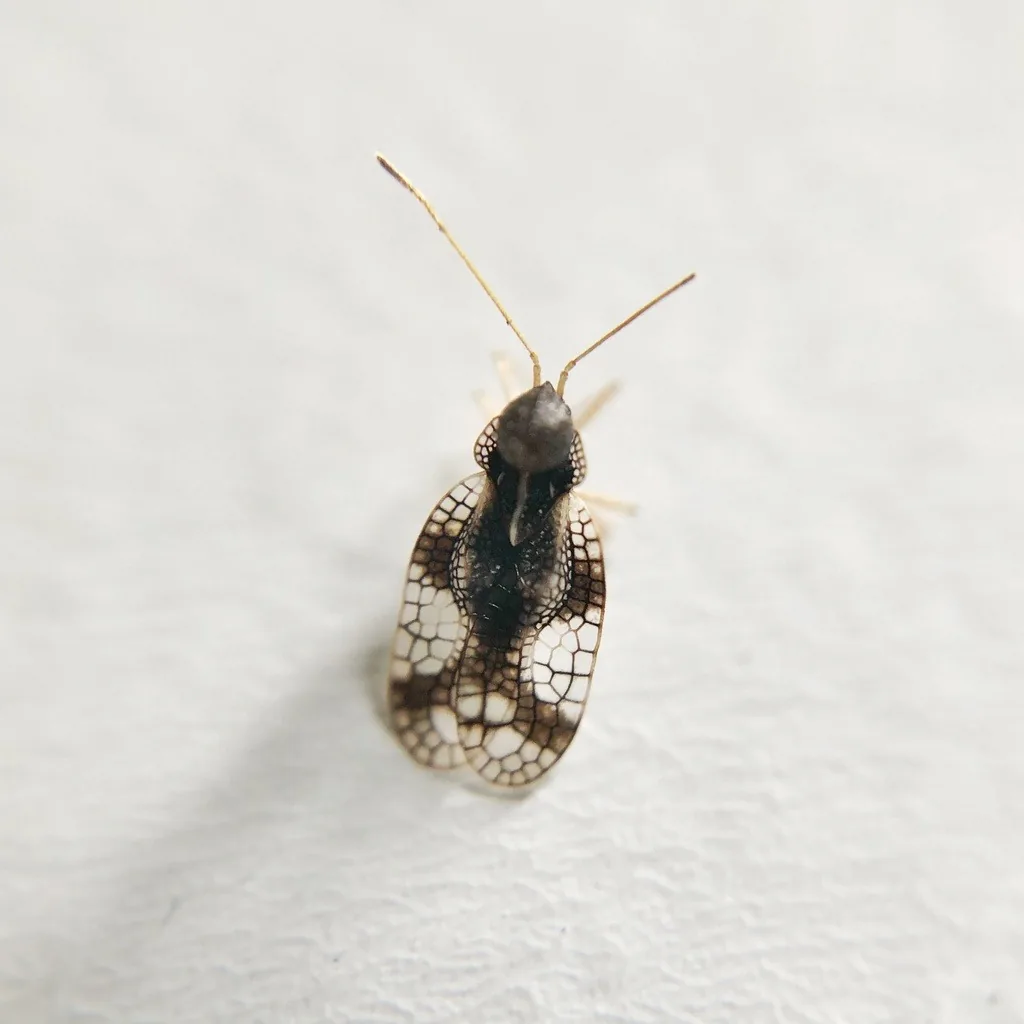
How to identify it
- Adults are about 1/8 inch long with delicate lace-like wings and an inflated hood over the head, contrastingly marked black and clear.[1][2]
- Nymphs are almost colorless at first, then dark and spiny; they and the adults feed on leaf undersides.[1][2]
- Eggs sit in young leaves under a shiny, dark, varnish-like drop.[1][2]
Look-alikes
| Look-alike | How to tell them apart |
|---|---|
| Azalea lace bug | Andromeda lace bug is rarely found on azalea.[1] |
Where it lives
NC State calls it relatively uncommon in North Carolina but damaging where it occurs; UMass reports three to four generations a year in New England.[1][2]
Biology and life cycle
It usually overwinters as eggs inside the leaf; most adults and nymphs die by late winter.[1]
Nymphs molt five times; there are at least four generations a year in North Carolina, active from May to September, and three to four in New England.[1][2]
The first generation causes the most damage.[1]
Damage and signs
Health risk
Control
Prevention
Plant mountain andromeda (Pieris floribunda), which is highly resistant, instead of Japanese andromeda where possible.[1]
Pesticides
Horticultural oil (summer rate) or insecticidal soap applied to leaf undersides works well, repeated as new eggs hatch; NC State says soil-applied systemics should go on after bloom to protect pollinators.[1]
Common questions
- Why are my Pieris leaves yellow and speckled?
- Andromeda lace bugs feeding underneath cause yellow to gray stippling on top.[1][2]
- Is there a resistant andromeda?
- Yes. Mountain andromeda (Pieris floribunda) is highly resistant.[1]
- Where should sprays go?
- On the leaf undersides, where the bugs, nymphs and eggs are.[1]
Sources
- NC State Extension, “Andromeda Lace Bug (PDIC Factsheet).” content.ces.ncsu.edu/andromeda-lace-bug (accessed 2026-10-15)
- UMass Extension Landscape, Nursery and Urban Forestry Program (Landscape Insect & Mite Guide), “Stephanitis takeyai (Andromeda Lace Bug).” www.umass.edu/agriculture-food-environment/landscape/publications-resources/insect-mite-guide/stephanitis-takeyai (accessed 2026-10-15)
- iNaturalist, “Stephanitis takeyai taxon page (order and family).” www.inaturalist.org/taxa/469978 (accessed 2026-10-06)