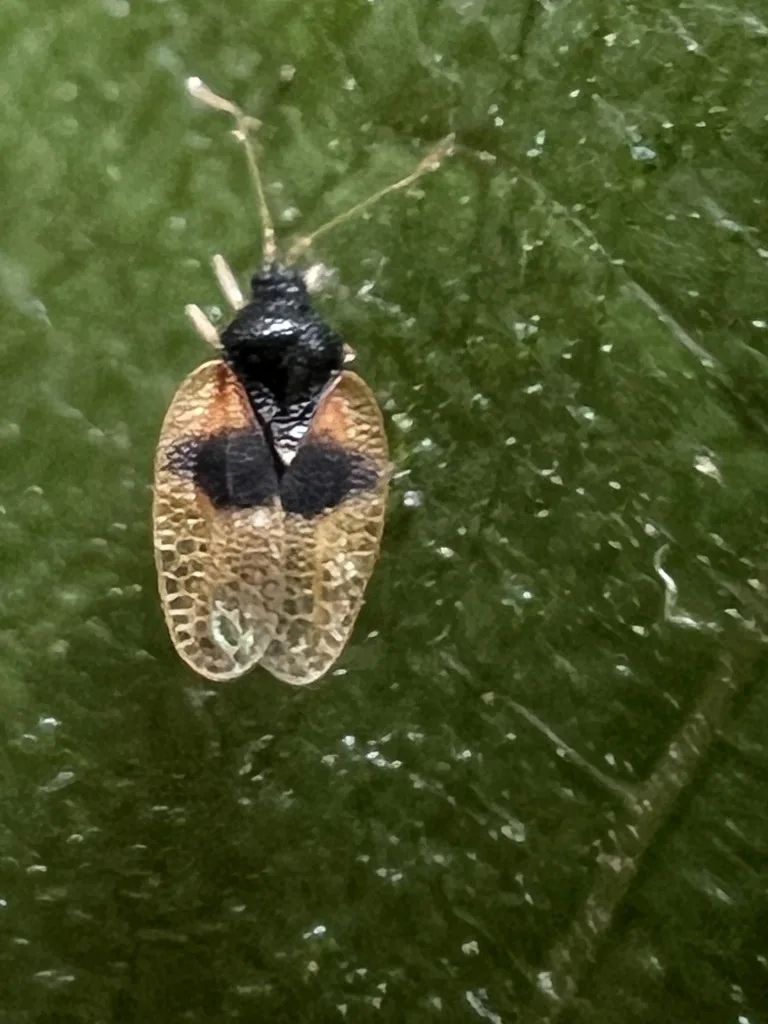
How to identify it
Look-alikes
| Look-alike | How to tell them apart |
|---|---|
| Other lace bugs | Most lace bug species feed on only one or a few related plants.[1] |
| Thrips and mites | Thrips, mites, salt damage and sunburn can mimic lace bug damage; look for the bugs and black specks.[1] |
Where it lives
It occurs in the Caribbean, Mexico and the southeastern U.S.; as of 2006, in California only in San Diego County.[1]
Biology and life cycle
Nymphs molt about five times; egg to adult takes three weeks in warm weather to months in cool weather.[1]
It has several generations a year, with all stages present year round.[1]
Damage and signs
Health risk
It feeds on leaves; UC IPM mentions no risk to people.[1]
Control
Prevention
Low populations don't damage trees; confirm lace bugs before acting, since other problems look similar.[1]
Common questions
Sources
- University of California Statewide IPM Program, “Pest Notes: Avocado Lace Bug (Publication 74134).” ipm.ucanr.edu/PMG/PESTNOTES/pn74134.html (accessed 2026-10-06)
- iNaturalist, “Pseudacysta perseae taxon page (order and family).” www.inaturalist.org/taxa/623080 (accessed 2026-10-06)