On this page
How to identify it
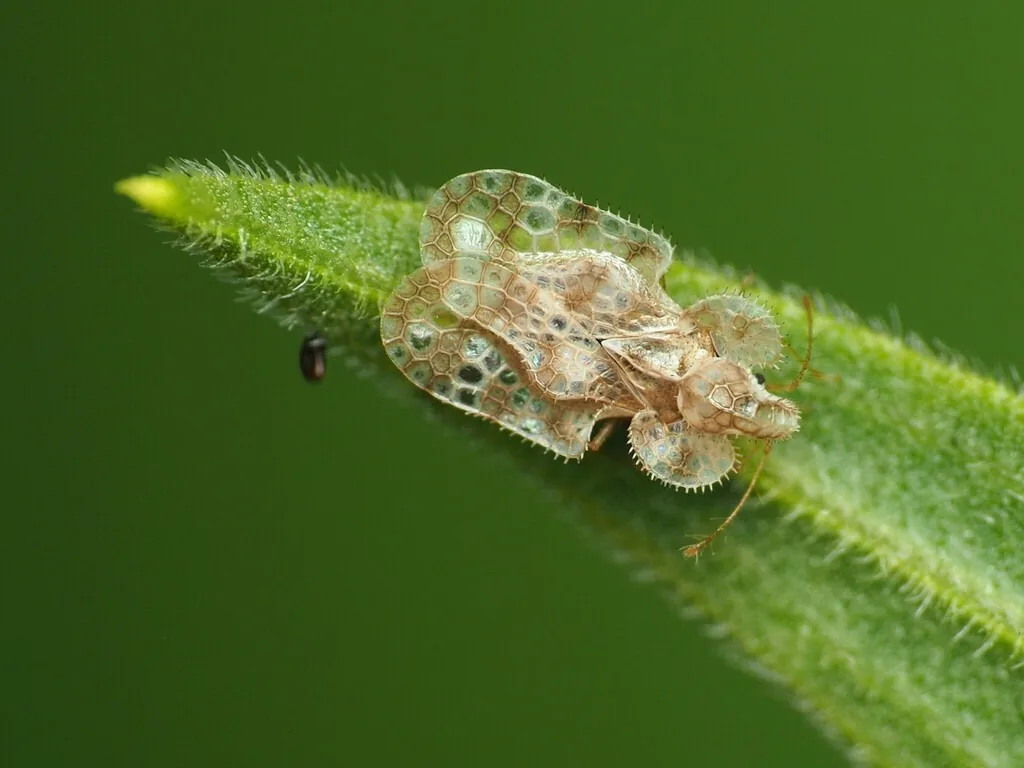
- Adults are about 1/8 inch long, with an inflated hood over the head and wings covered in small transparent cells like lace, usually with variable smoky-brown bands.[1]
- Nymphs are tiny and spiny and often cluster in groups of 6 to 100 on the leaves.[1]
- Damaged leaves are pale-speckled above and below, with small black, tar-like specks of excrement.[2][1]
Look-alikes
| Look-alike | How to tell them apart |
|---|---|
| Twospotted spider mite | Spider mites also speckle leaves but spin fine webbing and leave no tar-like specks of excrement, which lace bugs do.[2] |
Where it lives
It feeds on aster-family plants in gardens and landscapes; NC State and Ohio State report it on mums, asters, goldenrod, ragweed, sunflower and black-eyed Susan.[1][2]
Biology and life cycle
Females insert their tiny, dark eggs into the leaf along the larger veins in groups of 4 to 75 and cover them with a dark, varnish-like excretion.[1]
Nymphs pass through five stages before becoming adults.[1]
They spend the winter in dry leaves, under stones, in grass clumps and other sheltered debris.[1]
Damage and signs
Health risk
It feeds only on plants; NC State and Ohio State mention no risk to people.[1][2]
Control
Biological control
Control is usually unnecessary because natural enemies, including tiny wasps that parasitize the eggs, keep populations in check.[2][1]
Pesticides
If a planting is badly damaged, spray both the upper and lower leaf surfaces; most contact insecticides labeled for landscape use should work, and systemic products applied to the soil are another option.[2][1]
Common questions
- Why are my asters' leaves speckled white with black spots underneath?
- Most likely chrysanthemum lace bugs; their feeding leaves pale speckles and they leave tar-like specks of excrement on the leaves.[2][1]
- Is it lace bugs or spider mites on my plants?
- Look for webbing and tar spots: spider mites spin fine webbing, while lace bugs leave tar-like droplets and no webbing.[2]
Sources
- NC State Extension, “Chrysanthemum Lace Bug.” content.ces.ncsu.edu/chrysanthemum-lace-bug (accessed 2026-10-19)
- Ohio State University Extension, “Chrysanthemum Lace Bugs Abound on Asteraceae (Buckeye Yard & Garden onLine).” bygl.osu.edu/node/2039 (accessed 2026-10-19)
- iNaturalist, “Corythucha marmorata taxon page (order and family).” www.inaturalist.org/taxa/320845 (accessed 2026-10-06)