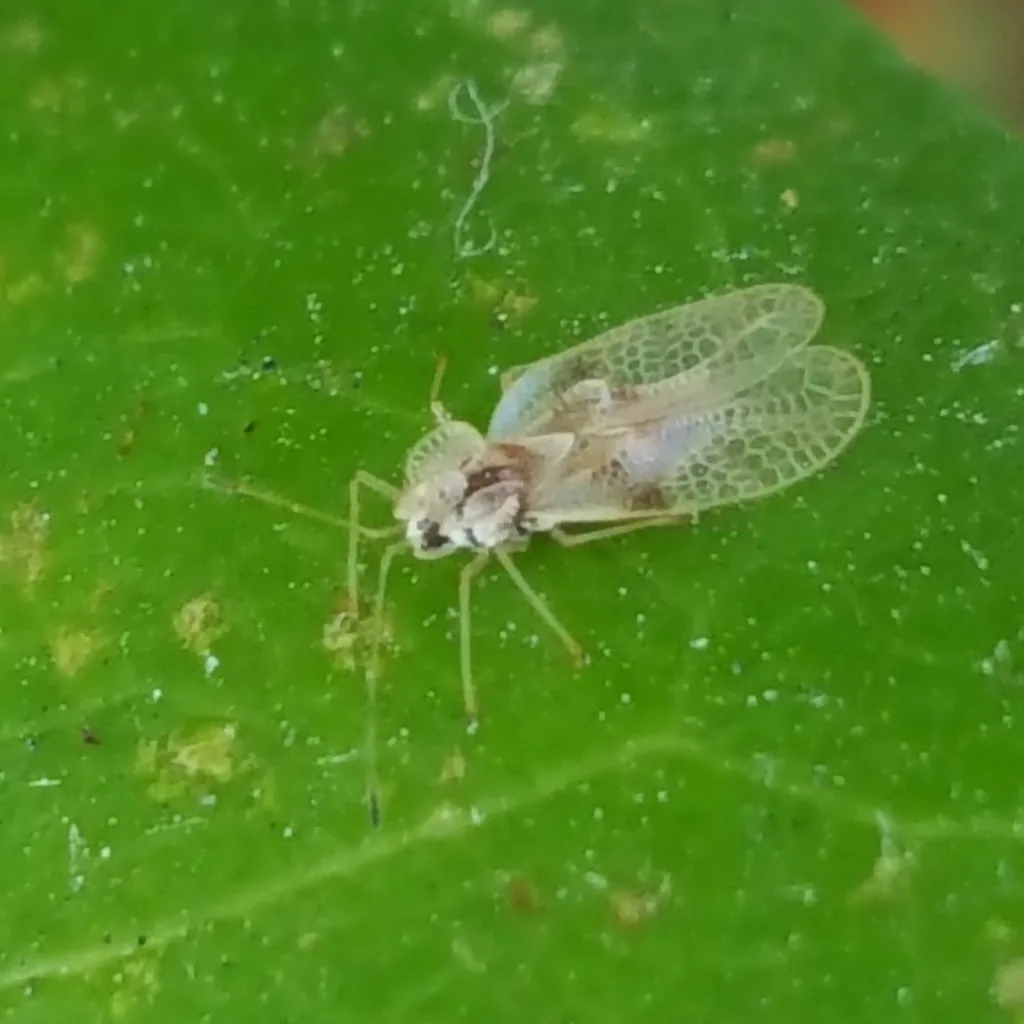
How to identify it
- Adults are about 1/8 inch long with wide, lace-like, translucent wings; they are whitish or yellowish, the palest of the common lace bugs.[1][2]
- Nymphs are dark and spiny, wingless, and cluster on leaf undersides among their black fecal spots and shed skins.[1][2]
- Feeding leaves pale stippling on the upper leaf surface; spots are larger than mite stippling and come with skins and fecal spots underneath.[1]
Look-alikes
| Look-alike | How to tell them apart |
|---|---|
| Azalea lace bug | Rhododendron lace bug is the palest of the lace bugs.[1] |
| Spider mites | Mite damage also stipples leaves, but the spots are smaller and there are no lace bug skins or fecal spots.[1] |
Where it lives
NC State and UMass Extension both cover it; egg hatch runs from late April in warm areas to late May farther north.[1][2]
Biology and life cycle
It overwinters as eggs inserted in the leaf midrib on the underside and covered with a varnish-like coating; younger leaves are preferred.[1][2]
Eggs hatch from late April through May, and a generation can take about 30 days.[1][2]
There are one to three generations a year, depending on climate and the length of the season.[1][2]
Damage and signs
Health risk
Control
Prevention
Avoid planting rhododendrons in sunny spots, which favor lace bugs, and reduce plant stress with proper watering.[2]
Traps and physical control
A strong jet of water aimed at leaf undersides dislodges adults and nymphs.[2]
Biological control
Tiny parasitic wasps attack the eggs, and natural enemies do better in shady, layered plantings with overstory trees and flowers, though they often don't prevent noticeable damage.[1][2]
Pesticides
Eggs in the leaves are protected from sprays, so treat in early spring and watch new growth for the first signs of damage.[1]
Common questions
- What are the black spots under my rhododendron leaves?
- Usually fecal spots left by lace bugs feeding on the underside, often with their shed skins.[1][2]
- Is it lace bugs or spider mites?
- Lace bug stippling is coarser and comes with black spots and skins underneath; mite stippling is finer.[1]
- When should lace bugs be treated?
- In early spring, since eggs hatch from late April through May and the first generations do the most damage.[1]
Sources
- NC State Extension, “Rhododendron Lace Bug (PDIC Factsheet).” content.ces.ncsu.edu/rhododendron-lace-bug (accessed 2026-10-15)
- UMass Extension Landscape, Nursery and Urban Forestry Program (Landscape Insect & Mite Guide), “Stephanitis rhododendri (Rhododendron Lace Bug).” www.umass.edu/agriculture-food-environment/landscape/publications-resources/insect-mite-guide/stephanitis-rhododendri (accessed 2026-10-15)
- iNaturalist, “Stephanitis rhododendri taxon page (order and family).” www.inaturalist.org/taxa/397475 (accessed 2026-10-06)