On this page
How to identify it
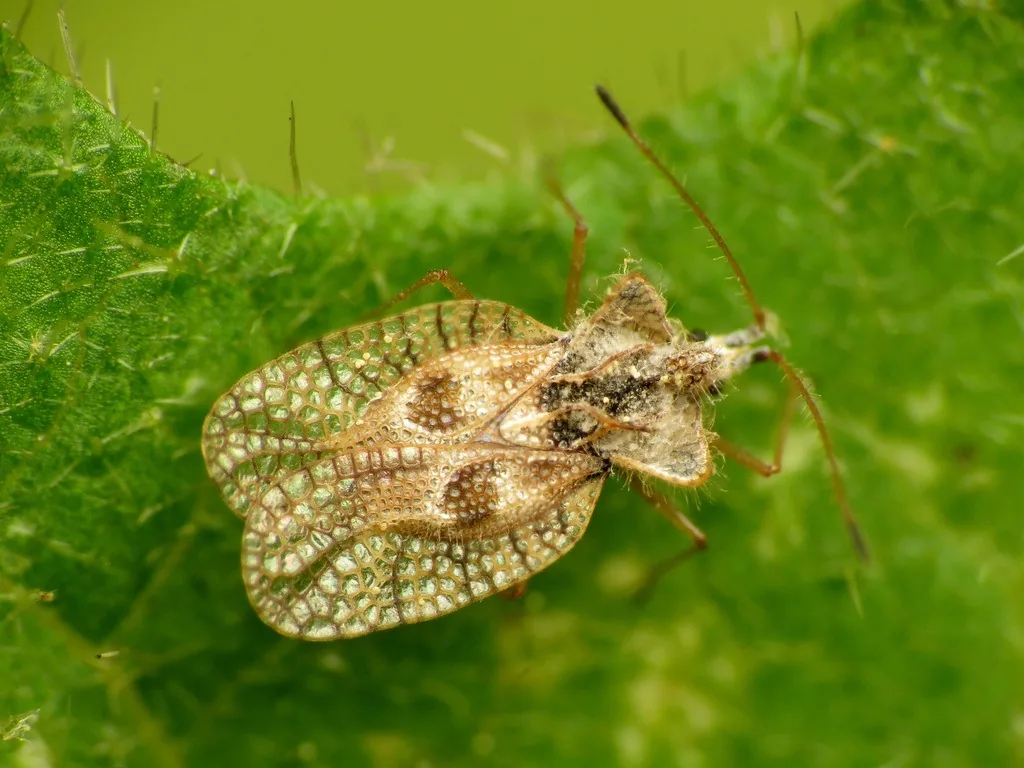
- Adults are grayish to light brown, almost 3/16 inch long and a little more than 1/16 inch wide, with two pairs of lacelike wings and a hoodlike projection just behind or over the head.[1]
- Nymphs are spiny and yellow and stay bunched together with adults in 'herds' on the undersides of leaves.[1]
- Like other lace bugs it is small and flattened, with a lacy network of ridges over the forewings and body; lace bugs in general are less than 1/4 inch long (usually 3 to 5 mm).[2]
- The first sign is often on the upper leaf surface: roughly circular pale or discolored areas over the colony feeding below, sometimes with tiny black excrement pellets on the leaves.[1][2]
Look-alikes
| Look-alike | How to tell them apart |
|---|---|
| Other lace bugs | Most lace bugs are limited to one kind of food plant, usually trees and shrubs, so a lace bug colony on eggplant, tomato, potato or horsenettle is most likely the eggplant lace bug; identifying the plant helps identify the bug.[2] |
| Chrysanthemum lace bug | Lace bugs are usually tied to one kind of food plant; a lace bug colony on a chrysanthemum is a different species from the grayish to light brown lace bugs with spiny yellow nymphs found on eggplant and other nightshades.[2][1] |
| Twospotted spider mite | Also causes pale spotting on eggplant leaves, but mites are almost microscopic, have eight legs and leave silvery or pale-yellow stippling and webbing; NC State notes the mites can be more damaging than lace bugs.[1] |
Where it lives
NC State Extension lists it as a common pest of eggplant in North Carolina, and the Missouri Department of Conservation includes it among the lace bugs found in Missouri, where different lace bug species follow the distributions of their food plants. Away from gardens it lives on wild horsenettle.[1][2][6]
Biology and life cycle
Like other true bugs it has simple metamorphosis: nymphs look like small wingless adults and there is no pupal stage. Lace bug adults overwinter in sheltered places such as under bark or in fallen leaves and other debris.[2]
Eggplant lace bug mothers guard their eggs and nymphs. Some females, called egg dumpers, lay their eggs among another female's guarded eggs and leave, so a single guard ends up defending both broods.[2][4]
Egg dumpers are drawn by a chemical that females deposit on their eggs during or soon after laying; dumping declines as egg masses age, and visual cues are not needed.[3]
Dumping is not simple cheating: in experiments, most dumped eggs (67%) went among the eggs of full siblings, and in the field, guarding females benefited from larger broods because eggs and gregarious nymphs are safer in numbers.[4][5]
Damage and signs
- Adults and nymphs feed in colonies on leaf undersides, sucking sap with tubelike beaks, which produces discolored spots on the upper surface. On eggplant it is a common pest, though NC State rates twospotted spider mites as potentially more damaging.[1][2]
- On horsenettle, a wild nightshade weed, leaf feeding by lace bugs reduced the plant's seed production and root growth.[6]
Health risk
Lace bugs are harmless to people. One might poke you with its beak if it lands on you, but MDC calls this a harmless annoyance.[2]
Control
Prevention
Check the undersides of eggplant, tomato and potato leaves when pale blotches appear on top, and keep garden plants healthy, which MDC recommends as the first defense against lace bugs.[1][2]
Sanitation
Lace bug adults spend the winter in sheltered spots such as fallen leaves and other debris; MDC advises raking up and disposing of leaf litter after a lace bug infestation, since it likely harbors eggs or overwintering insects.[2]
Biological control
Lady beetles and their larvae, spiders and shield-shaped soldier bugs prey on eggplant lace bugs; lacewing larvae, jumping spiders, assassin bugs and insect-eating birds also eat lace bugs, so encourage these predators.[1][2]
Pesticides
If eggplant lace bugs become a problem, NC State says effective insecticides are available and refers growers to the current North Carolina Agricultural Chemicals Manual for recommendations; check your own state's extension guide.[1]
Common questions
- What are the clusters of spiny yellow bugs under my eggplant leaves?
- Most likely eggplant lace bug nymphs. They feed in herds with the grayish to light brown, lacy-winged adults on leaf undersides, and the leaf tops above them show roughly circular discolored areas.[1]
- Do eggplant lace bugs bite people?
- No. Lace bugs are harmless to people; at most one may poke you with its beak, which MDC describes as a harmless annoyance.[2]
- Why are there so many eggs in one spot?
- Female eggplant lace bugs guard their eggs, and some females add their own eggs to another guard's clutch and leave. Researchers found these dumpers usually choose the eggs of close relatives, and larger broods survive better.[2][4][5]
Sources
- NC State Extension, “Pests of Eggplant (Insect and Related Pests of Vegetables).” content.ces.ncsu.edu/insect-and-related-pests-of-vegetables/pests-of-eggplant (accessed 2026-11-10)
- Missouri Department of Conservation, “Lace Bugs (Field Guide).” mdc.mo.gov/discover-nature/field-guide/lace-bugs (accessed 2026-11-10)
- Animal Behaviour, abstract via PubMed, “Chemical mediation of egg dumping in the lace bug Gargaphia solani Heidemann (Monaco, Tallamy and Johnson 1998, Animal Behaviour 56:1491-1495; PubMed 9933547).” doi.org/10.1006/anbe.1998.0934 (accessed 2026-11-10)
- Animal Behaviour, abstract via PubMed, “Egg-dumping lace bugs preferentially oviposit with kin (Loeb, Diener and Pfennig 2000, Animal Behaviour 59:379-383; PubMed 10675260).” doi.org/10.1006/anbe.1999.1328 (accessed 2026-11-10)
- American Naturalist, abstract via PubMed, “Evolution of egg dumping in a subsocial insect (Loeb 2003, American Naturalist 161:129-142; PubMed 12650467).” doi.org/10.1086/344918 (accessed 2026-11-10)
- Oecologia, abstract via PubMed, “Nutrient stress can have opposite effects on the ability of plants to tolerate foliar herbivory and floral herbivory (Wise and Mudrak 2023, Oecologia; PubMed 37596431).” pubmed.ncbi.nlm.nih.gov/37596431/ (accessed 2026-11-10)
- iNaturalist, “Gargaphia solani taxon page (order and family).” www.inaturalist.org/taxa/472014 (accessed 2026-11-10)