On this page
How to identify it
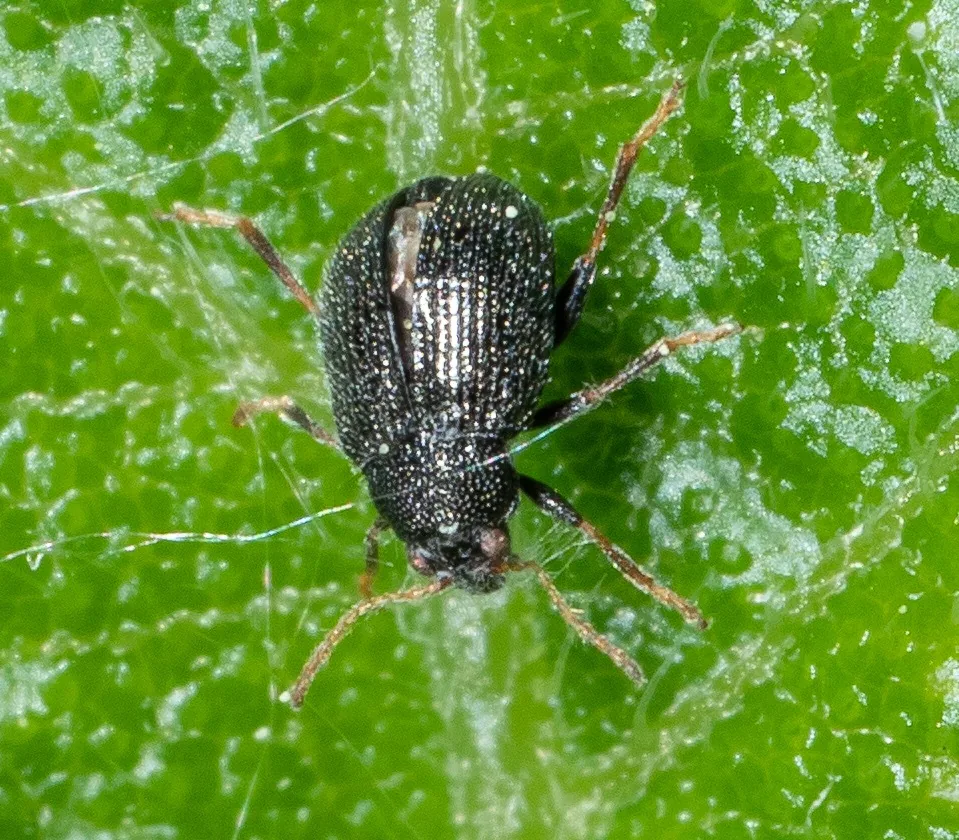
- A small, 2 mm, black beetle with thickened hind legs that let it jump rapidly when disturbed. The tobacco flea beetle (Epitrix hirtipennis), the other species in UC IPM's eggplant guideline, is brown instead.[1]
- UMass says it looks very similar to the potato flea beetle, which is also small and black and about 1/8 inch; the eggplant flea beetle is the one found in more southern areas.[2]
- The feeding sign is the giveaway: many small, shot-like holes chewed in the leaves, worst on small plants with only a few leaves.[3]
Look-alikes
| Look-alike | How to tell them apart |
|---|---|
| Potato flea beetle (Epitrix cucumeris) | Looks very similar; UMass says the potato flea beetle is the usual culprit in New England while the eggplant flea beetle occurs farther south.[2] |
| Tobacco flea beetle (Epitrix hirtipennis) | Brown rather than black; the other Epitrix in UC IPM's eggplant guideline.[1] |
| Palestriped flea beetle (Systena blanda) | Larger, about 0.12 inch, shiny brown with a broad white stripe down each wing cover.[1] |
Where it lives
UC IPM lists it among the flea beetles of California eggplant fields, and UMass places it in areas south of New England, where the potato flea beetle takes its place. In Virginia it is one of the two principal insect herbivores of horse nettle, a nightshade weed.[1][2][6]
Biology and life cycle
Most flea beetles spend the winter as adults in plant debris in the field, along field margins and in adjacent areas, emerging in spring to feed and lay eggs. Eggs go into the soil near the base of the plant and hatch in about a week. The larvae stay in the soil feeding on roots for two to three weeks, pupate there, and new adults emerge after 7 to 10 days and climb onto the plant, where they feed on leaves for two months or more.[1]
Males feeding on host foliage release an aggregation pheromone. USDA researchers identified six male-specific compounds, the two most abundant being nonatrienals, and traps baited with a synthetic mix of those two caught significantly more beetles of both sexes than unbaited traps.[4]
Away from crops, the beetle is one of the two main herbivores of horse nettle. In Virginia field tests, horse nettle plants exposed to normal insect attack set more than 75 percent fewer fruits than plants with insects excluded, and flea beetle feeding by itself reduced both fruit numbers and root growth.[6]
Damage and signs
- Adults chew small shot-like holes in the leaves and can be very destructive to young plants, often defoliating and killing them; the greatest damage comes from feeding on cotyledons, stems and foliage. Older leaves and larger plants tolerate a fair amount of injury.[1][3]
- UMass notes that tomatoes and potatoes often grow fast enough to outpace flea beetle damage, but eggplant seedlings are slow to establish and can be turned into fine lace with little chance of recovery.[2]
Health risk
A leaf-feeding crop pest; none of the sources describes any effect on people.[1][3]
Control
Prevention
Early detection is the key to preventing damage: monitor young transplants every few days during the first month after planting, because flea beetles can move into a field quickly. UMass suggests judging by damage rather than counts, since the beetles are hard to count.[1][2]
Keep them out
Row covers give partial protection. UMass advises placing the cover on hoops immediately after transplanting and sealing the edges well.[1][2]
Sanitation
Good field sanitation, trap crops such as Chinese Southern Giant Mustard, interplanted radishes and white or yellow sticky traps each provide partial control, which matters most in organically certified crops.[1]
Pesticides
If damage shows up on young plants, UC IPM says to consider a treatment to prevent plant loss; its organically acceptable options are cultural controls, pyrethrins (PyGanic) and the Entrust formulation of spinosad, with early treatment giving only about 50 percent suppression. University of Arkansas tests found spinosad, thiamethoxam and chlorfenapyr all toxic to the beetle on eggplant foliage, with reduced rates of spinosad and thiamethoxam still cutting beetle numbers in the field.[1][5]
Common questions
- My eggplant transplants are full of tiny holes. How urgent is this?
- Urgent in the first month. Young plants can be defoliated and killed, and eggplant seedlings establish slowly; larger plants tolerate a fair amount of feeding.[1][2][3]
- Is it the same beetle that attacks my potatoes?
- Probably a close relative. The potato flea beetle looks very similar and is the usual species in New England; the eggplant flea beetle is found in more southern areas.[2]
- Where do they come from each spring?
- Adults overwinter in plant debris in and around the field and emerge in spring to feed and lay eggs in the soil at the base of plants.[1]
Sources
- University of California Statewide IPM Program, “Flea Beetles, Eggplant Pest Management Guidelines.” ipm.ucanr.edu/agriculture/eggplant/flea-beetles/ (accessed 2026-11-10)
- University of Massachusetts Amherst Extension, “Solanaceous Flea Beetles (Vegetable Program fact sheet).” www.umass.edu/agriculture-food-environment/vegetable/fact-sheets/solanaceous-flea-beetles (accessed 2026-11-10)
- Clemson Cooperative Extension Home and Garden Information Center, “Eggplant Insect Pests & Diseases, HGIC 2224 (updated May 23, 2025).” hgic.clemson.edu/factsheet/eggplant-insect-pests-diseases/ (accessed 2026-11-10)
- Journal of Chemical Ecology (Springer), “Zilkowski, Bartelt, Cosse and Petroski (USDA ARS, Peoria). Male-produced aggregation pheromone compounds from the eggplant flea beetle (Epitrix fuscula): identification, synthesis, and field bioassays. Journal of Chemical Ecology 32: 2543-2558 (2006), PMID 17075723.” pubmed.ncbi.nlm.nih.gov/17075723/ (accessed 2026-11-10)
- Journal of Economic Entomology (Entomological Society of America), “McLeod, Diaz and Johnson (University of Arkansas). Toxicity, persistence, and efficacy of spinosad, chlorfenapyr, and thiamethoxam on eggplant when applied against the eggplant flea beetle. Journal of Economic Entomology 95: 331-335 (2002), PMID 12020009.” pubmed.ncbi.nlm.nih.gov/12020009/ (accessed 2026-11-10)
- Oecologia (Springer), “Wise and Sacchi (University of Virginia). Impact of two specialist insect herbivores on reproduction of horse nettle, Solanum carolinense. Oecologia 108: 328-337 (1996), PMID 28307846.” pubmed.ncbi.nlm.nih.gov/28307846/ (accessed 2026-11-10)
- iNaturalist, “Epitrix fuscula taxon page (order and family).” www.inaturalist.org/taxa/121232 (accessed 2026-11-10)