On this page
How to identify it
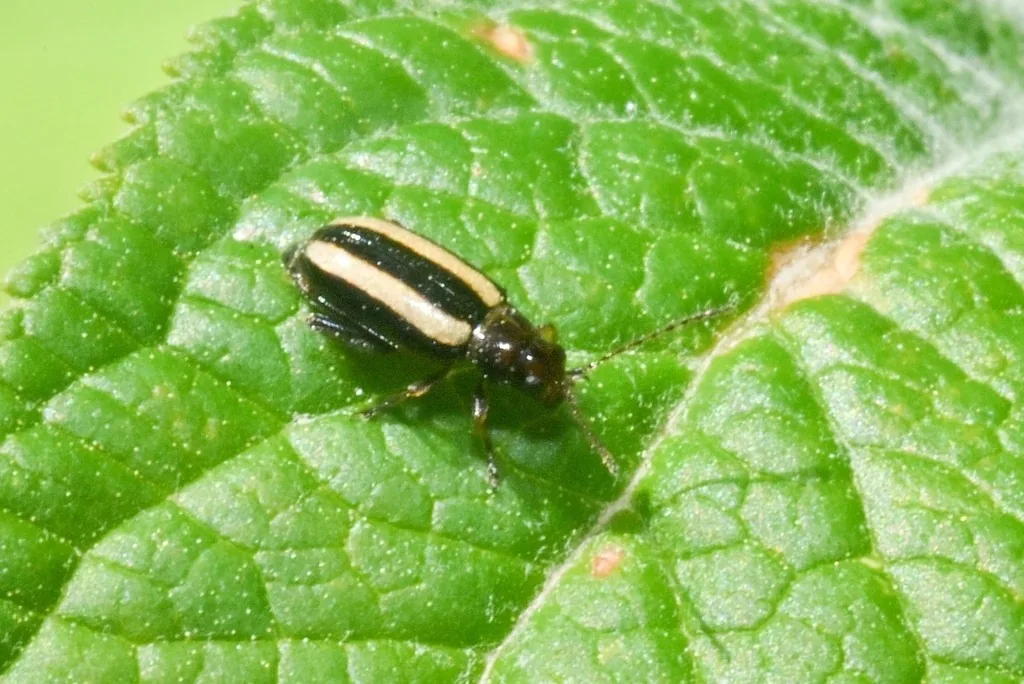
- Adults are about 0.12 inch (3 mm) long, shiny brown to dark brown, with a broad, lengthwise creamy white stripe on each wing cover and the enlarged hind legs that let flea beetles jump. It is roughly twice the size of the all-black potato flea beetle.[1][2][3]
- Larvae live in the soil and are slender, whitish and about 0.25 inch (6 mm) long when mature, with a brown head.[2][4]
- Adult feeding leaves small pits and rounded or irregular holes, mostly on the undersides of leaves, so that leaves look peppered with shot. On carrots, larval wounds on the taproot often run in a straight or curved line down one side of the root.[1][3][2]
Look-alikes
| Look-alike | How to tell them apart |
|---|---|
| Potato flea beetle (Epitrix cucumeris) | A uniformly black flea beetle about half the size, found on many of the same crops.[2][3] |
| Western black flea beetle (Phyllotreta pusilla) | The other flea beetle Utah State lists on hemp; black, without the white stripes.[4] |
| Cavity spot of carrot | The disease lesions are elliptical, more sunken, randomly scattered and concentrated on the upper third of the root, while flea beetle larval wounds follow a line down one side.[2] |
Where it lives
UC IPM treats it as a pest of alfalfa, carrots, corn and eggplant in California, with larval root damage reported from the Imperial and San Joaquin Valleys and fall outbreaks in Central Valley seedling alfalfa, and Utah State records damage as common in Utah field production. Hosts include brassica, leafy green, solanaceous, root and cucurbit crops.[1][2][4]
Biology and life cycle
Adults overwinter in protected sites: weed hosts around fields, plant debris on field margins and the soil and residue of previous susceptible crops such as tomatoes. They emerge in spring, feed on weeds or other hosts, then move into crops, mate and lay eggs in the soil near the base of host plants. The larvae feed below ground on roots and, in corn, on germinating seed.[1][3][4]
Utah State gives one to three generations a season, with peak adult activity from April to mid-June and the period of concern running from early April through August; in California the beetles are active in spring and have caused fall outbreaks in seedling alfalfa.[4][1]
Damage and signs
- Adults do most of the damage. Low numbers can cause economic loss while plants are at the cotyledon or first-leaf stage, and large populations can kill or stunt seedlings; once plants have several true leaves they tolerate several beetles each, and older plants rarely suffer economic damage even though their older leaves may be chewed.[1][2][3]
- Larval feeding is usually minor, but in corn the larvae feed on the roots of young plants and on germinating seeds, and in carrots grown in the Imperial and San Joaquin Valleys they cause serious root damage, scarring the taproot in a line down one side.[3][2][4]
Health risk
A crop flea beetle; none of the sources describes any risk to people.[1][4]
Control
Prevention
Keep field margins and the crop free of weeds, especially field bindweed and mustards, which the beetles prefer, and inspect first near weedy borders. After harvest, deeply disk the residue of infested fields and remove crop debris, and rotate to nonhost crops such as cereal grains; plastic mulch interferes with egg laying and the soil stages.[1][3][2][4]
Check newly emerged seedlings twice a week until they are well established. Infestations can be spotty, often along field edges where beetles migrate in, and spot treatment of outside rows or borders may be all that is needed. For organic alfalfa and carrots, cultural controls are the available tools.[1][2][4]
Pesticides
Treat seedlings that are losing stand, or, in Utah State's terms, at one to five beetles per plant or 10 to 30 percent defoliation; UC IPM has no formal threshold for corn and says to consider treatment when damage to young plants reaches a moderate level. One application should usually suffice, though mobile beetles can reinvade and new growth may need protecting; insecticides can disrupt biological control of aphids and whiteflies, and baits are not effective.[1][2][3][4]
Common questions
- How do I tell palestriped flea beetle damage from cavity spot on carrots?
- Flea beetle larval wounds run in a straight or curved line down one side of the taproot; cavity spot lesions are elliptical, more sunken, randomly scattered and concentrated on the upper third of the root.[2]
- Do I need to spray my established alfalfa or corn?
- Rarely. Plants with several true leaves tolerate several beetles each and older plants are even more tolerant; the risk is at the cotyledon and first-leaf stages.[1][3]
- Why are the beetles worst along the field edge?
- They overwinter in weeds and debris around fields and move in from the margins, so infestations are often spotty on the edges and spot treatment there may be enough.[1][2][4]
Sources
- University of California Statewide IPM Program, “Pale-Striped Flea Beetle, Alfalfa Pest Management Guidelines.” ipm.ucanr.edu/agriculture/alfalfa/pale-striped-flea-beetle/ (accessed 2026-11-10)
- University of California Statewide IPM Program, “Flea Beetles, Carrot Pest Management Guidelines.” ipm.ucanr.edu/agriculture/carrot/palestriped-flea-beetle/ (accessed 2026-11-10)
- University of California Statewide IPM Program, “Flea Beetles, Corn Pest Management Guidelines.” ipm.ucanr.edu/agriculture/corn/flea-beetles/ (accessed 2026-11-10)
- Utah State University Extension, “Flea Beetles (Hemp Pests), Utah Pests.” extension.usu.edu/planthealth/ipm/notes_ag/hemp-flea-beetles (accessed 2026-11-10)
- iNaturalist, “Systena blanda taxon page (order and family).” www.inaturalist.org/taxa/232167 (accessed 2026-11-10)