On this page
How to identify it
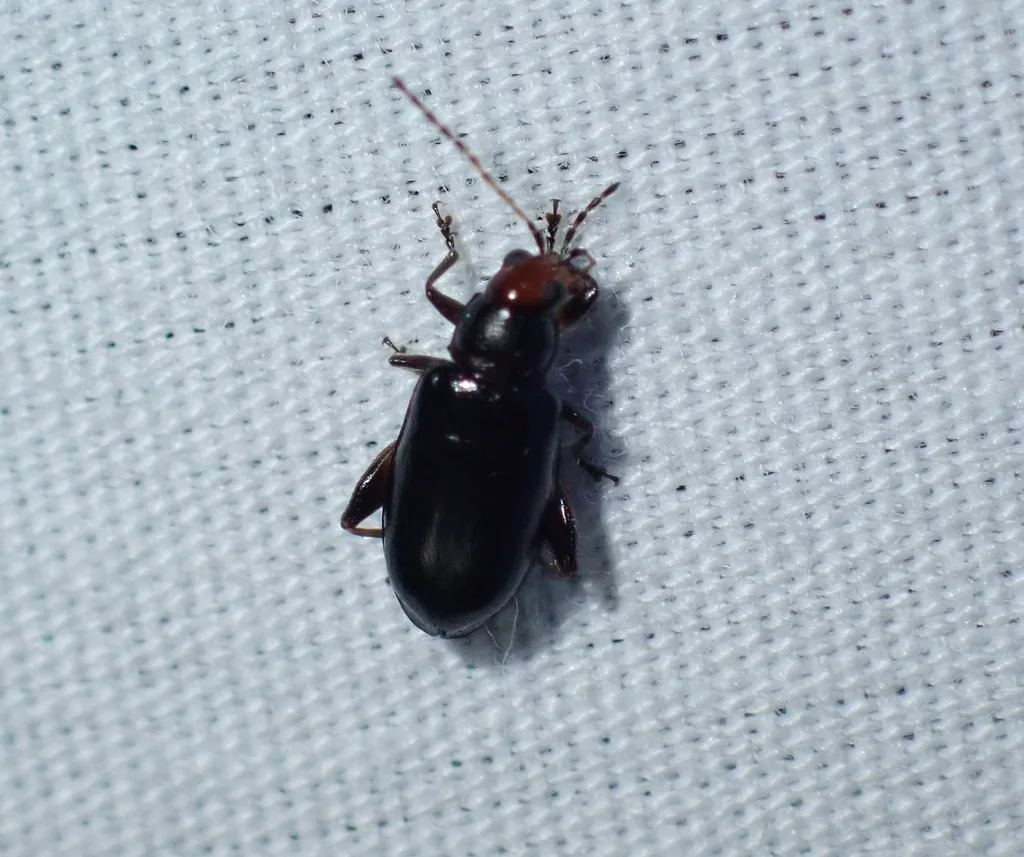
- Adults are small and oval, about 0.2 inch long according to Georgia (3.5 to 5 mm according to UMass), shiny metallic black with a red head, which sets them apart from similar flea beetles; swollen hind legs let them jump.[1][3]
- The damage is many small holes in the leaves, or skeletonized brown patches where only the surface was eaten, often with tiny dark droppings near the feeding sites.[1][2]
- They hop like a flea or fly away when disturbed.[2][1]
Look-alikes
| Look-alike | How to tell them apart |
|---|---|
| Other flea beetles | Many flea beetles chew similar small holes, but this one's red head on a shiny black body is distinctive.[1] |
Where it lives
Native to the central and eastern United States; it damages nursery and landscape plants from Georgia to Virginia and also turns up in New England cranberry bogs, where it is called the cranberry flea beetle.[1][2][3]
Biology and life cycle
It overwinters as eggs in the soil; in Georgia the first adults usually appear in the last week of May, followed by overlapping generations until late October.[1]
Females lay pale yellow eggs one at a time in the soil, and the creamy white larvae, about 0.2 to 0.4 inch long, feed on roots through three stages, rarely causing noticeable damage.[1]
In Massachusetts cranberry bogs, adults appear from July into September.[3]
Damage and signs
- Favorite hosts include panicle hydrangea and roses; damage is also reported on sweetspire (Itea), forsythia, azaleas, crapemyrtle, dogwoods, Japanese holly, weigela, viburnums and wax myrtle, perennials such as asters, coreopsis, salvia, sedum and zinnias, and blueberries and cranberries.[1][2]
- Known in the eastern United States since the 1800s, it has become an economic concern in nurseries only in the past decade, and damage can be severe and fast when many adults arrive.[2][1]
Health risk
It feeds only on plants; none of the sources reports any harm to people or pets.[1][2]
Control
Prevention
Check favorite hosts weekly for adults from mid-May, ideally around midday, and keep new plants away from infested ones.[1]
Sanitation
Pull weeds in and around plantings, since the beetles feed and build up on weeds such as pigweed, lambsquarters, smartweed, clover and jewelweed.[1]
Biological control
Insect-killing nematodes (Steinernema carpocapsae) and fungi (Beauveria bassiana and Metarhizium) work against the larvae in container soil.[1]
Pesticides
Adults usually need foliar insecticide sprays with thorough coverage, often repeated; ask your local Extension office for current products and follow the label.[1]
Common questions
- What is making tiny holes in my hydrangea leaves?
- Tiny shiny black beetles with red heads that jump when disturbed are redheaded flea beetles, which riddle panicle hydrangea leaves with small holes.[1][2]
- Where do redheaded flea beetles come from?
- They overwinter as eggs in the soil and build up on weeds around plantings; the larvae feed on roots and the adults move up to the leaves.[1]
Sources
- University of Georgia Cooperative Extension, “Red-Headed Flea Beetle: An Ornamental Nursery Pest (Circular 1187, S. V. Joseph and W. Hudson).” fieldreport.caes.uga.edu/publications/C1187/ (accessed 2026-10-17)
- Virginia Cooperative Extension, “Red Headed Flea Beetle in Virginia Nurseries (ENTO-464, E. Lane and A. Del-Pozo).” turf.spes.vt.edu/content/dam/pubs_ext_vt_edu/ENTO/ento-464/ENTO-464.pdf (accessed 2026-10-17)
- UMass Cranberry Station, “Red-Headed Flea Beetle (2011, A. L. Averill and M. M. Sylvia).” ag.umass.edu/sites/ag.umass.edu/files/fact-sheets/pdf/red-headed_flea_beetle-ua.pdf (accessed 2026-10-17)
- iNaturalist, “Systena frontalis taxon page (order and family).” www.inaturalist.org/taxa/232169 (accessed 2026-10-06)