On this page
How to identify it
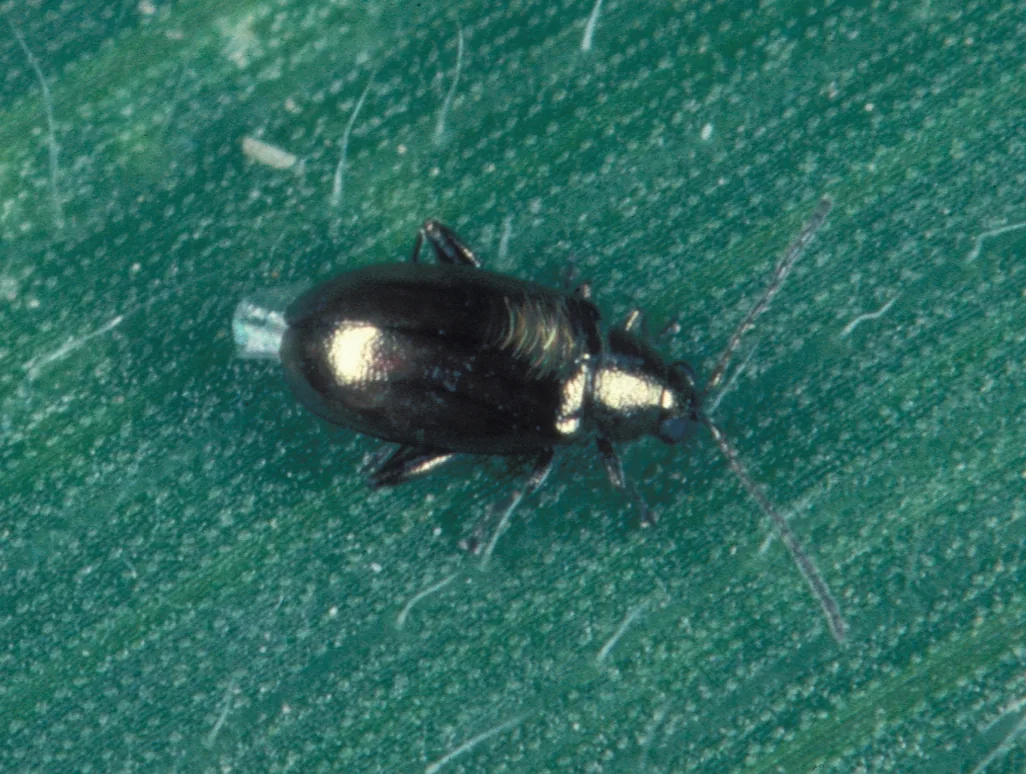
- A tiny, pinhead-sized beetle about 1/16 inch (1.6 mm) long, bronze-black to black, oval and elongated, with thickened hind legs that let it leap a considerable distance when disturbed.[1][2]
- Feeding strips the top layer of tissue from corn leaves, leaving gray to brown lines or tracks etched on the surface. Heavily infested seedlings look gray or silvery and whitish as the leaves shrivel and die; badly damaged plants look frosted.[1]
- Check the upper parts of the leaves and the undersides of the lower two leaves; after the V5 stage sampling is usually no longer needed.[1]
Look-alikes
| Look-alike | How to tell them apart |
|---|---|
| Other flea beetles on corn | Several flea beetles feed on corn; the corn flea beetle is the one Purdue and the 2024 study name as the carrier of the Stewart's wilt bacterium, and its feeding shows as gray to brown tracks etched on the leaf surface.[1][2] |
Where it lives
A pest of all types of corn grown in the United States, sweet corn and grain corn alike, with most of the acreage in the upper Midwest and Northeast. Warmer winters are expected to push economically damaging Stewart's wilt northward across the Corn Belt over the coming decades.[2]
Biology and life cycle
The beetle overwinters as an adult, in cold climates under leaf litter or other organic material. Spring activity, including wide-ranging searches for food, starts when daytime temperatures pass 50 F. Eggs are laid on weeds, corn and other crops or in the soil near the host and hatch within 10 days; the larvae feed on roots, pupate in the soil, and adults emerge in late July. There can be more than one generation a year if conditions allow.[1][2]
Winter temperature decides the spring population. Colder winters kill more beetles; mild winters let more survive and raise the chance of Stewart's disease the following season.[1]
Damage and signs
- Economic injury from feeding alone is generally limited to seedlings under 6 inches (15 cm) with high beetle numbers, or to plants already stressed by poor growing conditions. The beetles alone are seldom severe enough to kill plants, but they may when the disease is added.[1]
- The larger loss is Stewart's wilt. The beetle is the primary overwintering vector of Pantoea stewartii (formerly Erwinia stewartii), which attacks the plant's vascular system; the bacterium can also travel in infected seed, but in the United States it is spread mainly by this beetle. In sweet corn the disease can mean smaller ears or dead plants; in seed production fields severe leaf blight can leave lightweight, chaffy ears and raise the odds of stalk rot. Beyond yield, many countries have banned corn from fields contaminated with the bacterium, so the disease also costs export sales.[1][2]
Health risk
A leaf-feeding beetle of corn; neither source describes any risk to people.[1][2]
Control
Prevention
Purdue's winter index: add the average daily temperatures (F) for December, January and February. A sum below 90 means low beetle survival and little disease risk; 90 to 100 means moderate disease activity is possible; above 100 means disease problems are highly likely for some types of corn.[1]
Sample right away if early-season surveys turn up many beetles or feeding damage: five areas of the field, 20 consecutive plants each, recording the percentage of damaged plants, how severe the damage is and the average number of beetles per plant.[1]
Pesticides
On dent corn before growth stage V4, Purdue says control may be necessary when 50 percent of inspected plants show severe feeding (silvery or whitish plants, dying leaves), there are about five or more beetles per plant and poor growing conditions are slowing the corn. In seed production fields planted to highly susceptible inbreds, treatment is probably justified if beetles are numerous.[1]
Common questions
- My field corn seedlings have gray streaks. Should I spray?
- Use Purdue's three-part test before V4: half the plants severely damaged, about five or more beetles per plant, and corn growing slowly because of poor conditions. Healthy corn over 6 inches rarely suffers economic injury from the feeding itself.[1]
- How fast does the beetle spread Stewart's wilt?
- Quickly. Beetles can acquire the bacterium after as few as six hours feeding on an infected plant and transmit it to a healthy plant in less than three hours.[2]
- Will a cold winter take care of it?
- It helps. The beetle overwinters as an adult, colder winters cut survival, and a December-through-February temperature sum below 90 F points to a low-risk year; mild winters do the opposite, and the 2024 study expects warming winters to expand the problem northward.[1][2]
Sources
- Purdue University Extension Entomology, “Corn Flea Beetles (Corn), Field Crops IPM (Purdue Extension E-series 74-W).” ag.purdue.edu/department/entm/extension/field-crops-ipm/corn/corn-flea-beetles.html (accessed 2026-11-10)
- Environmental Entomology (Entomological Society of America), “Shifts in geographic vulnerability of US corn crops under different climate change scenarios: corn flea beetle and Stewart's wilt. Environmental Entomology 53(6) (2024), PMC11649341.” pmc.ncbi.nlm.nih.gov/articles/PMC11649341/ (accessed 2026-11-10)
- iNaturalist, “Chaetocnema pulicaria taxon page (order and family).” www.inaturalist.org/taxa/216625 (accessed 2026-11-10)