On this page
How to identify it
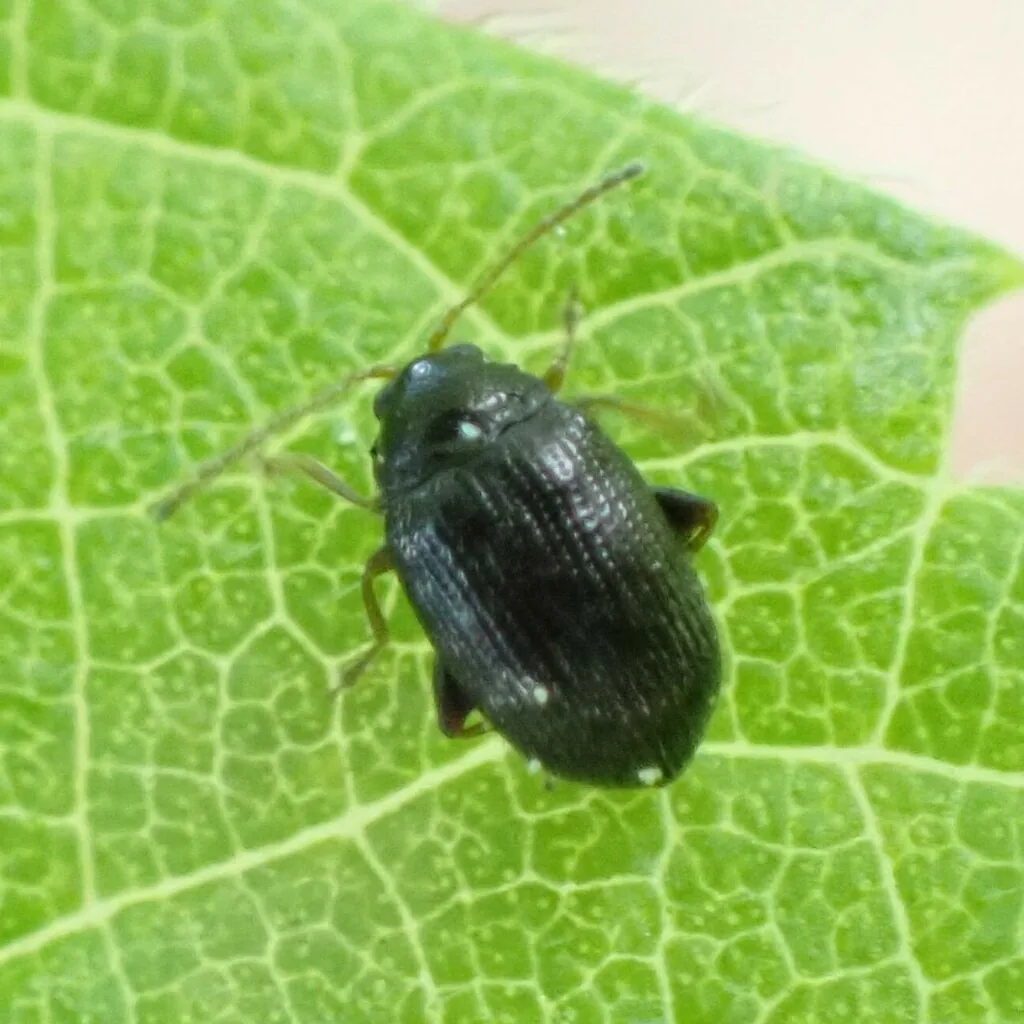
- A tiny, all-black flea beetle with enlarged hind legs that make it jump vigorously when approached. Size figures differ: UMass gives about 1/8 inch, while UC IPM (0.065 inch) and Wisconsin (1/16 inch) put it at half that.[1][2][6]
- Sources also differ on shine: UC IPM calls it shiny, Wisconsin dull black, and UMass says it is less shiny than the crucifer flea beetle. Compared with that beetle it is shorter, broader and chunkier, with a more pitted and hairy body surface.[2][6][1]
- Feeding leaves numerous tiny round shot holes, often from the undersides of the leaves, so the foliage looks peppered. UC IPM describes flea beetle larvae as slender, whitish and about 0.25 inch (6 mm) when mature, living in the soil on the roots.[1][2][3][5]
Look-alikes
| Look-alike | How to tell them apart |
|---|---|
| Eggplant flea beetle (Epitrix fuscula) | Looks very similar but occurs in more southern areas, according to UMass, and Wisconsin lists eggplant as its host.[1][6] |
| Crucifer flea beetle (Phyllotreta cruciferae) | Also black and about 1/8 inch, but shinier, slimmer and found only on brassica crops and weeds.[1][6] |
| Palestriped flea beetle (Systena blanda) | About twice the size, dark brown with a creamy white stripe down each wing cover, on many of the same crops.[2][3][6] |
Where it lives
UMass treats it as the main flea beetle of eggplant, potato and tomato in New England, where the similar eggplant flea beetle is found farther south, and UC IPM lists it among the flea beetles of corn and carrot fields in California. Crops affected include eggplant, potato, tomato in the field and greenhouse, sweet potato, and pumpkins, squash and gourds.[1][2][3]
Biology and life cycle
Adults spend the winter under leaf litter along field edges near the crop they fed on in late summer. In early spring they feed on horse nettle, pokeweed and other nightshade weeds until they move onto eggplant, potato or tomato, where they feed until August. Eggs are laid in the soil, the larvae feed on roots, and after a pupal stage in the soil a new generation of summer adults emerges, feeds, and moves to shelter for the winter. That gives two major flushes of adults, the first in late May and early June and the second from mid July to mid August.[1]
Wisconsin lists its hosts as the nightshade crops, including potato, tomato, eggplant and pepper; UMass also lists sweet potato and pumpkins, squash and gourds.[6][1]
It has also been found in Europe: it was recorded in damaged potato fields in Portugal in 2008, and the European Union adopted emergency measures against Epitrix flea beetles in 2012.[7]
Damage and signs
- The shot holes injure leaves and can stunt or kill plants, especially seedlings, and damage can occur at any stage. Tomatoes and potatoes often grow fast enough to outpace it, but anything that delays their growth lets the beetle slow them further, and eggplant seedlings, which are slow to establish, can be turned to lace. UC IPM notes that on young corn and carrot plants flea beetle feeding can be serious enough to kill them.[1][2][3]
- On potatoes it mainly damages the foliage; a European review says yield losses come when adults reach high densities, and that the tuber flea beetle, not this species, causes most tuber tunneling in North America. Minnesota notes that potato flea beetle larvae are an exception among flea beetles in causing plant damage.[7][5]
Health risk
A leaf-feeding vegetable beetle; none of the sources describes any risk to people.[1][2][6]
Control
Prevention
Clean cultivation, crop rotation, and removing or avoiding the spring weed hosts, horse nettle and pokeweed in the Northeast and field bindweed and mustard in California, take away the beetle's early-season food and overwintering cover.[1][2][6]
Scout uncovered transplants at least twice a week; UMass says damage is probably the best measure, because the beetles are hard to count. Yellow sticky traps also show when flea beetles are active.[1][6][5]
Keep them out
Row covers protect transplants and seedlings while they are most vulnerable. Put them on, with hoops, immediately after transplanting and seal the edges well so beetles can't get in.[1][6]
Pesticides
UMass thresholds: treat newly set transplants at two flea beetles per plant, seedlings 3 to 6 inches tall at more than four per plant, and plants over 6 inches at eight per plant; full-size plants rarely need treatment. Spot treatments aimed at eggplants along field edges, or at outside rows, often suffice, and baits are not effective. Most insecticides registered for Colorado potato beetle, including spinosad, also control flea beetles.[1][3]
In home gardens, insecticidal soap and horticultural oils such as neem oil work only by contact and are short-lived, so spray thoroughly onto the beetles. Check that the crop is on the label and observe the days-to-harvest interval.[6][5]
Common questions
- Is this the same flea beetle that is on my broccoli?
- No. The crucifer flea beetle feeds only on brassicas and is slimmer and shinier; the potato flea beetle is chunkier, hairier and pitted, and works the nightshade crops.[1][6]
- My tomato plants have holes but look fine. Do I spray?
- UMass says full-size plants rarely require treatment and tomatoes usually outgrow the damage; thresholds matter for transplants and seedlings under 6 inches.[1]
- Why does it show up in two waves?
- Overwintered adults move in from the field edges in spring, and their offspring, after feeding on roots and pupating in the soil, emerge as summer adults, so there is a flush in late May and early June and another from mid July to mid August.[1]
Sources
- University of Massachusetts Amherst Extension, “Solanaceous Flea Beetles (Vegetable Program fact sheet).” www.umass.edu/agriculture-food-environment/vegetable/fact-sheets/solanaceous-flea-beetles (accessed 2026-11-11)
- University of California Statewide IPM Program, “Flea Beetles, Corn Pest Management Guidelines.” ipm.ucanr.edu/agriculture/corn/flea-beetles/ (accessed 2026-11-11)
- University of California Statewide IPM Program, “Flea Beetles, Carrot Pest Management Guidelines.” ipm.ucanr.edu/agriculture/carrot/palestriped-flea-beetle/ (accessed 2026-11-11)
- iNaturalist, “Epitrix cucumeris taxon page (order and family).” www.inaturalist.org/taxa/219362 (accessed 2026-11-11)
- University of Minnesota Extension, “Flea beetles (reviewed 2022).” extension.umn.edu/yard-and-garden-insects/flea-beetles (accessed 2026-11-11)
- University of Wisconsin-Madison Extension, “Flea Beetles.” hort.extension.wisc.edu/articles/flea-beetles/ (accessed 2026-11-11)
- Pest Management Science, via PubMed, “Boavida C, Giltrap N, Cuthbertson AGS, Northing P (2013), Epitrix flea beetles: new threats to potato production in Europe, Pest Management Science.” pubmed.ncbi.nlm.nih.gov/23169596/ (accessed 2026-11-11). Cited from the PubMed abstract.