On this page
How to identify it
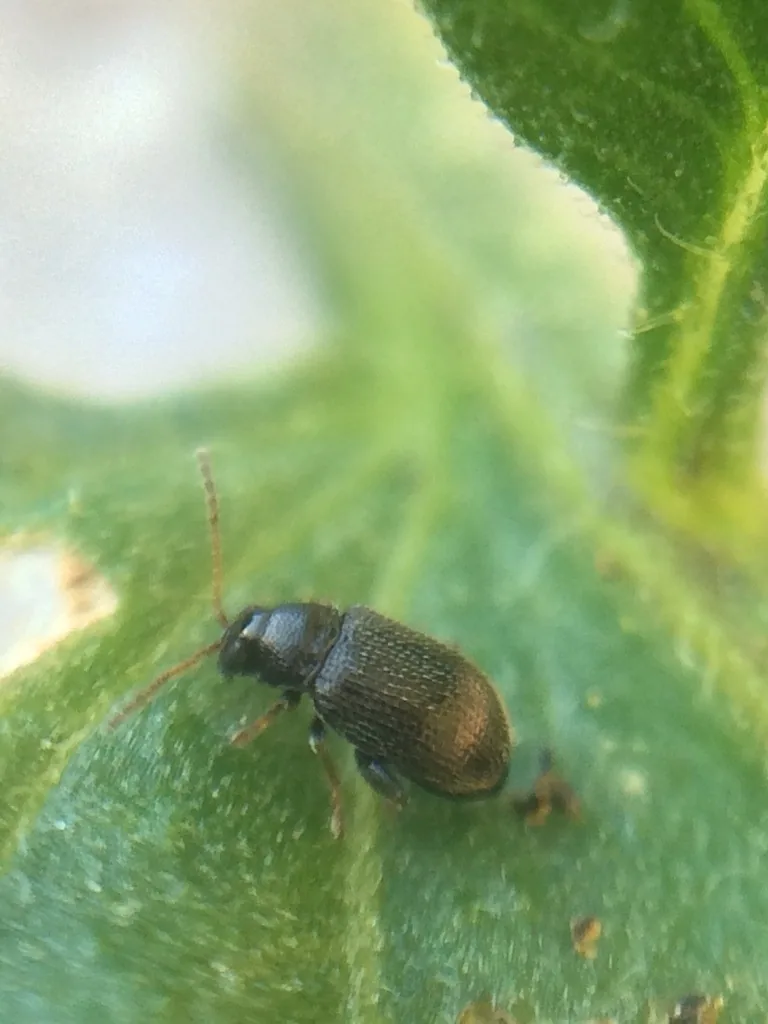
- A dull black flea beetle with yellowish-brown legs. The western potato flea beetle, which shares Northwest potato fields, shows a distinct bronze luster in bright light, and the tobacco flea beetle is brownish with a darker irregular band across the wing covers; the Phyllotreta flea beetles found on weeds in potato fields have black legs and do not feed on potato.[1]
- Epitrix species are morphologically very similar, and telling them apart reliably rests on the genitalia or on DNA, so in practice the tuber damage is the field clue: adults chew minute circular holes in the leaves in a shot-hole pattern, while larvae leave shallow subsurface wavy furrows, serpentine surface tunnels and deeper pits on the tubers.[4][1][3]
Look-alikes
| Look-alike | How to tell them apart |
|---|---|
| Western potato flea beetle (Epitrix subcrinita) | Bronze-lustered in bright light, a foliage feeder that does not seriously injure tubers; the only Epitrix in Malheur, Baker and Klamath county potato fields in Oregon surveys.[1] |
| Tobacco flea beetle (Epitrix hirtipennis) | Brownish with a dark irregular band across the elytra; a foliage feeder in the same fields.[1] |
| Potato flea beetle (Epitrix cucumeris) | The other major potato Epitrix in North America, which mainly damages foliage rather than tubers.[3] |
| Garden symphylan | Not an insect, but its tuber damage is almost identical and the two sometimes live in the same field.[1] |
Where it lives
A Pacific Northwest potato pest, mainly west of the Cascades, where it is a serious problem in some areas, particularly the Skagit Valley of Washington; it was once heavy in Deschutes, Crook and Jefferson counties of central Oregon but has not been a recent problem there. Agriculture and Agri-Food Canada studied it in a Canadian potato-growing region, and it is counted among the major potato flea beetles of North America.[1][2][3]
Biology and life cycle
Adults overwinter buried in the soil in and around potato fields, surviving best in elevated, wet, grassy headlands that do not flood. The overwintered adults fly from late May to late June, and mating and egg laying can run for a month. The larval stage takes about three weeks and pupation two, so a generation takes about six weeks, and there are two to three generations a year west of the Cascades: first-generation larvae feed from early June to mid-July, the second from mid-July to mid-August and the third from mid-August to mid-September.[1]
Larvae in the soil are probably attacked by nematodes, fungal diseases and predatory ground and rove beetles, and the adults mainly by spiders.[1]
Populations carry over in the ground. In the Canadian potato-growing region studied by Agriculture and Agri-Food Canada, counts of overwintered and first-generation beetles rose in step with the number of consecutive preceding years the field had been in potatoes, and rotated fields had significantly fewer beetles; interior counts in rotated fields never passed threshold while the field edges were below it.[2]
Damage and signs
- Adult feeding is the usual flea-beetle shot-holing of leaves. The real cost is in the tubers, where larvae feed just under the surface, leaving shallow wavy furrows, superficial serpentine tunnels and deeper pits that can make the crop unmarketable. Second- and third-generation larvae are the ones that damage late-maturing varieties.[1][3]
- Not rotating raised the share of that Canadian growing region that needed insecticide against the beetle by 4.2 to 7.3 percent, and insecticide costs per hectare rose with each consecutive year in potatoes.[2]
Health risk
A potato pest; none of the sources describes any effect on people.[1][3]
Control
Prevention
Rotate. Flea beetles become severe in second-year potato fields, and the Canadian data show beetle numbers climbing with each consecutive potato year and falling in rotated fields.[1][2]
Biological control
Soil-dwelling larvae are likely held back by nematode parasites, fungal diseases and predatory ground and rove beetles, and adults by spiders; the handbook lists no releases to make.[1]
Pesticides
Home gardens: the PNW Handbook says to apply a labeled product in late May when beetles appear on the foliage, directing it to where the vine stems enter the soil; no tuber treatments are available for home garden vegetables. Its home-use list includes acetamiprid, azadirachtin, carbaryl, cyfluthrin, deltamethrin, esfenvalerate, insecticidal soap with pyrethrins, kaolin, malathion, permethrin, plant essential oils, pyrethrins, spinosad and zeta-cypermethrin, with some formulations OMRI-listed.[1]
Commercial fields: foliar sprays are aimed at adults before they lay eggs, with soil-applied and seed-treatment products also available for larvae and adults. The first foliar application usually goes on when 50 to 66 percent of plants have emerged, repeated weekly or every 10 days or whenever adults reach 10 per 50 sweeps of a 15-inch net; in the Willamette Valley sweeps can be unreliable on just-emerging potatoes, two beetles per 25 sweeps on field borders may be economic, and border sprays are sometimes all that is needed. Pyrethroids can make aphid management harder and trigger aphid, thrips and spider mite outbreaks.[1]
Common questions
- How do I know the tuber scars are flea beetle and not symphylans?
- You may not be able to from the tubers alone; the PNW Handbook says the damage is almost identical and both pests can share a field. Shot-holed leaves and dull black, yellow-legged beetles on the foliage point to the flea beetle.[1]
- Can I treat the tubers in a home garden?
- No. The handbook says no tuber treatments against flea beetles are available for home garden vegetables; foliar sprays in late May against the adults, aimed at the base of the vines, are the option.[1]
- Does planting potatoes in the same bed each year matter?
- Yes. Beetle numbers rose with each consecutive year in potatoes in the Canadian study, and the handbook calls flea beetles a severe problem in second-year fields.[2][1]
Sources
- Pacific Northwest Pest Management Handbooks (Oregon State, Washington State and University of Idaho Extension), “Potato, Irish: Flea beetle, Pacific Northwest Insect Management Handbook.” pnwhandbooks.org/insect/vegetable/irish-potato/potato-irish-flea-beetle (accessed 2026-11-10)
- Journal of Economic Entomology (Entomological Society of America), “Kabaluk and Vernon (Agriculture and Agri-Food Canada, Agassiz). Effect of crop rotation on populations of Epitrix tuberis (Coleoptera: Chrysomelidae) in potato. Journal of Economic Entomology 93: 315-322 (2000), PMID 10826179.” pubmed.ncbi.nlm.nih.gov/10826179/ (accessed 2026-11-10)
- Pest Management Science (Society of Chemical Industry, Wiley), “Eyre and Giltrap (Food and Environment Research Agency, UK). Epitrix flea beetles: new threats to potato production in Europe. Pest Management Science 69: 3-6 (2013), PMID 23169596.” pubmed.ncbi.nlm.nih.gov/23169596/ (accessed 2026-11-10)
- Bulletin of Entomological Research (Cambridge University Press), “Germain, Chatot, Meusnier, Artige, Rasplus and Cruaud. Molecular identification of Epitrix potato flea beetles (Coleoptera: Chrysomelidae) in Europe and North America. Bulletin of Entomological Research 103: 354-362 (2013), PMID 23448201.” pubmed.ncbi.nlm.nih.gov/23448201/ (accessed 2026-11-10)
- iNaturalist, “Epitrix tuberis taxon page (order and family).” www.inaturalist.org/taxa/370896 (accessed 2026-11-10)