On this page
How to identify it
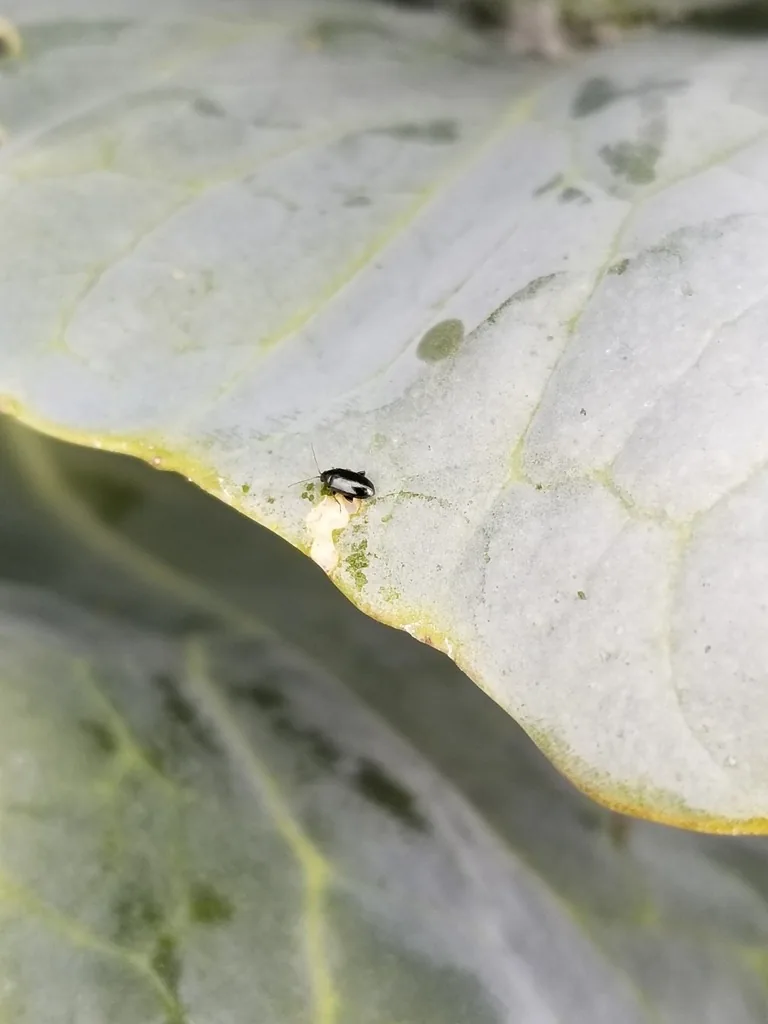
- Uniformly black and shiny, about 2 mm long, with the large hind legs all flea beetles use to hop away when disturbed. The striped flea beetle, which shares the same crops, has two yellow stripes down its back.[1][2]
- Host plant is the other clue: these two Phyllotreta species feed only on brassica crops, so a flea beetle on corn, potato or eggplant is a different species.[1]
- Feeding leaves small round holes in leaves and stems. On glossy-leaved crops such as bok choy, Napa cabbage and mustard the whole leaf gets riddled; on waxy cabbage, broccoli and kale feeding is lighter and concentrated at the leaf margins, especially as the crop matures.[1]
Look-alikes
| Look-alike | How to tell them apart |
|---|---|
| Striped flea beetle (Phyllotreta striolata) | Same size and the same brassica hosts, but with two yellow stripes on the back; the species pictured on the flea beetles group page.[1] |
| Western black flea beetle (Phyllotreta pusilla) | Another black Phyllotreta that Minnesota lists among its most common flea beetles.[2] |
| Potato flea beetle (Epitrix cucumeris) | Also small and black, but it feeds on potato, eggplant and tomato rather than brassicas.[1][2] |
Where it lives
Minnesota lists it first among the state's most common flea beetles, UMass's brassica flea beetle sheet is written around it and the striped flea beetle for New England growers, Virginia Tech found it and the striped flea beetle on cabbage in southwest Virginia, and across the Canadian prairies it is a major canola pest.[2][1][5][3]
Biology and life cycle
Adults overwinter outside the field in shrubby or woody borders, leaf litter, hedgerows and windbreaks, then move into brassica plantings in May to feed and mate. Eggs go into the soil near the plant and hatch in 11 to 13 days; the larvae feed on root hairs for about two weeks, pupate underground, and emerge about a week later as the next generation of adults in mid-June. A second summer generation emerges in late July to feed on fall brassicas, feeding tapers off in September, and the adults head for wooded areas for the winter.[1][2]
The beetles prefer the tender leaves of Brassica rapa and B. juncea crops such as arugula, tatsoi, mizuna, bok choi and mustard, but will also feed on the waxier Brassica oleracea crops, broccoli, cabbage, kale and collards. Brassica weeds harbor both adults and larvae.[1]
Canola research explains why they are hard to manage at scale: the review literature flags the difficulty of predicting population swings, differing insecticide susceptibility and the lack of resistant cultivars, and prairie farmers rely on prophylactic neonicotinoid seed coatings that can still fail when canola emerges slowly or beetle numbers are very high.[4][3]
Damage and signs
- Heavy feeding can kill seedlings, and moderate feeding can delay maturity, reduce yield or make leafy crops unmarketable. Glossy-leaved crops are susceptible from planting until harvest. In Virginia cabbage trials, significant yield losses showed up at as little as 1 to 20 percent defoliation and again above 60 percent.[1][5]
Health risk
A brassica crop pest; none of the sources describes any effect on people.[1][2]
Control
Prevention
Rotate spring brassicas as far as possible from last fall's brassica plantings and the borders where beetles overwinter, keep early and late plantings apart, and, if the budget allows, skip brassicas before July to break the reproductive cycle. Control brassica weeds, which otherwise undo the rotation. Keep the crop growing with adequate water and nutrients and avoid compacted soil.[1]
Keep them out
Spun-bonded row cover gives excellent protection when it goes on immediately after seeding or transplanting and the edges are sealed with soil or bags; lift and replace it the same day for cultivation.[1]
Sanitation
Incorporate and till crops immediately after harvest to kill the larvae feeding on the roots.[1]
Traps and physical control
Trap cropping works because the beetles prefer certain brassicas: establish a fast-growing, attractive trap crop before or alongside the main crop, as a border or row-end perimeter, and spray only the trap crop once beetles build up there. UMass suggests pairing it with a kaolin clay coating on the main crop as a push-pull system. Yellow sticky cards in the canopy help gauge numbers, since the beetles are hard to count.[1]
Pesticides
On young plants, about one beetle per plant or 10 percent average leaf damage is a reasonable action threshold, though susceptibility differs so much among brassicas that no single threshold fits all. Pyrethroids, carbamates, neonicotinoids and diamides are labeled; rotate groups and avoid both soil and foliar use of the same one. Organic growers have spinosad, kaolin clay and pyrethrin, with spinosad the most effective in UMass trials and pyrethrin giving only a short knockdown. In Virginia, soil-applied dinotefuran or imidacloprid and foliar bifenthrin left the fewest beetles and the highest cabbage yields.[1][5]
Common questions
- Will the beetles on my arugula move to my tomatoes?
- No. The crucifer flea beetle feeds only on brassicas; the flea beetles on solanaceous crops and corn are different species.[1]
- Why is my bok choy shredded while the cabbage looks fine?
- Glossy-leaved Brassica rapa and B. juncea crops are far more attractive than waxy cabbage and broccoli, where feeding stays near the leaf edges.[1]
- Is there a second wave?
- Yes. Overwintered adults arrive in May, their offspring emerge in mid-June, and a second summer generation appears in late July to feed on fall brassicas.[1]
Sources
- University of Massachusetts Amherst Extension, “Brassica Flea Beetles (Vegetable Program fact sheet, updated May 26, 2022).” www.umass.edu/agriculture-food-environment/vegetable/fact-sheets/brassica-flea-beetles (accessed 2026-11-10)
- University of Minnesota Extension, “Flea beetles (Yard and Garden Insects).” extension.umn.edu/yard-and-garden-insects/flea-beetles (accessed 2026-11-10)
- Pest Management Science (Society of Chemical Industry, Wiley), “Woodland, Carcamo, Wist, Otani, Gavloski, Duncan, Nagalingam and Costamagna (University of Manitoba and Agriculture and Agri-Food Canada). Combined effects of canola plant density and insecticide management strategies on flea beetle abundance, canola defoliation, and yield across the Canadian prairies. Pest Management Science 82: 10648-10657 (2026), PMID 41168101.” pmc.ncbi.nlm.nih.gov/articles/PMC13665633/ (accessed 2026-11-10)
- Annual Review of Entomology (Annual Reviews), “Li, Costamagna, Beran and You. Biology, Ecology, and Management of Flea Beetles in Brassica Crops. Annual Review of Entomology 69: 199-217 (2024), PMID 38270984.” pubmed.ncbi.nlm.nih.gov/38270984/ (accessed 2026-11-10)
- Journal of Economic Entomology (Entomological Society of America), “Mason, Alford and Kuhar (Virginia Tech). Flea beetle (Coleoptera: Chrysomelidae) populations, effects of feeding injury, and efficacy of insecticide treatments on eggplant and cabbage in southwest Virginia. Journal of Economic Entomology 113: 887-895 (2020), PMID 31880307.” pubmed.ncbi.nlm.nih.gov/31880307/ (accessed 2026-11-10)
- iNaturalist, “Phyllotreta cruciferae taxon page (order and family).” www.inaturalist.org/taxa/228005 (accessed 2026-11-10)