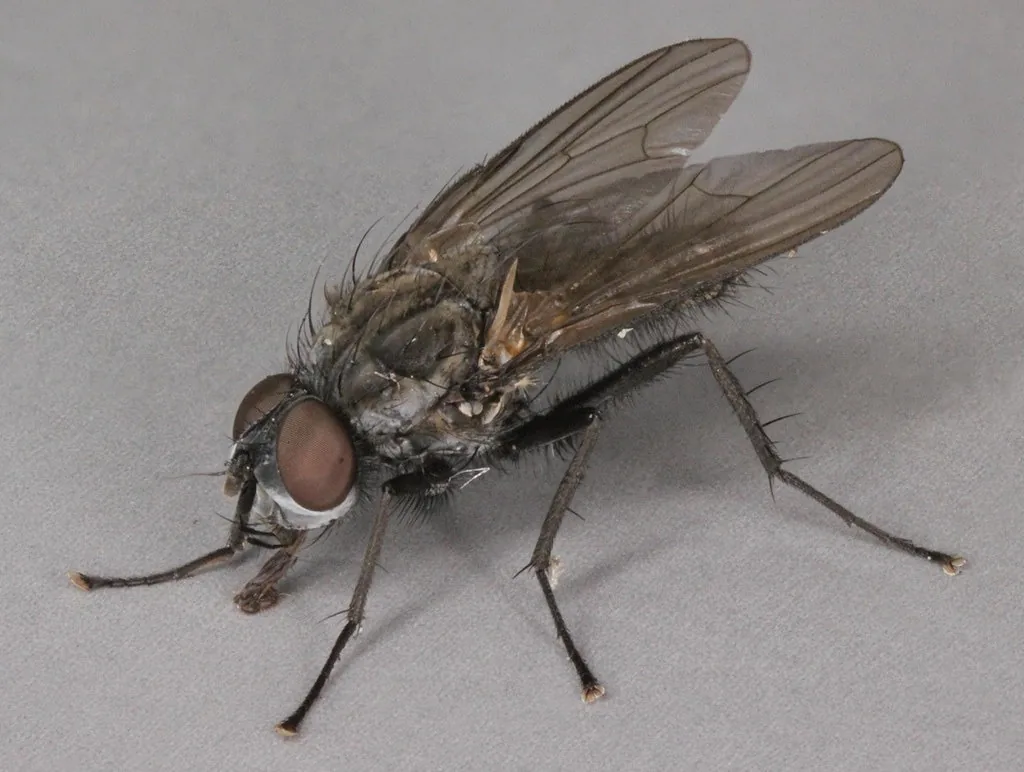
How to identify it
- Maggots are white to yellowish white, legless and up to about 1/4 to 0.4 inch long, tapering to a pointed head with a blunt rear end.[1][3][2]
- They are found in and around the roots, often with small, oblong brown pupae and feeding tunnels nearby.[2][3]
- Adults are dark gray flies about 1/4 inch long, roughly half the size of a house fly, with a humped back.[1][3][2]
- Eggs are white, about 1/8 inch long and bullet-shaped, laid at the base of the stem or in nearby soil cracks.[2][1]
Look-alikes
| Look-alike | How to tell them apart |
|---|---|
| Imported cabbageworm | A velvety green caterpillar that chews big holes in leaves and bores into heads above ground; cabbage maggots are legless white maggots in the roots.[4][2] |
| Cabbage looper | A smooth green caterpillar that loops as it crawls and chews ragged holes in leaves, instead of tunneling in roots below the soil line.[5][1] |
| Onion maggot and seedcorn maggot | These related flies and maggots look nearly identical; each is usually found on its preferred crops, and telling them apart for sure takes a microscope.[2][3][1] |
Where it lives
A pest of cole crops in cool regions such as New England and the upper Midwest, and in California's coastal areas; it is not a pest in the southern desert.[2][1][3]
Biology and life cycle
It spends the winter as a pupa in the soil near the roots of last fall's cabbage-family crops.[2][1]
Flies emerge in spring, around the time yellow rocket (wintercress) blooms along roadsides, and can travel up to a mile to find host plants.[2][1]
Each female lays about 50 to 200 eggs, which hatch within a week; maggots feed on roots for three to five weeks, then pupate.[1][3]
Cool, moist soil favors the eggs, while several days of soil above 95 degrees F kills them.[2]
There are several generations a year, such as three to four in central New England, and a late-summer flight can hit fall root crops.[2][3][1]
Damage and signs
- The first sign is plants wilting on sunny days, with yellow or purplish outer leaves; plants may then stunt, collapse and die.[2][1][3]
- Maggots riddle roots with tunnels, which can let in bacterial soft rot and black leg disease.[3]
- Young plants, from seedlings to about a month after transplanting, are hit hardest; established, healthy plants can often outgrow moderate damage.[3][1]
- Tunnels in radishes, turnips and rutabagas make the roots unusable.[2]
- Hosts include cabbage, broccoli, cauliflower, Brussels sprouts, radishes and turnips.[1][2]
Health risk
No health risk to people or pets: cabbage maggots feed only on the roots of cabbage-family crops, and the damage is to the garden.[1][2]
Control
Prevention
Don't use row covers where cabbage-family crops grew last year, because flies emerging from pupae in that soil would be trapped under the cover.[1][2]
Rotate cabbage-family crops to a different spot each year, and avoid planting one right after another in the same bed.[2][3][1]
Planting a bit later, around late May or June 1 in northern areas, helps crops miss the first spring flight.[1][2]
Keep them out
Cover new seedings and transplants with floating row covers right away, sealing the edges with soil, and keep them on through the spring egg-laying flight.[2][1]
Sanitation
Skip spring applications of manure or green manure, which attract the flies, and pull or till under crop roots after harvest to destroy pupae.[1][2][3]
Traps and physical control
Pull a wilting plant and check the roots and soil for maggots; if roots are tunneled but empty, the maggots have already left to pupate.[3][2]
Biological control
Ground beetles and rove beetles eat the eggs, maggots and pupae; the beneficial nematode Steinernema feltiae has also reduced damage in trials.[2]
Pesticides
Once maggots are feeding there is no rescue treatment, and no preplant insecticide is available for home gardens; farm options are preventive root-zone drenches.[1][3][2]
Common questions
- Why are my broccoli transplants wilting even though the soil is wet?
- Cabbage maggots may be eating the roots. Pull one plant and look for small white maggots, brown pupae or tunnels in the roots.[2][3]
- Can I spray for cabbage maggots after I see them?
- No. Once maggots are feeding there is nothing effective to apply, so focus on row covers, rotation and planting timing next time.[1]
- Do cabbage maggots damage radishes?
- Yes. Maggots tunnel on and into radishes, turnips and rutabagas, leaving the roots scarred and unusable.[2][1]
Sources
- University of Minnesota Extension, “Root Maggots (Yard and Garden Insects).” extension.umn.edu/garden-and-home/yard-and-garden/yard-and-garden-insects/root-maggots (accessed 2026-10-06)
- UMass Amherst Center for Agriculture, Food, and the Environment, “Cabbage Root Maggot (vegetable fact sheet).” www.umass.edu/agriculture-food-environment/vegetable/fact-sheets/cabbage-root-maggot (accessed 2026-10-06)
- University of California Statewide IPM Program, “Cole Crops Pest Management Guidelines: Cabbage Maggot.” ipm.ucanr.edu/agriculture/cole-crops/cabbage-maggot/ (accessed 2026-10-06)
- University of California Statewide IPM Program, “Cole Crops Pest Management Guidelines: Imported Cabbageworm.” ipm.ucanr.edu/agriculture/cole-crops/imported-cabbageworm/ (accessed 2026-10-06)
- University of California Statewide IPM Program, “Cole Crops Pest Management Guidelines: Cabbage Looper.” ipm.ucanr.edu/agriculture/cole-crops/cabbage-looper/ (accessed 2026-10-06)
- iNaturalist, “Delia radicum taxon page (order and family).” www.inaturalist.org/taxa/466703 (accessed 2026-10-06)