On this page
How to identify it
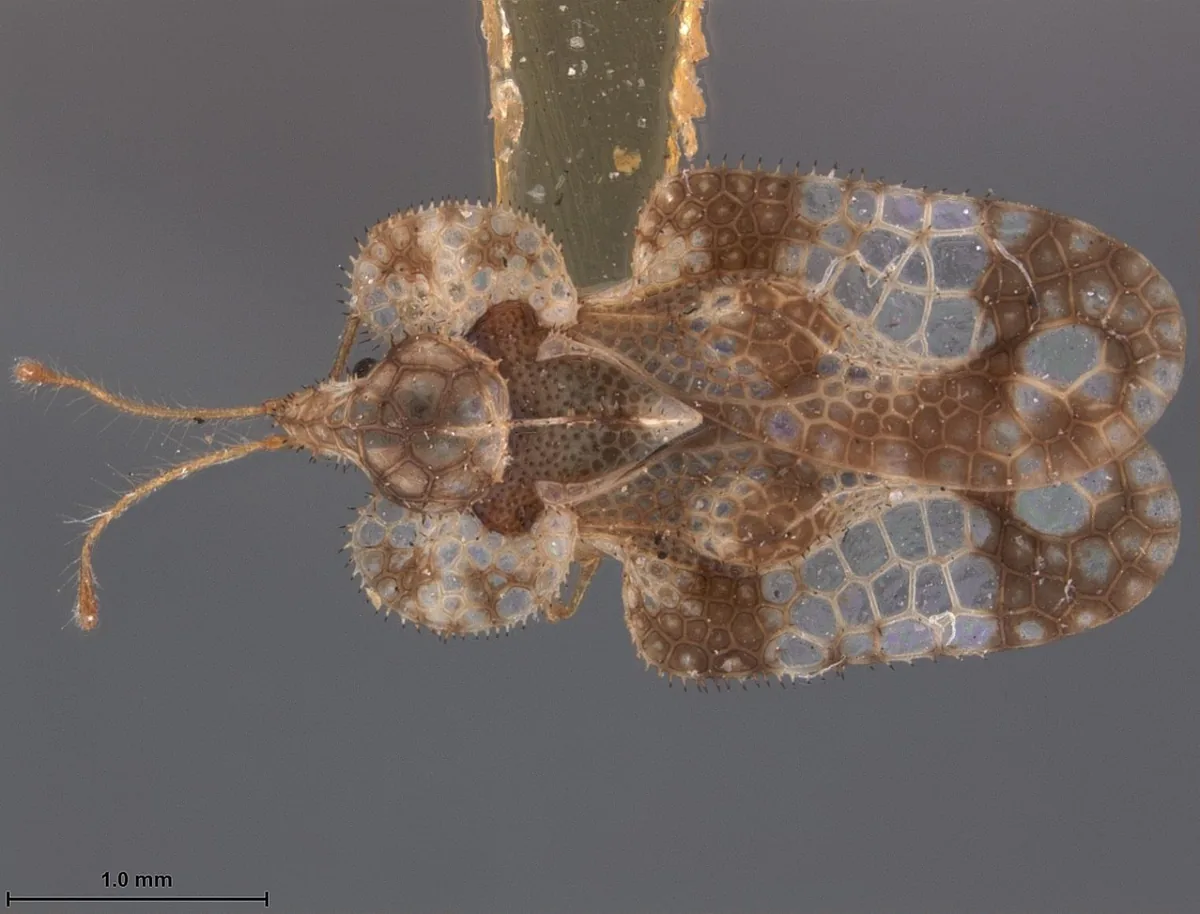
- Adults are tiny, about 1/8 inch long and 1/16 inch wide, and roughly rectangular. The wings and the hood over the head are covered with a net of veins that looks like lace.[1][3]
- Nymphs are oval, dark and often covered with long spines.[1][3]
- Unlike most lace bugs, which move slowly when disturbed, hackberry lace bugs tend to drop off a leaf when it is touched.[1]
- The undersides of infested leaves are speckled with small, black, shiny, varnish-like spots of excrement.[1][2]
Look-alikes
| Look-alike | How to tell them apart |
|---|---|
| Hackberry psyllids | Psyllids form nipple and blister galls on hackberry leaves. Lace bugs leave pale spotting on top of the leaf and varnish-like specks underneath.[3][1] |
| Sycamore lace bug | A close relative with the same kind of damage on sycamore. Iowa State names hackberry, sycamore and oak as the trees lace bugs hit most often there.[2][3] |
| Oak lace bug | Another Corythucha species on oaks, also with two and sometimes three generations a summer in Ohio.[1][3] |
Where it lives
One of the most common lace bugs in Ohio, and Iowa State names hackberry as the tree lace bugs hit most there. Heavy infestations often occur on hackberry in the Midwest. It has also been reported from Florida.[1][2][3]
Biology and life cycle
It feeds on hackberry and is fairly well restricted to that host.[1][3]
Lace bugs on deciduous trees spend the winter as adults, hidden under bark on the host tree or in the leaf litter below.[1][3]
Hackberry lace bugs have two and occasionally three generations a summer. In Iowa they are on the leaves all summer long.[1][2]
Damage varies a great deal from year to year, mostly because of weather and natural enemies.[2]
Damage and signs
- Nymphs and adults suck sap from the leaf underside, leaving yellow or whitish spots on the upper surface. Leaves can look scorched or bleached.[1][2]
- Damage usually doesn't show until August or September. Heavy feeding can yellow whole leaves and cause early leaf drop.[2][1]
- Healthy, well-established trees are not seriously harmed.[2]
Health risk
The sources describe only sap feeding on hackberry leaves and report no harm to people.[1][2]
Control
Prevention
On an established, healthy hackberry no treatment is usually needed: Iowa State says the trees are not seriously harmed.[2]
Don't spray in late summer once the damage shows. It does little or nothing for the tree and can kill the lace bugs' natural enemies. Spotting already on the leaves won't fade anyway.[2][1]
Traps and physical control
On a small tree, a hard jet of water dislodges young nymphs in spring.[1]
Biological control
Green lacewings, mites and assassin bugs feed on lace bugs.[1]
Pesticides
If you treat a small or valued tree, start early: Ohio State says knocking out the first generation is what prevents visible damage, with treatments timed to egg hatch in spring, usually mid- to late May. Insecticidal soap and horticultural oil must hit the bugs on the leaf undersides; pyrethroids also need contact, and some systemic sprays or drenches give season-long control. Check that the label lists lace bugs and the host.[1]
Common questions
- Why are my hackberry leaves turning brown in late summer?
- Lace bugs are the likely cause. Their feeding bleaches the upper leaf surface and leaves black, varnish-like specks underneath, and the damage usually shows in August or September.[2]
- Will lace bugs kill my hackberry?
- No. Severe feeding can make leaves drop early, but healthy, established trees are not seriously harmed.[2]
- Should I spray my hackberry for lace bugs?
- Not in late summer, when it does little for the tree and can kill natural enemies. Control, if wanted, has to target the first generation in spring.[2][1]
Sources
- Ohio State University Extension, Ohioline, “HYG-2150: Lace Bugs (D. J. Shetlar, 2011).” ohioline.osu.edu/factsheet/HYG-2150-10 (accessed 2026-11-10)
- Iowa State University Extension and Outreach, “Why are the leaves on my hackberry turning brown and falling to the ground? (Yard and Garden FAQ).” yardandgarden.extension.iastate.edu/faq/why-are-leaves-my-hackberry-turning-brown-and-falling-ground (accessed 2026-11-10)
- USDA Forest Service, “Eastern Forest Insects, Miscellaneous Publication 1175 (W. L. Baker, 1972; scanned copy).” archive.org/details/easternforestins1175bake (accessed 2026-11-10)
- iNaturalist, “Corythucha celtidis taxon page (order and family).” www.inaturalist.org/taxa/1111968 (accessed 2026-11-10)