The short answer
- Pick off the bags in fall, winter or early spring. Each bag left from last year can hold a female's whole egg mass, from 300 to 1,000 eggs depending on the source, which hatch the next May or June.[1][4][3][2][5]
- Cut the silk band holding each bag instead of pulling it. Ohio State says the band doesn't rot quickly and can girdle and kill the branch years later.[1][3]
- Destroy the bags: squash them, or drop any with live caterpillars into soapy water. Kentucky Extension warns not to toss them on the ground under the plant, because the larvae will just return to feed.[1][3]
- If you missed some, spray while the larvae are small, under about half an inch, which is usually in June. Bt and spinosad both work on young larvae.[4][7][3][1]
- Late-summer larvae in 1- to 2-inch bags are hard to kill. Sprays then limit damage but likely won't wipe out the population, so plan to pick bags that winter.[3][2][6]
Related profiles
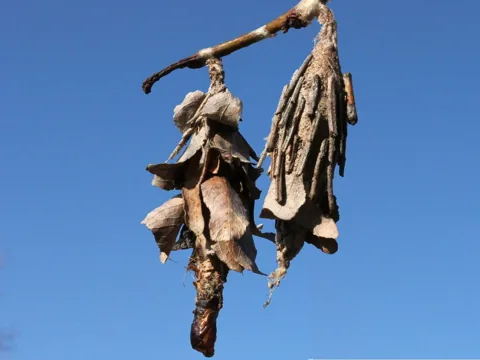 Bagworm
Thyridopteryx ephemeraeformis
Bagworms are caterpillars that build spindle-shaped bags of silk and bits of plant material and feed from inside them. Ohio State says they are hard to control because they often go unnoticed until the larvae are mature, by which time arborvitae, cedar or juniper can be badly defoliated; Missouri Extension notes complete defoliation is not uncommon.
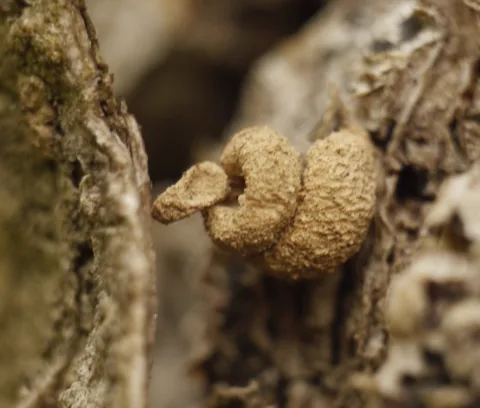 Snailcase Bagworm
Apterona helix
Snailcase bagworms are tiny moth larvae in coiled cases often found hanging on houses, sheds and fences.
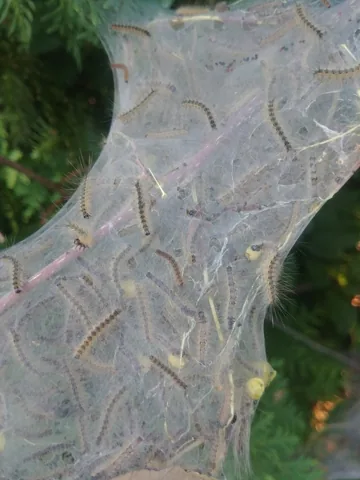 Fall Webworm
Hyphantria cunea
The fall webworm is a native caterpillar that spins large, loose webs over the ends of branches on a long list of deciduous trees and shrubs. The webs look alarming from midsummer into fall, but on healthy, established trees the damage is mostly cosmetic.
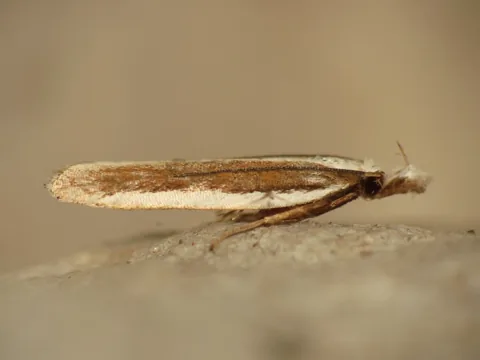 Juniper Webworm
Dichomeris marginella
Juniper webworm caterpillars feed deep inside junipers, webbing foliage into brown, dirty-looking nests that often go unnoticed until spring.
Is it bagworm?
The bags are what people notice. Fully grown, they're about 1 1/2 to 2 1/2 inches long, spindle- or pinecone-shaped, and covered in needles, leaf bits, bark or berries from the plant they're on, so a bag on a juniper looks different from one on a maple. They hang from twigs like small ornaments, and people often mistake them for pine cones or part of the plant.[1][3][2][4][7][5]
Early in the season the bags are tiny and stand upright on the foliage instead of hanging. Delaware Extension calls this the 'dunce-cap' stage, and the University of Kentucky compares them to tiny ice cream cones made of plant material. Ohio State gives about 1/8 inch for a brand-new bag.[5][4][1]
- The caterpillar: brown to dark brown with yellowish to whitish and black markings on the head and front segments, about 1 inch long when grown. It sticks its head and front legs out of the bag to feed and pulls back in when disturbed.[2][3][1]
- Bags in odd places: mature larvae sometimes carry their bags off the host plant before attaching them, so bags can turn up on house siding, fences and other structures.[3][1]
- Feeding signs: young larvae chew small holes or leave a windowpane look on leaves and needles; older larvae strip needles or eat whole leaves down to the large veins. Damage usually starts near the top of the plant and works down.[3][4]
- Grass bagworm: a much smaller relative makes 1-inch bags with grass pieces and may fasten them to fences or walls. It doesn't damage lawns.[1]
Which plants they attack
The worst trouble is on evergreens. Arborvitae, red cedar and other junipers are the most commonly attacked, and spruce, pine and cypress are also hosts.[2][6][1][3]
Deciduous trees get them too, including black locust, maple, sycamore, oak, elm, birch, willow and apple. Missouri and Iowa State Extension say more than 128 plant species have been recorded as hosts; the University of Kentucky puts it at trees and shrubs from over 50 plant families.[2][6][3][1]
Because the adult females can't fly, numbers can build quickly on a favored plant, while spread to new plants is slow. Ohio State notes bagworms rarely build up large numbers in forests; problems are mostly on landscape plants.[1][2][4]
The bagworm year
Bagworms have one generation a year, and the timing below is what makes winter bag picking and June spraying work.[1][2]
- Winter: eggs sit inside the bag of last year's female. Ohio State gives 300 to 1,000 eggs per bag; Missouri and Delaware Extension say 500 to 1,000.[1][2][5]
- Late May to June: eggs hatch. Sources give late May to mid-June in Missouri, about June 1 in Delaware and mid to late May in central Kentucky. The tiny larvae crawl out, and many spin down on silk threads and get carried by the wind to nearby plants, which is called ballooning.[2][5][4][1][3]
- June to August: each larva builds its own bag right away and enlarges it as it feeds. Kentucky Extension gives about six to eight weeks of feeding; Missouri says the larva molts four times, while Kentucky's current fact sheet counts seven larval stages.[1][3][4][2]
- Mid-August into early fall: grown larvae fasten their bags firmly to a twig with a band of silk, seal them and pupate inside.[1][2][5][3]
- September to early October: winged males, small black furry moths with nearly clear wings about 1 inch across, fly to the bags of the wingless females, which never leave their bags. After mating, the female lays her eggs in the bag and dies.[2][5][1][3]
Picking off bags (the winter job)
On small trees and shrubs, removing the bags by hand is the simplest and cheapest control, and for a few infested plants it may be all you need. It has to happen before the eggs hatch in late spring, so the window runs from fall through early spring.[2][4][5][7]
Late fall and winter are the easiest times. Ohio State points out that the bags stand out once deciduous trees drop their leaves and the plant bits on bags on evergreens turn brown.[1][3][7]
- Cut, don't yank: use sharp scissors, pruners or a knife to cut the silk loop holding each bag to the twig. Ohio State says this silk band doesn't decay quickly and can girdle the branch as it grows, killing it several years later.[3][1]
- Get them all: Missouri Extension says to pick off every bag you can reach. Each overwintering female bag can hold hundreds of eggs.[2][1][4]
- Destroy what you collect: squash the bags, or put any bags with living caterpillars into a bucket of soapy water. Don't leave them on the ground under the plant.[1][3][7]
- Saving the parasites: Delaware Extension suggests holding bags collected in late fall in jars covered with coarse screening, so any parasitic insects inside can get out while the bagworms can't.[5]
- Check again in late spring: Iowa State notes that even after a winter of hand-picking, young bagworms can still show up. Newly hatched larvae can balloon in on the wind from nearby plants. On a few small trees you can also pick the small bags by hand early in the season.[6][1]
Spraying young larvae: Bt and spinosad
If the plant is too big to pick clean, or you find lots of small bags in June, treat while the larvae are young. Small larvae are easier to kill and have done little damage yet; insecticides work less well as the larvae and their bags grow.[4][2][6][7]
Sources differ slightly on the exact timing. Missouri and Iowa State say to spray as soon as the eggs hatch and small larvae start feeding. Ohio State and Nebraska suggest waiting until all the eggs have hatched, which Ohio State puts at the end of June once ballooning is over. Kentucky gives early June, while larvae are under 1/2 inch.[2][6][1][7][4]
- Bt (Bacillus thuringiensis, kurstaki strain): a bacterial insecticide that works against young bagworm larvae. Ohio State says it's effective if used against young larvae and suggests the end of June.[1][7][3]
- Spinosad and neem (azadirachtin): Kentucky Extension lists both, along with Bt, as biorational products that manage bagworms caught in May or June while still small.[3][4]
- Cover the foliage thoroughly. Ohio State says stomach insecticides, which the larvae take in by eating treated leaves and needles, are very useful, because the bag shields the larvae from contact.[1]
- Degree days: Ohio State gives a model for timing sprays. With a 50 degree F base, last egg hatch comes at around 900 degree-day units; allow about one more week for ballooning before spraying.[1]
- In a laboratory study on arborvitae, chlorantraniliprole and indoxacarb controlled bagworms as well as spinosad and bifenthrin, and chlorantraniliprole still had an effect 10 days after treatment.[8]
- Read the label: make sure bagworms or caterpillars on ornamental trees and shrubs are listed, and follow its directions. Ohio State notes its recommendations can go out of date as labels change, and Kentucky's apply only to products registered in Kentucky.[1][3]
Big larvae in late summer
Bagworms often go unnoticed until the larvae are nearly grown, later in summer, when the bags are 1 to 2 inches long and hang down where they're easier to see. By then control is harder. Ohio State says mature larvae may pupate early if they detect pesticide on the foliage.[1][5][6]
Kentucky Extension says larger late-season larvae can be partly managed with broader pyrethroid insecticides such as bifenthrin, or with carbaryl, but these likely won't eliminate the population; they limit damage. If only one plant is infested, picking bags is still an option in late summer.[3]
For tall trees heavily infested in the upper canopy, a Purdue study found that the systemic insecticides dinotefuran and, to a lesser extent, clothianidin applied to the soil raised larval death and cut feeding for up to 50 days in lab tests. See the systemic tree insecticide guide before choosing that route.[8]
When an evergreen won't recover
Deciduous trees usually put out new leaves after being stripped. Evergreens are different: Delaware Extension says they cannot recover from complete defoliation, and Nebraska notes they don't regrow lost needles, so the damage is permanent.[5][7]
On evergreens, heavy feeding often turns sections bronze or brown. Kentucky Extension says those areas will likely never recover. Crowded larvae can also eat the buds on arborvitae, cedar and juniper, causing branch dieback and open dead patches.[3][1]
How fast a plant dies depends on the source. Ohio State says excessive defoliation can kill the whole plant in the following season. Kentucky's older fact sheet says heavy infestations over several years in a row, especially with other stresses, can lead to plant death.[1][4]
Missouri Extension says complete defoliation is not uncommon, and Iowa State says it can happen in the course of a single summer.[2][6]
Natural enemies
Some birds, including woodpeckers and sapsuckers, tear open the bags and eat the larvae. Insect predators and parasitic wasps also attack bagworms.[2][7]
Two ichneumonid wasps, the native Itoplectis conquisitor and the introduced Pimpla disparis, commonly parasitize bagworms in central Illinois, according to a University of Illinois study.[9]
These enemies have limits. Missouri Extension says they usually handle small to moderate populations but seldom control large ones until a lot of damage is done, and Ohio State says they're often not enough in urban settings. Delaware's screened-jar tip is one way to keep parasites in your yard while removing bagworms.[2][1][5]
Where bagworms are a problem
This bagworm occurs in the eastern United States from New England west to Nebraska and south through Texas.[1][2]
Toward the northern edge of its range it's patchier. Iowa State says infestations are rare north of Interstate 80 in Iowa, and a study across six degrees of latitude in the Midwest found female mating success dropped from about 100% to about 0% near the edge of the range.[6][10]
Common questions
- When is the best time to remove bagworm bags?
- From late fall through early spring, before the eggs inside hatch in late May or June. Bags are easiest to see in late fall and winter.[1][4][7][3]
- Do I need to cut the silk on bagworm bags?
- Yes. Cut the silk band rather than pulling, because a band left on the twig can girdle and kill the branch years later.[1][3]
- When should I spray for bagworms?
- When larvae are small, under about half an inch, usually in June. Sources range from right after hatch to the end of June once all eggs have hatched.[4][7][2][1]
- Does Bt work on bagworms?
- Yes, on young larvae. Insecticides in general work less well once larvae are large and protected in their bags in late summer.[1][7][3]
- Will my arborvitae grow back after bagworms?
- Branches that were stripped or turned bronze usually won't. Evergreens don't regrow lost needles, and heavy defoliation can kill the whole plant.[5][7][3][1]
- Can bagworm adults fly to my yard?
- Only the males fly. Females stay in their bags, so new infestations mostly come from young larvae ballooning on the wind or crawling from nearby plants.[2][1][4]
- How many eggs are in a bagworm bag?
- Sources give 300 to 1,000 (Ohio State) or 500 to 1,000 (Missouri, Delaware).[1][2][5]
Photo credits
- Bagworm: (c) Peter Chen 2.0, some rights reserved (CC BY) — via iNaturalist, CC BY 4.0
- Snailcase Bagworm: (c) Roman, some rights reserved (CC BY) — via iNaturalist, CC BY 4.0
- Fall Webworm: Andalyne Tofflemire, public domain (CC0), via iNaturalist
- Juniper Webworm: (c) Donald Hobern, some rights reserved (CC BY) — via iNaturalist, CC BY 4.0
Sources
- Ohio State University Extension, “Bagworm and Its Control, HYG-2149 (D. J. Shetlar, 2011).” ohioline.osu.edu/factsheet/HYG-2149-10 (accessed 2026-11-10)
- University of Missouri Extension, “The Bagworm in Missouri, G7250.” extension.missouri.edu/publications/g7250 (accessed 2026-11-10)
- University of Kentucky Entomology, “ENTFACT-440: Dealing with Bagworms on Landscape Plants (J. L. Larson).” entomology.mgcafe.uky.edu/ef440 (accessed 2026-11-10)
- University of Kentucky College of Agriculture (hosted by Kentucky Division of Forestry), “Entfact 440: Bagworms on Landscape Plants (M. F. Potter, L. Townsend; revised 2010).” eec.ky.gov/Natural-Resources/Forestry/forest-health/Documents/34.bagworms.pdf (accessed 2026-11-10)
- University of Delaware Cooperative Extension, “Bagworms (B. A. Kunkel, L. N. Colon; revised April 2025).” www.udel.edu/content/dam/udelImages/canr/pdfs/extension/factsheets/Bagworms.pdf (accessed 2026-11-10)
- Iowa State University Extension and Outreach, “Bagworms Have Hatched (Yard and Garden, June 20, 2007).” yardandgarden.extension.iastate.edu/article/2007/6-20/bagworm.html (accessed 2026-11-10)
- University of Nebraska-Lincoln Extension, “Bagworms (Backyard Farmer).” byf.unl.edu/bagworms (accessed 2026-11-10)
- Journal of Economic Entomology (PubMed 19610433), “Rhainds M, Sadof C. Control of bagworms (Lepidoptera: Psychidae) using contact and soil-applied systemic insecticides. J Econ Entomol 2009;102(3):1164-9.” pubmed.ncbi.nlm.nih.gov/19610433/ (accessed 2026-11-10)
- Environmental Entomology (PubMed 19036211), “Moser SE et al. Influence of oviposition experience on multiparasitism by Pimpla disparis and Itoplectis conquisitor. Environ Entomol 2008;37(5):1307-12.” pubmed.ncbi.nlm.nih.gov/19036211/ (accessed 2026-11-10)
- PLoS One (PubMed 21152445), “Rhainds M, Fagan WF. Broad-scale latitudinal variation in female reproductive success contributes to the maintenance of a geographic range boundary in bagworms. PLoS One 2010;5(11):e14166.” pubmed.ncbi.nlm.nih.gov/21152445/ (accessed 2026-11-10)