The short answer
- Check where and when the silk appears. Eastern tent caterpillar nests sit in the forks and crotches of branches in spring. Fall webworm nests wrap the ends of branches, enclose the leaves, and show up in late summer and fall.[1][2][8]
- Healthy, established trees tolerate the feeding. Extension sources call the damage mostly cosmetic, so doing nothing is a reasonable choice for a healthy tree.[4][2][10]
- In winter, cut or scrape off the shiny egg masses that ring small twigs. That removes next spring's nests before they start.[1][2][5]
- In spring or summer, pull out small nests with a stick or a brush on a pole, or prune out webbed twigs, then bag, bury or crush the caterpillars.[1][4][8]
- Don't burn nests on the tree. Fire damages the tree more than the caterpillars do.[1][2]
- If you spray, do it while caterpillars are small, under about an inch. Bacillus thuringiensis (Bt) kills only caterpillars that eat treated leaves, and it needs a forceful spray that gets through the webbing.[4][5][7]
- Big caterpillars wandering over walls and driveways have finished feeding. They won't harm the tree, and spraying them does little.[1][2]
Tent caterpillar and webworm profiles
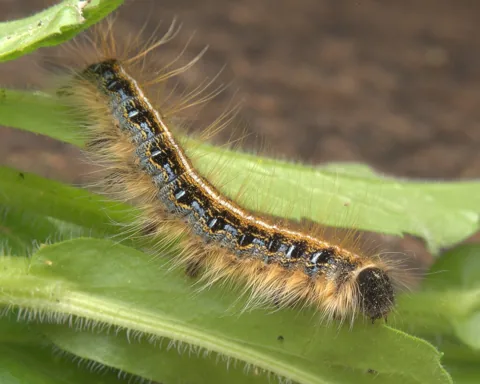 Eastern Tent Caterpillar
Malacosoma americana
Eastern tent caterpillars build silk tents in the crotches of wild cherry, apple and crabapple in spring. They can nearly defoliate a tree, but the tree usually recovers and puts out new leaves. It is a native insect with many natural enemies, and often no spraying is needed.
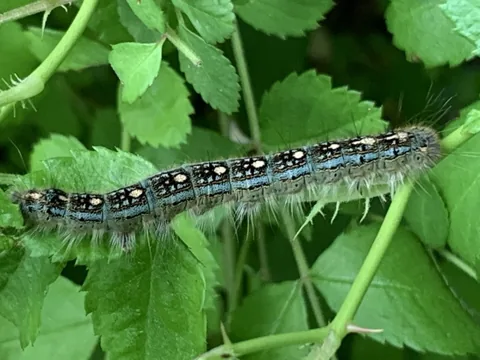 Forest Tent Caterpillar
Malacosoma disstria
Despite its name, the forest tent caterpillar doesn't build a tent, and it is often mistakenly called an armyworm because the caterpillars feed in groups. It is a native spring caterpillar that periodically defoliates aspen, oak, basswood, birch and other hardwoods, then crawls over buildings and roads in search of places to spin cocoons.
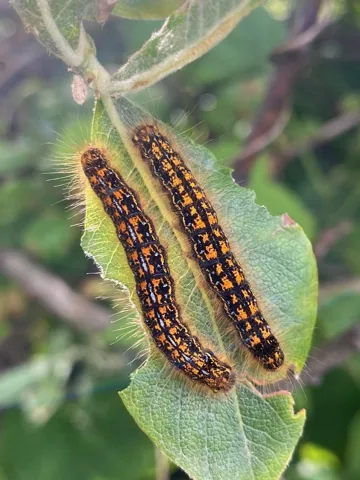 Western Tent Caterpillar
Malacosoma californicum
Western tent caterpillars hatch around budbreak and feed in groups inside silk tents on aspen, fruit trees, oak, willow and many other broadleaf hosts. Healthy trees tolerate the leaf loss, and natural enemies often keep numbers in check.
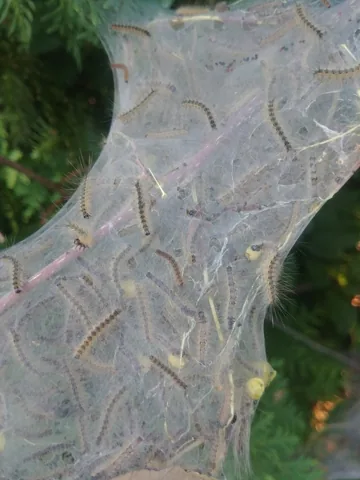 Fall Webworm
Hyphantria cunea
The fall webworm is a native caterpillar that spins large, loose webs over the ends of branches on a long list of deciduous trees and shrubs. The webs look alarming from midsummer into fall, but on healthy, established trees the damage is mostly cosmetic.
Which one do you have?
This guide covers four caterpillars that live in groups and spin silk on trees. Three are tent caterpillars in the genus Malacosoma (family Lasiocampidae); the fourth, fall webworm, belongs to a different moth family. Nest position and season tell them apart.[7][8]
- Eastern tent caterpillar: a silk tent in the fork or crotch of branches in spring and early summer, mostly on wild cherry, apple and crabapple. The tent doesn't enclose the leaves; the caterpillars leave it to feed.[1][2]
- Forest tent caterpillar: despite the name, no obvious tent. Caterpillars feed in groups on the leaves and rest together on a thin silk mat on the trunk or branches. Look for white keyhole- or footprint-shaped spots down the back.[6][5][7]
- Western tent caterpillar: a large silk web on leaves and twigs in spring, with reddish-brown caterpillars that feed mostly inside the tent.[7][9]
- Fall webworm: loose webs over the ends of branches in late summer and fall, enclosing the leaves the caterpillars are eating, plus dead leaves and droppings.[3][8][1]
- Timing can overlap. Kentucky's fact sheet notes some overlap between the two, but fall webworm generally comes later in the season.[1]
Eastern tent caterpillar
This is the spring tent maker of eastern North America. Penn State gives its range from the northeastern United States and adjacent Canada south to Florida and west to the Dakotas and Texas. It prefers trees in the rose family such as cherry, crabapple and apple, and Kentucky's fact sheet adds hawthorn, maple, peach, pear and plum.[2][1]
Eggs spend the winter in a mass wrapped around a twig about pencil-size or smaller, coated in a shiny black varnish-like material. Kentucky Extension counts 150 to 400 eggs per mass, Penn State 150-350. The caterpillars hatch about when buds open (early March in Kentucky) and build a tent in a branch crotch. Caterpillars from two or more egg masses can share one big tent, which grows to a foot or more long.[1][2]
- Caterpillars: hairy, black with a white stripe down the back, brown and yellow lines along the sides and a row of blue spots. They are full grown in 4 to 6 weeks at about 2 to 2-1/2 inches, according to Kentucky; Penn State and Minnesota say about two inches.[1][2][4]
- When they're home: sources differ. Kentucky says caterpillars stay in the tent in the heat of the day and in rain and feed in the early morning, evening or night. Minnesota says they feed during the day and stay in the tent at night and in rainy weather. Either way, a rainy day finds them inside.[1][4]
- Cocoons and moths: mature caterpillars leave to spin white or yellowish cocoons about 1 inch long in protected spots. Reddish-brown moths with two pale diagonal stripes on each forewing emerge about 3 weeks later and lay the eggs that hatch next spring. There is one generation a year.[1][2]
- Egg mass or black knot? Penn State points out that black knot fungus on cherry can look similar. The egg mass is smooth and shiny; the fungus is rough and knotty.[2]
Forest tent caterpillar
The forest tent caterpillar occurs throughout most of the United States and Canada wherever hardwood trees grow. In Minnesota it feeds on aspen, balsam poplar, basswood, oaks, ashes, birches, alder and fruit trees, and rarely on red maple or conifers. UMass says outbreaks can defoliate trees heavily and then typically collapse because of parasites, predators and disease.[5][6]
- Caterpillars: blue and gray with white spots down the back that UMass describes as key holes or tiny penguins, up to 2 inches long. Penn State notes these spots are dots rather than the eastern tent caterpillar's solid white line.[6][2][7]
- Egg masses: gray bands around small twigs, 100 to 350 eggs each in Minnesota. UMass says the ends of a forest tent caterpillar mass are square, while eastern tent caterpillar masses taper.[5][6]
- Season: in Minnesota the caterpillars hatch in early to mid-May as aspen leaves open and feed for five to six weeks. Full-grown caterpillars look for sheltered places to spin cocoons at the end of June, and moths emerge about two weeks later.[5]
- Tree effects: Minnesota Extension says feeding generally doesn't kill deciduous trees, which can grow a second set of leaves the same season, and healthy trees tolerate two to three years in a row of heavy defoliation. Trees defoliated four or more years running, or stressed by drought, are at more risk.[5][6]
- Big gray flies: during outbreaks a large gray fly, Sarcophaga aldrichi, multiplies on the caterpillars. Minnesota says it doesn't bite and is harmless, though it lands on everything, and it helps end outbreaks.[5][6]
Western and Pacific tent caterpillars
Western tent caterpillar larvae are reddish brown with some blue spots and tufts of orange to white hairs. They spin large silken webs on leaves and twigs and feed mostly inside the tent. Utah State lists hosts including quaking aspen, alder, bitterbrush, chokecherry, cottonwood, crabapple, fruit trees, oak, serviceberry and wild rose; Oregon State adds red alder, madrones and roses.[7][9][10]
- Life cycle: one generation a year, overwintering as eggs on the host tree. Pupation comes 1 to 1 1/2 months after spring hatch, and Utah State says adults fly from late July through August.[9][10][7]
- Egg masses: in a central Oregon study the masses were more common on the sunny side of trees.[10]
- Pacific tent caterpillar: a close relative that usually feeds only on oaks, makes small tents a few inches wide and feeds out in the open.[7]
- Damage: Oregon State calls it primarily aesthetic and says chemical control is rarely recommended; Utah State says severe damage to ornamentals is uncommon. Utah State also notes that defoliation every year can reduce growth or kill trees.[10][9]
Fall webworm
Fall webworm is a native moth whose caterpillars build loose webs over branch tips from summer into early fall. Penn State says it feeds on almost 90 species of deciduous trees; UC IPM says more than 100 species of woody broadleaves. Penn State names hickory, walnut, birch, cherry and crabapple as common hosts.[3][8]
- Caterpillars: color varies a lot, often greenish, gray or yellowish brown, with whitish hairs growing from black or orange bumps. UC IPM says they grow up to 1 inch long.[3][8]
- Webs: the caterpillars feed inside, skeletonizing leaves, and keep enlarging the web; a web can cover 2–3 feet of branch. Empty webs may hang on through winter.[3][8]
- Life cycle: eggs are laid in masses on leaves and hatch in about a week; caterpillars mature in about 6 weeks, then pupate in litter, soil or bark crevices, where they spend the winter. There are one or two generations a year depending on location.[3][8]
- Damage: it may defoliate a tree occasionally but rarely kills it. On shade trees webs usually cover scattered branches and mainly reduce the tree's looks. UC IPM adds that on fruit and nut trees severe defoliation can sunburn the crop and cut the next season's yield.[3][8]
How worried should you be?
For most yards, not very. Penn State says healthy trees can withstand eastern tent caterpillar defoliation and recover without intervention, and that damage is generally aesthetic rather than a threat to tree health. Kentucky notes that a tree stripped by tent caterpillars usually puts out a new crop of leaves. UC IPM says healthy plants tolerate losing some leaves and tent caterpillars generally don't warrant insecticides.[2][1][7]
The exceptions are young trees and trees that are already stressed. Minnesota Extension says those suffer more and may need protection, and repeated heavy defoliation over several years adds up.[4][5][9]
- Natural enemies do much of the work. UC IPM says more than 100 species of parasitic flies and wasps attack tent caterpillars, birds eat eggs, larvae and moths, and a caterpillar-specific virus often quickly reduces high populations. Oregon State, on the other hand, says birds generally find western tent caterpillars repellent in flavor.[7][1][6][10]
- Outbreaks cycle. Penn State says eastern tent caterpillar outbreaks often come at eight to ten year intervals; Oregon State cites 6-11 year cycles for western tent caterpillar in British Columbia.[2][10]
Winter: remove egg masses
Tent caterpillar eggs sit on the tree all winter in plain view once the leaves drop. Clipping or scraping them off small trees and fruit trees before they hatch greatly reduces the next spring's problem, and Kentucky, Penn State, Minnesota and UMass all recommend it.[1][2][5][6]
Pulling and pruning nests
Small nests are easy to deal with by hand. Kentucky says to remove small tents early in spring, prune out larger ones, or wind the nest onto the end of a stick. For fall webworm, UC IPM suggests cutting out infested twigs on small trees with a pole saw, or twirling the webbing into a ball with a toilet brush or similar tool on a telescoping pole, then crushing or disposing of the caterpillars.[1][8]
- Timing: Minnesota suggests pulling the webbing out when the caterpillars have gone back into the tent, at the end of the day or when it rains, then bagging or burying them.[4]
- Pruning limits: prune out tents only if you can do it without cutting large limbs. Penn State says pruning fall webworm nests is practical while the webs are small and pruning won't spoil the plant's shape.[7][3]
- No fire: Kentucky doesn't recommend burning tents with a torch because it can easily damage the tree, and Penn State says tents should never be burned: besides the risk to nearby structures, the fire hurts the tree more than the caterpillars. Minnesota mentions burning only where it is permitted.[1][2][4]
- Wear gloves: tent caterpillars are covered in defensive hairs. Penn State says gentle handling is usually safe, but wash your hands afterward so hairs don't get into your eyes or mouth.[2]
Caterpillars on walls, decks and driveways
Late in the season, full-grown caterpillars leave the tree one by one to find a protected place to spin a cocoon. Kentucky and Penn State both stress that these wanderers have stopped feeding and do no more damage. Insecticides are generally ineffective against mature larvae, so spraying them isn't worth it.[1][2]
- Sweep them off: Minnesota suggests brushing forest tent caterpillars and cocoons off houses, picnic tables and decks with a stiff broom.[5]
- Avoid squashing: crushed caterpillars leave a mess on patios and walks, can make roads greasy and slippery, and can smear and mark some paints.[1][5]
- They're a nuisance, not a danger to property: Minnesota says forest tent caterpillars don't bite people or harm animals or property, though cocoons on siding are hard to remove.[5]
Bt and other sprays: timing matters
If nests are too many or too high to remove, a spray aimed at young caterpillars is the next step. Minnesota Extension says to spray when the caterpillars are an inch long or less; near their full size of about two inches, pesticides may no longer work. Kentucky adds that caterpillars inside tents are sheltered by the webbing and harder to kill.[4][5][1]
Bacillus thuringiensis var. kurstaki (Bt) is the usual first choice. It works only when caterpillars eat treated leaves: NPIC says the toxin is activated only in the high-pH insect gut, young larvae are most affected, and death comes within 1-5 days. UC IPM says Bt kills only caterpillars that feed on sprayed foliage, which spares the parasitic flies and wasps that help control these pests.[11][7][8]
- Get through the silk: UC IPM says Bt works if high-pressure spray equipment drives it through the webbing and thoroughly covers the leaves around it, and that adding a wetting agent improves penetration of webworm nests. Penn State says only the webs and nearby foliage need treating for fall webworm, not the whole plant.[7][8][3]
- Repeat once: UC IPM recommends a second Bt application about 7 to 10 days after the first because Bt doesn't last long. NPIC says sunlight breaks Bt spores down quickly, with typical half-lives of 1 to 4 days on foliage.[7][8][11]
- Flowering trees: Minnesota calls Bt a good option on a tree in bloom because it won't harm honey bees and other pollinators. Spinosad also works, but UC IPM says it stays toxic to bees for several hours after the spray dries, so don't use it on plants in flower.[4][7][8]
- Soap and oil: Minnesota notes insecticidal soap must hit the caterpillars directly and has no residual activity, so repeat applications may be needed. Penn State lists horticultural oil alongside Bt for young eastern tent caterpillars.[4][2]
- Broad-spectrum insecticides: carbaryl, malathion, pyrethroids and others are labeled for caterpillars, but Penn State calls them a last resort for older caterpillars, and Minnesota suggests considering low-impact products and lists Bt, soap, spinosad and azadirachtin as options that conserve beneficial insects. UMass advises spraying after bloom to protect pollinators.[2][1][5][6][9]
- Tall trees: if you can't reach the canopy, UC IPM suggests hiring a company with the right equipment and asking it to use Bt, or spinosad if the tree isn't in bloom.[8]
- Labels: check that the plant and pest are on the label and follow it. Some products are restricted to licensed applicators or to certain states.[1][6][8]
Hairs, kids and horses
Penn State says eastern tent caterpillars are covered in defensive hairs that can irritate if they get into the eyes or mouth, so wear gloves and wash your hands after handling them. For caterpillars with venomous spines, see the stinging caterpillars guide.[2]
- Horse owners: eastern tent caterpillars are linked to mare reproductive loss syndrome, which causes pregnant mares to abort. In University of Kentucky studies, some pregnant mares fed eastern tent caterpillar larvae aborted, while mares in the control groups didn't. Penn State advises horse owners to watch for host trees such as cherry around pastures and for outbreak years.[2][12]
A simple plan, season by season
- Winter: clip or scrape egg masses off small trees, especially wild cherry, apple and crabapple.[1][2]
- Early spring: check trees after budbreak for small tents in branch forks and pull or prune them out while they're small.[9][7][1]
- Spring, only if needed: spray Bt on young caterpillars under an inch, getting it through the webbing, and repeat in 7 to 10 days.[4][7]
- Early summer: sweep wandering caterpillars and cocoons off buildings; they're done feeding.[5][2]
- Mid to late summer: watch branch tips for fall webworm webs and prune or brush them out while small.[3][8]
- Every year: keep trees healthy so they can regrow leaves, and give natural enemies a chance by avoiding broad-spectrum sprays.[9][5][8]
Common questions
- Will tent caterpillars kill my tree?
- Rarely. Healthy trees usually put out a new set of leaves after being defoliated, and Minnesota Extension says they tolerate two to three years in a row of heavy forest tent caterpillar feeding. Young, stressed or repeatedly defoliated trees are at more risk.[1][5][2]
- What's the difference between tent caterpillars and webworms?
- Eastern tent caterpillars build tents in branch forks in spring and leave them to feed. Fall webworms web over the ends of branches in late summer and fall and feed inside the web on the leaves it encloses.[1][2][8]
- Should I burn the nests?
- No. Kentucky and Penn State both advise against it: fire damages the tree more than the caterpillars and risks nearby structures. Pull the nest out with a stick or brush, or prune the twig.[1][2]
- Does Bt work on tent caterpillars?
- Yes, on young caterpillars that eat the treated leaves. Spray while they're under about an inch, use enough pressure to reach through the silk, and repeat after 7 to 10 days because sunlight breaks Bt down quickly.[4][7][11]
- Are tent caterpillars dangerous to touch?
- They're hairy rather than venomous. Penn State says handling them gently is usually safe, but wear gloves and wash your hands so hairs don't reach your eyes or mouth.[2]
- Why are there caterpillars all over my house?
- Full-grown caterpillars leave the trees to find sheltered places to spin cocoons. They've stopped feeding, so they won't hurt the trees; sweep them off with a stiff broom and avoid crushing them on painted surfaces.[1][5]
Photo credits
- Eastern Tent Caterpillar: (c) Norman Kuring, some rights reserved (CC BY) — via iNaturalist, CC BY 4.0
- Forest Tent Caterpillar: (c) Healthy Yards, some rights reserved (CC BY) — via iNaturalist, CC BY 4.0
- Western Tent Caterpillar: Erin Springinotic, public domain (CC0), via iNaturalist
- Fall Webworm: Andalyne Tofflemire, public domain (CC0), via iNaturalist
Sources
- University of Kentucky Entomology, “Eastern Tent Caterpillar (Entfact 423).” entomology.mgcafe.uky.edu/ef423 (accessed 2026-11-10)
- Penn State Extension, “Eastern Tent Caterpillar.” extension.psu.edu/eastern-tent-caterpillar (accessed 2026-11-10)
- Penn State Extension, “Fall Webworm.” extension.psu.edu/fall-webworm (accessed 2026-11-10)
- University of Minnesota Extension, “Eastern tent caterpillars.” extension.umn.edu/yard-and-garden-insects/eastern-tent-caterpillars (accessed 2026-11-10)
- University of Minnesota Extension, “Forest tent caterpillars.” extension.umn.edu/yard-and-garden-insects/forest-tent-caterpillars (accessed 2026-11-10)
- UMass Amherst Extension, “Malacosoma disstria (Insect and Mite Guide).” www.umass.edu/agriculture-food-environment/landscape/publications-resources/insect-mite-guide/malacosoma-disstria (accessed 2026-11-10)
- University of California Statewide IPM Program, “Tent Caterpillars.” ipm.ucanr.edu/home-and-landscape/tent-caterpillars/ (accessed 2026-11-10)
- University of California Statewide IPM Program, “Fall Webworm.” ipm.ucanr.edu/home-and-landscape/fall-webworm/ (accessed 2026-11-10)
- Utah State University Extension, “Western Tent Caterpillar (Ornamental Pest Guide).” extension.usu.edu/planthealth/ipm/ornamental-pest-guide/arthopods/moths/western-tent-caterpillar (accessed 2026-11-10)
- Oregon State University, College of Agricultural Sciences, “Western Tent Caterpillar.” agsci.oregonstate.edu/nurspest/insects/western-tent-caterpillar (accessed 2026-11-10)
- National Pesticide Information Center, “Bacillus thuringiensis (Bt) General Fact Sheet.” npic.orst.edu/factsheets/btgen.html (accessed 2026-11-10)
- Journal of Insect Physiology, abstract via PubMed (PMID 15019520), “Webb et al. 2004, Eastern tent caterpillars (Malacosoma americanum) cause mare reproductive loss syndrome.” pubmed.ncbi.nlm.nih.gov/15019520/ (accessed 2026-11-10)