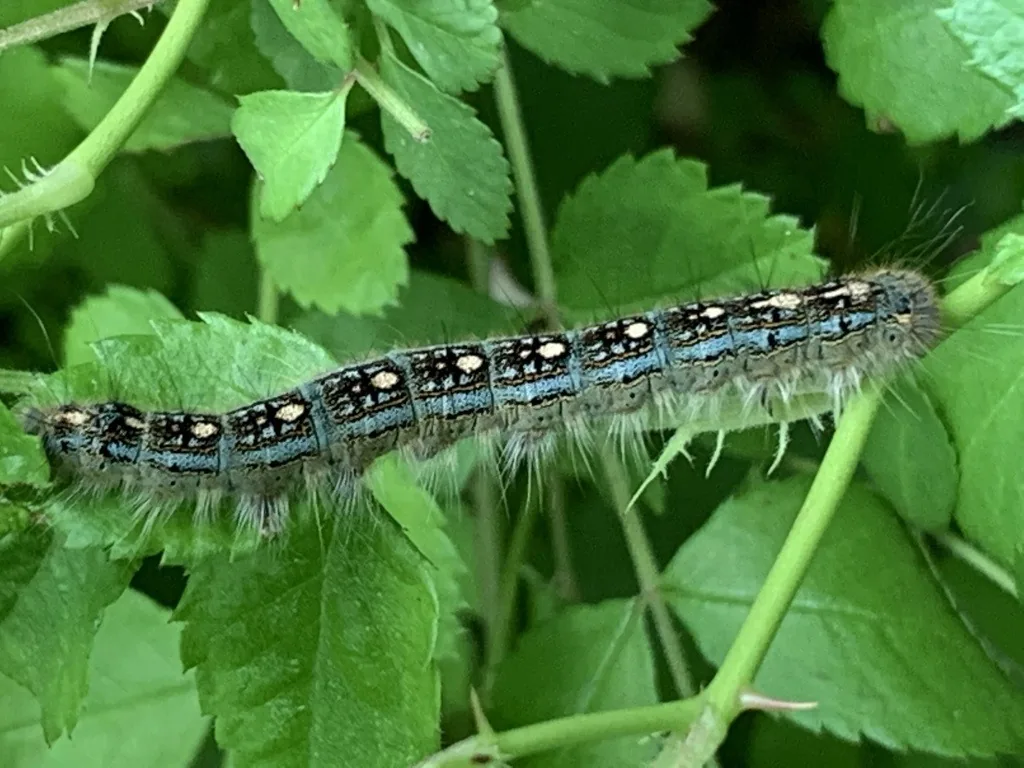
How to identify it
- Full-grown caterpillars are about 2 inches long, mostly blue and black, with a row of white keyhole- or footprint-shaped spots down the back.[1][2]
- Many hairs stick out along the sides of the body, and UC IPM notes wavy reddish-brown lines along the dark blue body.[1][3]
- Instead of a tent, caterpillars spin a thin silk mat on trunks and branches where they gather between feeding.[1][2]
- Egg masses are gray, shiny bands wrapped around small twigs, with squared-off ends.[2][1]
- Adults are tan moths, about 1.6 inches, with two dark brown stripes across each forewing; they fly at night and come to lights.[2][1]
Look-alikes
| Look-alike | How to tell them apart |
|---|---|
| Eastern tent caterpillar | Builds a large silk tent in branch crotches, and its egg masses have tapered ends instead of square ones.[2][4] |
| Western tent caterpillar | A western species that feeds in groups inside silk tents and is reddish brown with tufts of orange to white hairs.[3] |
| Fall webworm | Makes large, obvious webs, while the forest tent caterpillar makes no tent or web of that kind.[2] |
Where it lives
Found throughout most of the United States and Canada wherever hardwood trees grow.[1]
Biology and life cycle
Caterpillars hatch in early to mid-May, about when aspen leaves open, and climb into the canopy to feed on expanding buds and leaves.[1][2]
They feed in groups while small, then wander more on their own; large caterpillars tend to feed at night and hide near the ground by day.[2]
After five to six weeks of feeding, around late June, they spin pale yellow cocoons in folded leaves or on plants and buildings.[1][2]
Moths emerge about two weeks later, in mid-July, live roughly five days, and lay 100 to 350 eggs in bands around twigs; there is one generation a year.[1]
Damage and signs
- Hosts include quaking aspen, balsam poplar, basswood, oak, ash, birch, sugar maple and fruit trees; red maple and conifers are rarely eaten.[1][2]
- Feeding usually doesn't kill trees, which can grow a second set of leaves the same season; healthy trees tolerate two or three years of heavy defoliation.[1][2]
- Trees may die after four or more years of heavy defoliation in a row, or when also stressed, such as by drought.[1]
- When trees are stripped, hungry caterpillars move to nearby plants, including vegetables, small fruits and nursery stock.[1]
Health risk
Forest tent caterpillars don't bite people or harm animals; they are a nuisance on buildings, and crushed caterpillars can make roads greasy and slippery.[1]
Control
Traps and physical control
Remove and destroy egg masses from twigs of small trees before they hatch in spring.[1][2]
Brush caterpillars and cocoons off houses, decks and picnic tables with a stiff broom, or knock them off with a spray of water.[1]
Biological control
Cold or wet springs, starvation, disease and parasites, including a large gray fly, usually end outbreaks on their own.[1][2]
Bacillus thuringiensis (Bt) is effective and spares beneficial insects; apply it while caterpillars are 1 inch or smaller, usually early to mid-May.[1]
Pesticides
Insecticidal soap, spinosad and azadirachtin also conserve beneficials; large caterpillars are hard to kill and keep feeding before sprays take effect.[1]
The big gray flies that follow an outbreak
During outbreaks, a large gray fly, Sarcophaga aldrichi, feeds on forest tent caterpillars and becomes abundant when they are numerous.[1][2]
The fly doesn't bite and is harmless, though it lands on everything, including people, and it plays an important part in ending outbreaks.[1]
Common questions
- Why can't I find a tent?
- This species doesn't build one. It spins only a thin silk mat on the trunk or branches where caterpillars rest together.[2][1]
- Will forest tent caterpillars kill my trees?
- Usually not. Trees can releaf the same season and tolerate a few years of defoliation, though four or more years, or drought stress, can kill them.[1]
- Do forest tent caterpillars bite?
- No. They don't bite people or harm pets; they are a nuisance when they gather on buildings or get crushed on roads.[1]
Sources
- University of Minnesota Extension, “Forest Tent Caterpillars (reviewed 2018).” extension.umn.edu/yard-and-garden-insects/forest-tent-caterpillars (accessed 2026-10-06)
- UMass Extension Landscape, Nursery and Urban Forestry Program, “Malacosoma disstria, Forest Tent Caterpillar (Landscape Insect and Mite Guide).” www.umass.edu/agriculture-food-environment/landscape/publications-resources/insect-mite-guide/malacosoma-disstria (accessed 2026-10-06)
- University of California Statewide IPM Program, “Tent Caterpillars (Home and Landscape).” ipm.ucanr.edu/home-and-landscape/tent-caterpillars/ (accessed 2026-10-06)
- University of Kentucky Entomology, “ENTFACT-423: Eastern Tent Caterpillar (revised January 2026).” entomology.mgcafe.uky.edu/ef423 (accessed 2026-10-06)
- iNaturalist, “Malacosoma disstria taxon page (order and family).” www.inaturalist.org/taxa/81663 (accessed 2026-10-06)