The short answer
- A small, teardrop-shaped tuft of tan or brown 'fur' with a tail of hair at the back: the puss caterpillar (asp), the caterpillar behind most stings in the South. Do not touch it.[1][10][9][2]
- Short, stocky, slug-shaped caterpillars that creep on the undersides of leaves, often with spiny horns or lobes: slug caterpillars. The saddleback (green 'saddle' with a dark spot in the middle and spiny horns at both ends) is the best known; spiny oak slug, stinging rose and hag moth caterpillars belong here too.[1][7][2][11]
- Large green caterpillar with a red-and-white stripe down each side and clumps of branched, black-tipped spines: io moth. Dark, spiny caterpillar flecked with white or yellow on oak in spring: buck moth.[1][3][5]
- Fuzzy white caterpillar with black tufts down the back, wandering in late summer: hickory tussock moth. Hairy caterpillar with four white brush-like tufts, two black 'pencils' at the head and red bumps near the rear: white-marked tussock moth. Both cause itchy rashes rather than stings.[12][8]
- Dark brown and hairy with white stripes and two bright red-orange spots near the rear, in coastal Maine or Massachusetts: browntail moth, whose hairs cause a rash like poison ivy and can drift on the wind.[17][15]
- If you are stung: lift the spines out with tape, wash with soap and water, and put ice on it. Call 911 for trouble breathing, fainting, or swelling of the lips, face or tongue.[19][18][1]
If someone may be poisoned
- Call 911 right away if someone develops difficulty breathing, fainting, or swelling of the lips, face or tongue after touching a caterpillar. Severe allergic reactions are rare but possible.[19]
- Get medical care promptly if hairs or spines get into the eyes, if a child swallows a caterpillar or its hairs, or if an allergic reaction develops. For anything else, Poison Control (1-800-222-1222, free and open 24 hours) can tell you what to do.[19][12][10][18]
Stinging and irritating caterpillar profiles
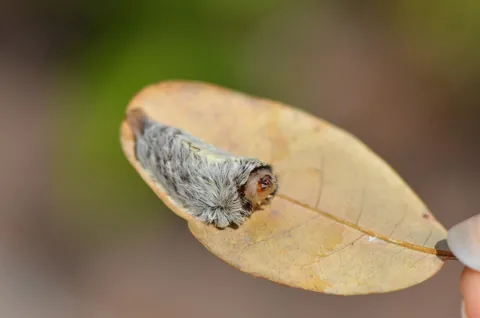 Puss Caterpillar (southern flannel moth)
Megalopyge opercularis
The puss caterpillar is the larva of the southern flannel moth. Its soft, fur-like coat hides short venomous spines, and medical reviews count it among the most serious stinging caterpillars in North America.
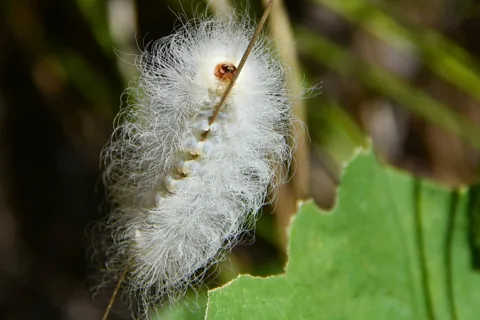 Black-waved Flannel Moth
Megalopyge crispata (also listed as Lagoa crispata)
The black-waved, or crinkled, flannel moth caterpillar is a fuzzy caterpillar that looks a lot like the puss caterpillar. Its coat of long, soft hairs hides short venomous spines that sting if you brush against it or pick it up.
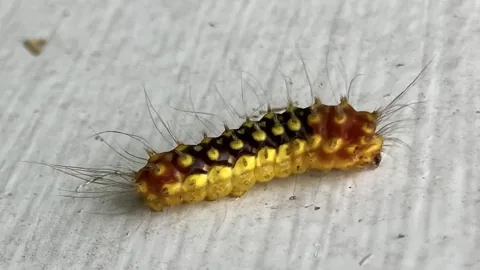 White Flannel Moth
Norape ovina
The white flannel moth caterpillar, also called the hackberry leafslug, is a stinging caterpillar that NC State says turns up more often on redbud than on hackberry. Brushing bare skin against it breaks off stinging hairs, and the sting is about like a bee's or wasp's.
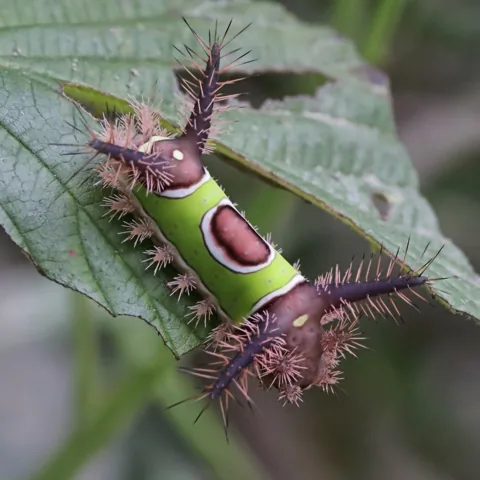 Saddleback Caterpillar
Acharia stimulea
The saddleback caterpillar is a slug caterpillar, a stinging moth larva named for the saddle-shaped spot in the middle of its green back. Clemson calls it the most common slug caterpillar, and poison center records list it among the caterpillars that actually cause stings.
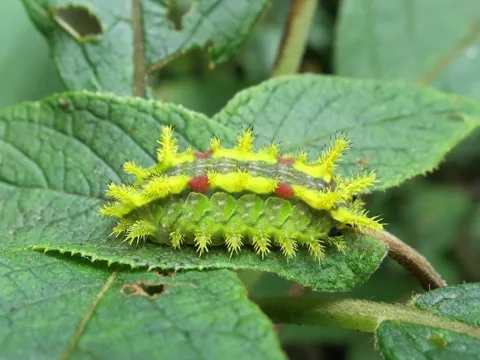 Spiny Oak-Slug
Euclea delphinii
The spiny oak-slug is a stinging slug caterpillar, less venomous than the saddleback but still worth avoiding.
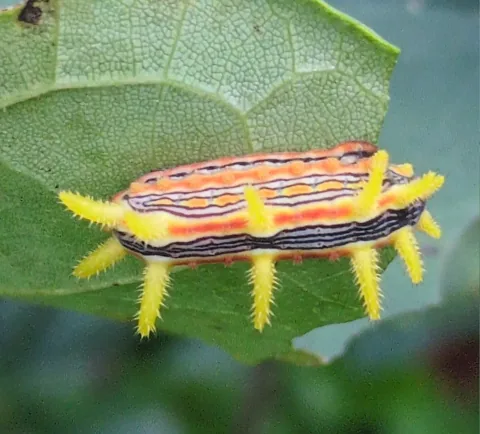 Stinging Rose Caterpillar
Parasa indetermina
The stinging rose caterpillar's bright stripes and spiny horns are warning colors: the spines sting. It is a slug caterpillar of eastern forests, widespread but not particularly common.
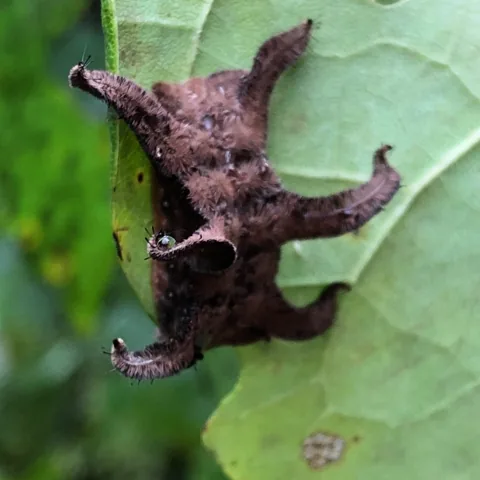 Hag Moth Caterpillar
Phobetron pithecium
The hag moth caterpillar resembles a dried leaf, yet all of its fleshy lobes carry stinging hairs.
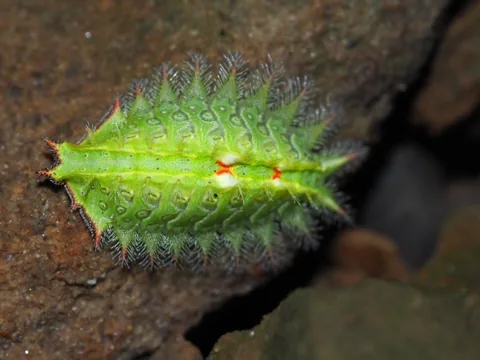 Crowned Slug Caterpillar
Isa textula
The crowned slug is a flat, pale green slug caterpillar ringed with plumes of stinging hairs; it feeds on oak, maple, cherry and other hardwoods in summer and fall and can sting painfully if touched.
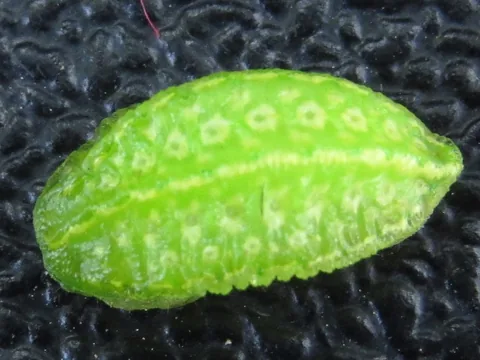 Yellow-shouldered Slug Moth
Lithacodes fasciola
The yellow-shouldered slug is the caterpillar of a slug moth (family Limacodidae). Slug caterpillars are one of the main groups of stinging caterpillars, but this one is a green, yellow-spotted caterpillar whose short hairs are nonstinging and sunk into pits in its corrugated skin. It feeds on many forest trees and shrubs from July to September.
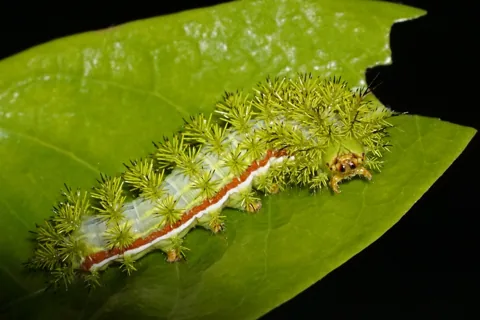 Io Moth Caterpillar
Automeris io
The io moth caterpillar is the larva of a giant silkworm moth. Most giant silkworm caterpillars are harmless, but this one carries stinging spines, and Clemson calls it the largest stinging caterpillar commonly encountered in South Carolina.
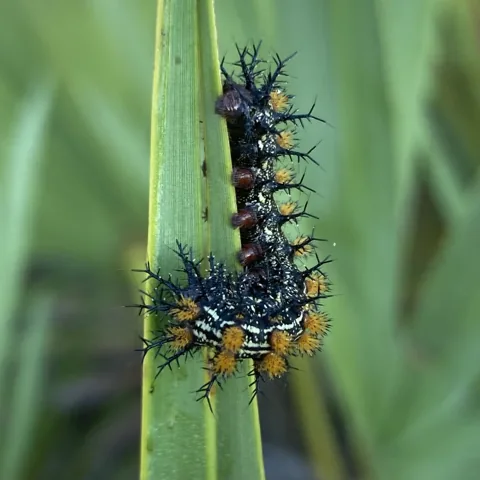 Buck Moth Caterpillar
Hemileuca maia
The buck moth caterpillar is the larva of a giant silkworm moth that feeds mainly on oaks in spring. Its branched spines carry venom, and a sting can be severely painful; Poison Control lists it among the venomous caterpillars of the U.S.
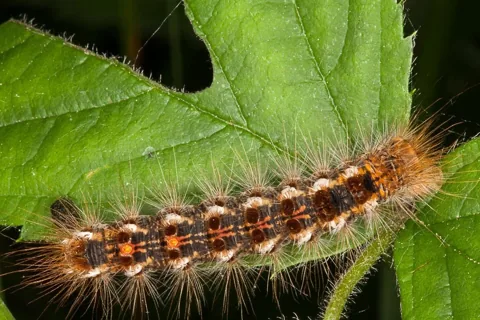 Browntail Moth
Euproctis chrysorrhoea
The browntail moth is an invasive moth whose caterpillars and cocoons carry toxic hairs that cause skin rashes and, if breathed in, breathing problems. The National Park Service calls it a pest of both human and forest health; Maine has had outbreaks for about a decade.
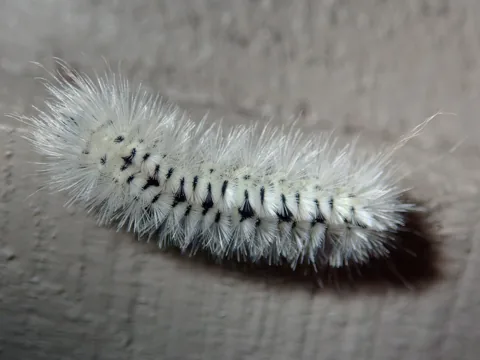 Hickory Tussock Moth
Lophocampa caryae
Hickory tussock moth caterpillars are fuzzy white and black caterpillars, often common in fall, whose loose, barbed hairs can lodge in skin and cause a local rash.
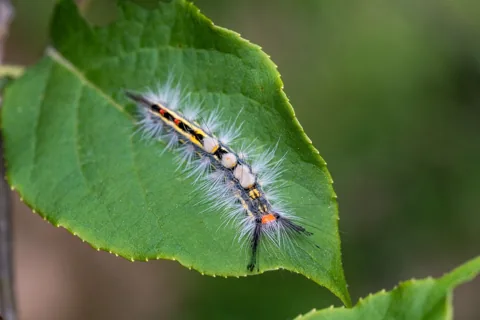 Tussock Moth Caterpillars (whitemarked tussock moth)
Orgyia leucostigma
Tussock moth caterpillars are hairy, brightly tufted caterpillars that feed on the leaves of many trees and shrubs. This page centers on the whitemarked tussock moth, a native species that can suddenly become abundant, and whose hairs can irritate skin.
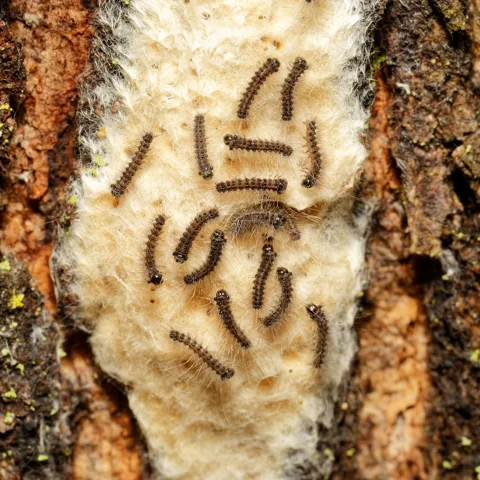 Spongy Moth
Lymantria dispar
The spongy moth, formerly called the gypsy moth, is an invasive defoliator from Europe whose caterpillars feed on the leaves of hundreds of kinds of trees and shrubs, oaks above all. Management changes with the season to target whichever life stage is present.
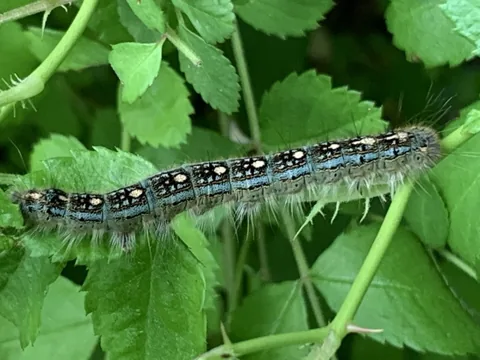 Forest Tent Caterpillar
Malacosoma disstria
Despite its name, the forest tent caterpillar doesn't build a tent, and it is often mistakenly called an armyworm because the caterpillars feed in groups. It is a native spring caterpillar that periodically defoliates aspen, oak, basswood, birch and other hardwoods, then crawls over buildings and roads in search of places to spin cocoons.
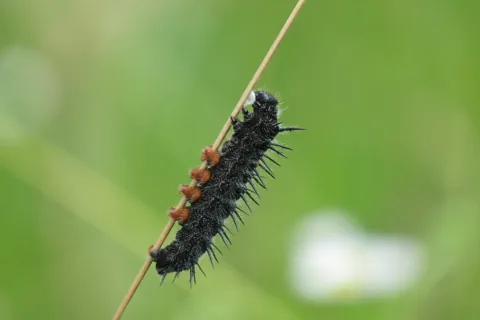 Spiny Elm Caterpillar (Mourning Cloak)
Nymphalis antiopa
The spiny elm caterpillar is the larva of the mourning cloak butterfly. Groups strip willow, elm and poplar branches, but they are usually not serious pests.
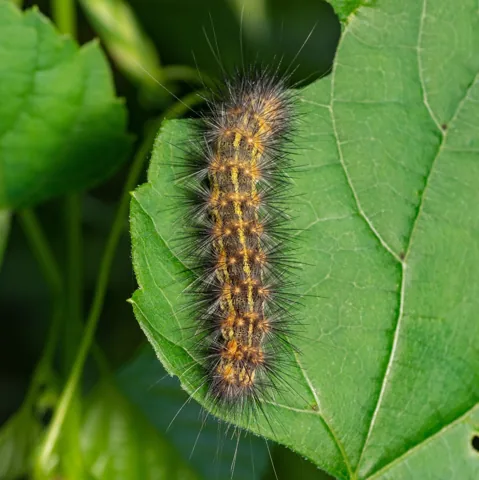 Saltmarsh Caterpillar
Estigmene acrea
The saltmarsh caterpillar is a very hairy, color-variable caterpillar that feeds mainly on broadleaf weeds such as pigweed and sometimes moves onto beans, lettuce, tomatoes, grapes and other crops. UC IPM calls it a sporadic, uncommon pest, and Utah State rates the threat as very low.
How a caterpillar stings
Stinging caterpillars do not sting like bees or wasps. Their weapons are hollow setae (hairs or spines) with a poison sac or gland at the base. Brushing against them snaps the brittle tips, which can stay in the skin while the toxin spills out. Only the caterpillar stage stings; the adult moths of these species do not.[3][1][2][9]
A second group, including tussock moths, the browntail moth and the forest tent caterpillar, has no venom spines but sheds fine barbed hairs that break off and irritate sensitive skin. These hairs are woven into the cocoons too, so a cocoon can cause a rash long after the caterpillar has gone.[9][12][8][15]
- Reactions range from mild itching to burning pain, swelling, blistering and, with some species, nausea or stomach upset. How bad it gets depends on the species, how firmly the caterpillar was pressed against the skin, and the person.[1][3][19]
- Bigger caterpillars give worse stings, and Kentucky says puss caterpillar stings are often more severe than those of other caterpillars. Mississippi State warns that dead puss caterpillars can still sting, and Forsyth County Extension notes that shed skins keep their stinging ability.[1][9][3]
- Spines are not a reliable warning sign. Many spiny caterpillars are harmless, and the hickory horned devil looks fierce but cannot hurt you. Poison Control's rule of thumb: brightly colored caterpillars with spines, bristles or a fuzzy look might be venomous, so don't touch them.[9][3][19]
Puss caterpillar, or asp (southern flannel moth)
Megalopyge opercularis. Clemson cites USDA that most caterpillar stings in the South come from puss caterpillars, and Texas A&M AgriLife calls it perhaps the most common stinging caterpillar in Texas.[2][10]
- ID marks: about 1 inch long, teardrop-shaped and covered in a dense, wooly coat of soft tan, grayish or brown hair that peaks over the back and tapers into a tail. The head is tucked underneath. The short venomous spines are hidden under the soft hair.[1][9][3][10]
- Where and when: on many broadleaf trees and shrubs, including oak, elm, hackberry, maple, sycamore and apple, and sometimes on azalea and yaupon holly in local outbreaks. NC State reports two generations a year in North Carolina, with caterpillars peaking in July and October. They are rarely seen in large numbers.[4][1][9]
- The sting: very painful, and on a leg or arm the pain can radiate into the groin or across the chest. Mississippi State says some people go to the hospital thinking they are having a heart attack, while others feel only mild stinging. NC State lists pain lasting several hours, swelling for several days, and in some people nausea, headache, fever, numbness and difficulty breathing; Forsyth County Extension gives pain lasting from one to twelve or more hours.[9][4][3]
- Relatives: the black-waved flannel moth caterpillar looks similar but lacks the long tail and usually stings less severely; young ones carry long, white wispy hairs. The white flannel moth caterpillar, up to 1-1/4 inch, is yellow with a wide black stripe down the back and tufts of hair, and its short, needle-like hairs at the base of the tufts sting. Both are late-summer caterpillars on hardwoods.[1][2]
Slug caterpillars (saddleback, spiny oak slug, stinging rose, hag moth)
Slug caterpillars (family Limacodidae) are short and stocky, about 0.4 to 1 inch long, with the head and legs hidden underneath, and glide over leaves like slugs. Young ones may feed in groups; older ones feed alone, often on the undersides of leaves and on lower, shaded branches. Grown caterpillars are mostly seen in late summer.[11][1][6]
Mississippi State lists crowned slugs among the state's stinging caterpillars as well.[9]
- Saddleback caterpillar (Acharia stimulea): about 3/4 to 1 inch. Brown at both ends and green in the middle, with a dark brown, white-edged oval 'saddle' spot on the green, and spiny horns at the front and rear. Found on many trees and shrubs (apple, basswood, cherry, dogwood, elm, maple, oak, plum) and sometimes on corn, mostly in late summer and fall. NC State says the sting causes immediate pain that spreads to nearby lymph nodes, with swelling and redness that can last more than a week.[7][3][1][2]
- Spiny oak slug (Euclea delphinii): about an inch long, pale yellow-green with a dark mottled stripe down the back, rows of spiny, yellowish or red lobes and four dark patches of spines toward the rear. Colors vary. Feeds on oak, beech, cherry, chestnut, pear, willow and other trees, and has been found as late as September. Kentucky rates it less venomous than the saddleback, but NC State says some very sensitive people need immediate medical treatment.[6][1]
- Stinging rose caterpillar (Parasa indetermina): about 1 inch, striped lengthwise in yellow and orange to red with a blue-purple stripe outlined in black down the back, and spiny horns at the front, middle and rear. On oak, redbud, hickory, wild cherry, sycamore and other trees and shrubs in summer and fall.[11][1]
- Hag moth or monkeyslug (Phobetron pithecium): an odd brown caterpillar that looks like a dried leaf, with nine pairs of fleshy lobes that all carry stinging hairs. Feeds on the undersides of leaves on lower branches of oak, chestnut, dogwood, sassafras, ash and other trees and shrubs.[1][6][9]
Io moth and buck moth (giant silkworm moths)
Most giant silkworm caterpillars are harmless; Kentucky says only two in that state have poisonous spines. Both carry clumps of branched spines.[1][2]
- Io moth (Automeris io): 2 to 2.5 inches when grown, the largest stinging caterpillar commonly met in South Carolina. Pale green to yellow-green with a red stripe edged in white along each side, and covered with branched, black-tipped spines. It eats a wide range of plants: corn, roses, willow, elm, oak, locust, apple, maple, cherry, clover and grasses.[1][2][3]
- Buck moth (Hemileuca maia): about 2 to almost 2.5 inches; dark, purplish-black to black and spiny, flecked with small white or yellow spots, with branched spines on rows of bumps. Young caterpillars feed in groups on oaks from spring to midsummer, and grown ones are often met when they crawl down from the tree to pupate in leaf litter or soil. One generation a year; the moths fly in fall.[1][5][10]
- The sting: NC State says buck moth stings cause immediate pain that spreads to nearby lymph nodes, with swelling and redness lasting over a week, and that some people need medical attention.[5]
Browntail moth (New England)
Euproctis chrysorrhoea is an invasive moth whose barbed caterpillar hairs are a public-health problem. Parts of Maine have had outbreak populations since about 2015 to 2016; in Massachusetts it has been confined to parts of Cape Cod and the North Shore, often on beach plum.[17][15]
- ID marks: about 1.5 inches, dark brown and hairy with white stripes and two bright red-orange spots, which set it apart from similar caterpillars.[17]
- When and where: caterpillars spend the winter in groups of 25-400 inside 2-4 inch webs of bright white silk wrapped around leaves at branch tips, often on apple or red oak. They come out to feed as leaves open in spring, are fully grown around June, and pupate in cocoons that are also full of irritating hairs.[15]
- The rash: contact with the caterpillars or their hairs can cause a rash similar to poison ivy, and hairs that blow in the wind can cause breathing trouble and headaches. Risk is highest from April through July according to the Park Service, May through July according to UMass, but hairs can be a problem any time of year.[17][15]
- Avoid infested areas, wear gloves, long sleeves and closed shoes around the caterpillars or cocoons, and wash exposed skin and clothing. Winter webs can be clipped and dropped in soapy water before the caterpillars come out; Acadia National Park removes webs in winter, when exposure risk is lowest.[15][17]
Tussock moths and other rash-causing caterpillars
These are the fuzzy caterpillars that cause outbreaks of itchy rash, especially among children. The rash often comes from the hairs, not a sting, and may appear minutes to hours after contact.[9][18][8]
- Hickory tussock moth (Lophocampa caryae): fuzzy white caterpillar with black tufts along the back and black hair 'pencils' at the front and back, up to 1.7 inches. Caterpillars are out July through September and are most noticed in fall, sometimes in large numbers, crawling off walnut, hickory and other trees to spin hairy cocoons. Found from Maine to North Carolina and west to Wisconsin and Illinois, less commonly into Texas.[12][13]
- Hickory tussock rash: a localized rash and itching. Penn State knows of no systemic allergic reaction to this species' hairs, and UMass calls severe allergic reactions rare. The cocoons can still cause exposure, for example when moving firewood, and may be found year-round.[12][13]
- White-marked tussock moth (Orgyia leucostigma): 1 to 1.5 inches, with two black hair 'pencils' reaching forward past the head, one at the rear, four dense white tufts on the back, and two bright red bumps toward the rear. Ranges through much of the eastern US and west to Texas and Colorado. Eggs hatch from about April to June; NC State reports two generations a year there.[8][18][14]
- White-marked tussock rash: welts may appear within minutes and fade by the next day, but itching can last several days. CDC describes a delayed, minor, itchy bumpy rash on the abdomen, chest, back, arms or legs without fever. Cocoons can cause the same symptoms even when a year old.[14][18][8]
- Spongy moth (Lymantria dispar, formerly gypsy moth): hairy caterpillar up to more than 3 inches, with five pairs of blue dots followed by six pairs of red dots down the back. UMass says a small percentage of people get itchy skin, or itchy eyes and a runny nose, from the hairs, mostly during outbreaks; Poison Control notes the hairs often blow on the breeze.[16][19]
- Others named by extension sources: the forest tent caterpillar (fine irritating hairs), the spiny elm caterpillar of the mourning cloak butterfly (reported to have venomous spines), the laurel cherry smoky moth (mild, short-lived nettling and small red welts) and dagger moth caterpillars.[9][3]
First aid for a caterpillar sting or rash
There is no antidote for a home kit. The aim is to get the broken spines or hairs out, wash off venom, and ease the pain. Kentucky says no home first aid is really effective, so expect relief, not a cure.[1][19]
- 1. Get the caterpillar off without bare hands. Use a stick or other tool; don't slap or brush it off with your hand. Spines can also break off in clothing and gloves.[19][1][3]
- 2. Tape out the spines. Press tape sticky side down on the area and pull it up; repeat with fresh pieces as needed. Almost any tape works: adhesive, transparent or duct tape. In one Poison Control case, nothing helped a saddleback sting until tape pulled the tiny hairs out, and the burning went away soon after. Penn State adds that hairs left after taping may need fine tweezers.[19][18][1][7][12]
- 3. Wash the area gently with soap and water. Poison Control and CDC tape first, then wash; NC State washes first, lets the skin air dry, then tapes off what remains. Loose hairs that haven't embedded usually wash off.[19][18][7][12]
- 4. Ice it. An ice pack reduces the stinging and swelling. Kentucky also mentions baking soda; Poison Control says ibuprofen or acetaminophen can help, and the pain usually improves within a few hours.[18][1][2][19]
- 5. For itching: Poison Control suggests hydrocortisone cream, then an oral or topical antihistamine if that doesn't help, and CDC mentions a low-potency steroid cream. Kentucky notes that antihistamines given for bee stings are reportedly ineffective against caterpillar stings. The sources differ here.[19][18][10][1]
- 6. Wash clothing that touched caterpillars or cocoons separately.[14]
When to get medical care
- Call 911 for trouble breathing, fainting, or swelling of the lips, face or tongue.[19]
- Get immediate care if hairs or spines get in the eyes, if hairs are swallowed, or if an allergic reaction develops.[10][12][18]
- See a health care provider or urgent care for a local allergic reaction, blistering around the sting, eye irritation that doesn't go away, or severe symptoms such as vomiting, headache, breathing trouble or signs of shock. CDC also advises calling a provider if the person has hay fever, asthma or allergies.[19][10][18][1]
- Check whether a tetanus booster is due.[19]
- Very young, elderly and unhealthy people are more likely to have severe reactions.[1][3]
- When in doubt, call Poison Control at 1-800-222-1222.[19]
Children and caterpillars
Children often get hurt because fuzzy caterpillars look soft enough to pick up or pet, the puss caterpillar especially. One Pennsylvania study found children accounted for 80% of hickory tussock moth exposures.[10][12]
- Teach children to leave caterpillars and cocoons alone, or to check with an adult before touching any caterpillar they don't know.[19][13][14]
- Rash outbreaks from white-marked tussock caterpillars have hit child care centers and schools. In Florida, children's rashes were misdiagnosed as chickenpox, scabies, flea bites and other illnesses, so they were treated for the wrong thing and kept out of child care unnecessarily. CDC's report says a mild itchy rash without fever during caterpillar season, with a chance of caterpillar contact, should raise suspicion; tell the doctor about any contact.[18][8]
- Florida health officials told affected centers to keep children away from caterpillars and cocoons, inform parents, and power-wash playground equipment to remove caterpillars, cocoons and hairs.[18]
- If a child eats a caterpillar: a swallowed caterpillar can get stuck and block breathing or swallowing and may need removal at a hospital. If nothing is blocked, reported cases have not led to serious problems. Swallowed hickory tussock hairs can cause drooling and irritability. Call Poison Control or get care.[19][12]
Do you need to spray?
- Usually not. Stinging caterpillars are seldom common, and Kentucky and Clemson do not recommend preventive sprays. A single caterpillar can be moved by clipping the leaf or twig it is on.[1][2]
- Where many caterpillars threaten people, such as around homes, schools or playgrounds, Kentucky suggests Bacillus thuringiensis or carbaryl. Bt works on young caterpillars, not old ones, and NC State says spraying mature, wandering tussock caterpillars is a waste of time. Always follow the label.[1][8][4]
- Wear gloves, long sleeves and a hat when working in shrubs and trees where these caterpillars feed; they rest on the undersides of leaves and are easy to miss.[19][6][15]
Fuzzy but harmless
Common questions
- What is the most venomous caterpillar in the US?
- Extension sources point to the puss caterpillar (southern flannel moth). Its stings are often more severe than other caterpillars', and the pain can radiate far from the spot that was touched.[1][9][3]
- How long does a caterpillar sting last?
- Poison Control says pain usually improves within a few hours. A puss caterpillar sting can hurt for several hours and swell for several days, and saddleback and buck moth stings can leave swelling and redness for more than a week.[19][4][7][5]
- Does tape really work on caterpillar spines?
- Yes. CDC, Poison Control and extension services all recommend pressing tape on the area and pulling it off repeatedly to remove the broken spines or hairs, then washing with soap and water.[18][19][1][2]
- Are fuzzy caterpillars poisonous to touch?
- Some are. Fuzzy puss caterpillars sting badly, and tussock and browntail caterpillars cause rashes, but many fuzzy caterpillars, such as the saltmarsh woolly bear, are harmless. If you can't identify it, don't touch it with bare hands.[10][9][19]
- Can a caterpillar cocoon cause a rash?
- Yes. Tussock and browntail caterpillars weave their irritating hairs into the cocoon. White-marked tussock cocoons can cause symptoms even after a year.[12][8][15]
Photo credits
- Puss Caterpillar (southern flannel moth): Center for Urban Ecology, public domain (CC0), via iNaturalist
- Black-waved Flannel Moth: (c) Jay Pruett, some rights reserved (CC BY) — via iNaturalist, CC BY 4.0
- White Flannel Moth: (c) Antonio Lupercio, some rights reserved (CC BY) — via iNaturalist, CC BY 4.0
- Saddleback Caterpillar: Dennis White, public domain (CC0), via iNaturalist
- Spiny Oak-Slug: (c) Evan M. Raskin, some rights reserved (CC BY) — via iNaturalist, CC BY 4.0
- Stinging Rose Caterpillar: Jess Miller-Camp, public domain (CC0), via iNaturalist
- Hag Moth Caterpillar: (c) Christopher Zacharias, some rights reserved (CC BY) — via iNaturalist, CC BY 4.0
- Crowned Slug Caterpillar: (c) Clay Gibbons, some rights reserved (CC BY) — via iNaturalist, CC BY 4.0
- Yellow-shouldered Slug Moth: (c) Theo Rickert, some rights reserved (CC BY) — via iNaturalist, CC BY 4.0
- Io Moth Caterpillar: (c) Eridan Xharahi, some rights reserved (CC BY) — via iNaturalist, CC BY 4.0
- Buck Moth Caterpillar: Jade Fortnash, public domain (CC0), via iNaturalist
- Browntail Moth: (c) Drepanostoma, some rights reserved (CC BY) — via iNaturalist, CC BY 4.0
- Hickory Tussock Moth: (c) Robert Roach, some rights reserved (CC BY) — via iNaturalist, CC BY 4.0
- Tussock Moth Caterpillars (whitemarked tussock moth): (c) DiegoH, some rights reserved (CC BY) — via iNaturalist, CC BY 4.0
- Spongy Moth: (c) Patrick Hanly, some rights reserved (CC BY) — via iNaturalist, CC BY 4.0
- Forest Tent Caterpillar: (c) Healthy Yards, some rights reserved (CC BY) — via iNaturalist, CC BY 4.0
- Spiny Elm Caterpillar (Mourning Cloak): Federico Del Barba, public domain (CC0), via iNaturalist
- Saltmarsh Caterpillar: (c) Justin Williams, some rights reserved (CC BY) — via iNaturalist, CC BY 4.0
Sources
- University of Kentucky Entomology, “ENTFACT-003: Stinging Caterpillars (R. Bessin).” entomology.mgcafe.uky.edu/ef003 (accessed 2026-11-10)
- Clemson University Home & Garden Information Center, “Stinging Caterpillars, HGIC 2482.” hgic.clemson.edu/factsheet/stinging-caterpillars/ (accessed 2026-11-10)
- N.C. Cooperative Extension, Forsyth County Center, “Do Venomous Caterpillars Live in Your Yard? (W. Hartup).” www.forsyth.cc/CES/documents/Stinging_Caterpillars.pdf (accessed 2026-11-10)
- NC State Extension, “Puss Caterpillar.” content.ces.ncsu.edu/puss-caterpillar (accessed 2026-11-10)
- NC State Extension, “Buck Moth.” content.ces.ncsu.edu/buck-moth (accessed 2026-11-10)
- NC State Extension, “Spiny Oakslug.” content.ces.ncsu.edu/spiny-oak-slug (accessed 2026-11-10)
- NC State Extension, “Saddleback Caterpillar.” content.ces.ncsu.edu/saddleback-caterpillar (accessed 2026-11-10)
- NC State Extension, “Whitemarked Tussock Moth.” content.ces.ncsu.edu/whitemarked-tussock-moth (accessed 2026-11-10)
- Mississippi State University Extension Service, “Bug's Eye View: Puss Caterpillar, Vol. 7, No. 19 (B. Layton).” extension.msstate.edu/newsletters/bugs-eye-view/2021/puss-caterpillar-vol-7-no-19 (accessed 2026-11-10)
- Texas A&M AgriLife Extension Service, “Watch out for fuzzy, stinging caterpillars (AgriLife Today).” agrilifetoday.tamu.edu/2022/04/14/start-looking-out-for-stinging-caterpillar (accessed 2026-11-10)
- University of Missouri Extension, “Caterpillars in Your Yard and Garden, IPM1019, page 43: Stinging rose caterpillar.” extension.missouri.edu/publications/ipm1019-43 (accessed 2026-11-10)
- Penn State Extension, “Hickory Tussock Moth Caterpillar.” extension.psu.edu/hickory-tussock-moth-caterpillar (accessed 2026-11-10)
- UMass Extension Landscape, Nursery and Urban Forestry Program, “Insect & Mite Guide: Lophocampa caryae (hickory tussock moth).” www.umass.edu/agriculture-food-environment/landscape/publications-resources/insect-mite-guide/lophocampa-caryae (accessed 2026-11-10)
- UMass Extension Landscape, Nursery and Urban Forestry Program, “Insect & Mite Guide: Orgyia leucostigma (white-marked tussock moth).” www.umass.edu/agriculture-food-environment/landscape/publications-resources/insect-mite-guide/orgyia-leucostigma (accessed 2026-11-10)
- UMass Extension Landscape, Nursery and Urban Forestry Program, “Insect & Mite Guide: Euproctis chrysorrhoea (browntail moth).” www.umass.edu/agriculture-food-environment/landscape/publications-resources/insect-mite-guide/euproctis-chrysorrhoea (accessed 2026-11-10)
- UMass Extension Landscape, Nursery and Urban Forestry Program, “Insect & Mite Guide: Lymantria dispar (spongy moth).” www.umass.edu/agriculture-food-environment/landscape/publications-resources/insect-mite-guide/lymantria-dispar (accessed 2026-11-10)
- U.S. National Park Service, “Browntail Moth in Acadia: 2025 Management Update.” www.nps.gov/articles/000/browntail-moth-in-acadia.htm (accessed 2026-11-10)
- Centers for Disease Control and Prevention, “Caterpillar-Associated Rashes in Children, Hillsborough County, Florida, 2011 (MMWR 61(12)).” www.cdc.gov/mmwr/preview/mmwrhtml/mm6112a3.htm (accessed 2026-11-10)
- Poison Control, National Capital Poison Center, “Are caterpillars poisonous?.” www.poison.org/articles/caterpillar-stings (accessed 2026-11-10)