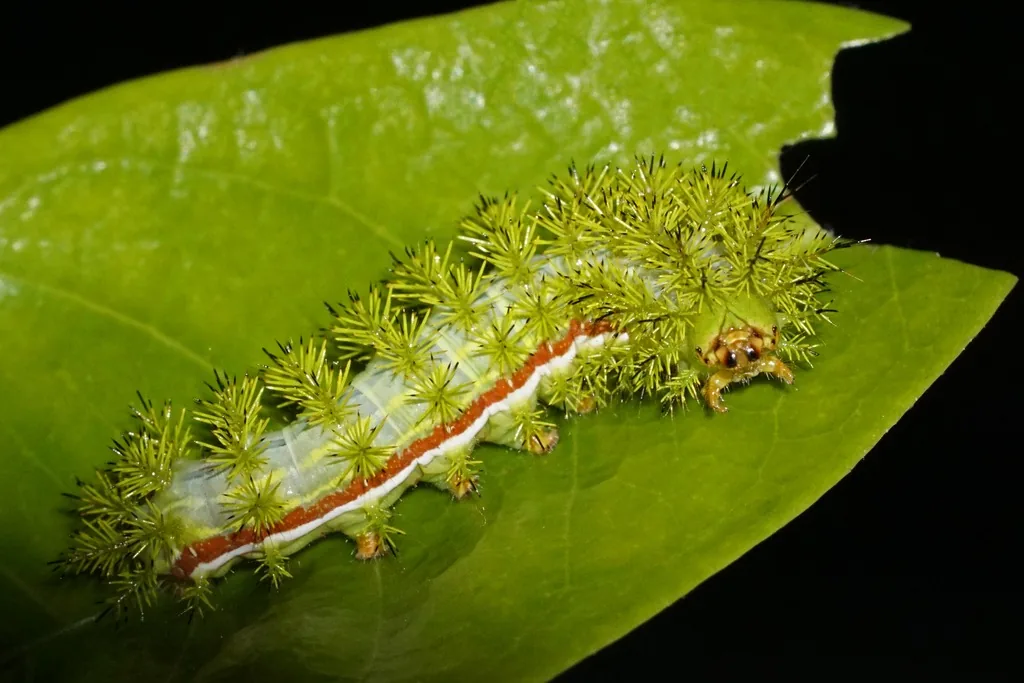
How to identify it
- Full-grown caterpillars reach about 2 to 2 1/3 inches and are pale green, with a white stripe along each side bordered by red.[1][3][2]
- Clusters of branched yellow or green spines with black tips cover nearly the whole body. These are the venomous spines.[1][3][2]
- The true legs and the fleshy rear legs are reddish, and there are reddish patches low on the sides.[1]
- Young caterpillars start out reddish or dark brown and turn more yellowish or orange-brown as they grow.[1][2]
- The adult is a 2- to 3-inch moth with a large black-and-white eyespot on each hind wing. Males have yellow forewings and females red-brown ones.[1]
Look-alikes
| Look-alike | How to tell them apart |
|---|---|
| Buck moth caterpillar | Black or purplish black with many small light spots and branched dark spines, and it feeds mainly on oaks in spring.[3][2] |
| Saddleback caterpillar | Short and slug-like, brown at both ends with a green middle 'saddle' and spiny horns front and rear.[3] |
| Puss caterpillar | Looks like a tuft of soft brown fur; its stinging spines are hidden under long silky hairs.[3] |
Where it lives
Southern Canada through the eastern United States to eastern Mexico. It has become rare in most of New England and has declined in the Gulf States since the 1970s.[1]
Biology and life cycle
Females lay clusters of eggs, usually on the undersides of leaves. They hatch in 8 to 11 days, and the new caterpillars eat their eggshells first.[1]
Young caterpillars stay in groups and march in single file along silk trails to new feeding spots.[1]
They feed on many plants, including maples, redbud, cherries, willows, elms, hackberry, wisteria, hibiscus, roses, clover and corn.[1][2][3]
Grown caterpillars crawl down from the plant and spin thin, papery cocoons in leaf litter or sheltered crevices.[1]
Northern populations have one generation a year; the Gulf States and north Florida probably have two, and south Florida four or five.[1]
Adults don't feed, live only a short time and fly at night. When threatened they flash the eyespots on their hind wings.[1]
Damage and signs
- Io caterpillars are rarely numerous enough to need control on crops. Control is only worth considering when they pose a stinging hazard on landscape plants.[1]
Health risk
A sting causes almost immediate burning pain and itching, then a raised welt with surrounding redness. Pain usually fades within a couple of hours and the welt within 6 to 8 hours; whole-body symptoms are rare, but watch for allergic reactions.[1][2]
Control
Prevention
Most stings come from brushing against leaves where caterpillars are feeding. Their bright warning colors make them easy to spot and avoid if you look first.[3]
Traps and physical control
Don't brush one off bare-handed; use a stick. A single caterpillar can be moved by clipping the leaf or stem it is on.[3]
Pesticides
Preventive sprays aren't recommended. Where stinging caterpillars are numerous around homes, schools or play areas, Bacillus thuringiensis or carbaryl can be used, following the label.[3][1]
First aid for an io caterpillar sting
Press cellophane or adhesive tape on the area and pull it off to strip out broken spine tips.[1][3]
Washing with soap and water may remove some venom, and an ice pack helps limit swelling and pain.[3][1]
Antihistamines don't appear to help: injections of diphenhydramine at sting sites failed to block reactions in volunteers.[1][3]
See a physician for a severe reaction. Very young, elderly or unhealthy people are more likely to react badly.[3]
Common questions
- Can the io moth itself sting?
- No. Only the caterpillar stage has stinging spines; the adult moths don't.[3]
- How common are io caterpillar stings?
- Not very. In a Louisiana study of 112 caterpillar stings, 11 percent were from io caterpillars, though stings are likely underreported.[1]
- Why are tiny caterpillars marching in a line?
- Young io caterpillars travel together in a line, following silk trails to new leaves. Even these small ones can sting.[1]
Sources
- University of Florida/IFAS Extension (EDIS), “Io Moth, Automeris io (Fabricius), Featured Creatures EENY-608 / IN1065.” edis.ifas.ufl.edu/publication/IN1065 (accessed 2026-10-06)
- University of Florida/IFAS Extension (EDIS), “Stinging and Venomous Caterpillars of the Southeast (IN014).” edis.ifas.ufl.edu/publication/IN014 (accessed 2026-10-06)
- University of Kentucky Entomology, “ENTFACT-003: Stinging Caterpillars.” entomology.mgcafe.uky.edu/ef003 (accessed 2026-10-06)
- iNaturalist, “Automeris io taxon page (order and family).” www.inaturalist.org/taxa/82279 (accessed 2026-10-06)