How to identify it
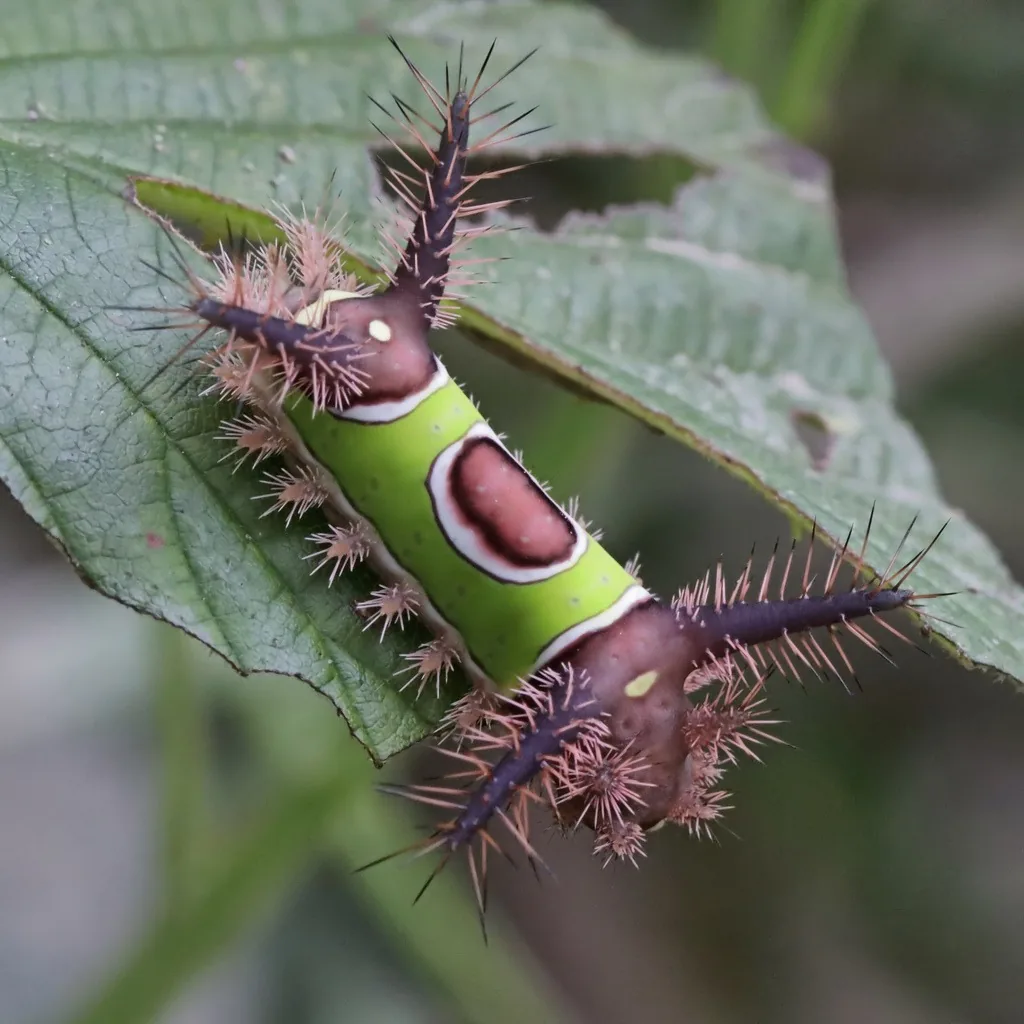
- A short, stocky, slug-like body, brown at both ends with a bright green middle section edged in white.[1][2]
- A purple spot sits in the center of the green saddle.[2]
- Fleshy horns at the front and rear carry long hairs and clusters of stinging spines.[1][2]
- Full-grown caterpillars are only about 0.8 inch long; the head and legs are hidden underneath and it glides like a slug.[1][2]
Look-alikes
| Look-alike | How to tell them apart |
|---|---|
| Spiny oak slug | Pale yellow-green with four dark patches of spines toward the rear and many yellow or red spiny lobes; it is less venomous than the saddleback.[2] |
| Stinging rose caterpillar | Yellow to red, with black and blue stripes down the back and spiny yellow horns at the front, middle and rear.[2] |
| Other caterpillars | Most caterpillar spines are harmless show, but the saddleback's hollow spines are connected to venom sacs.[2] |
Where it lives
Eastern United States, from Florida north to New York and Massachusetts and west to Texas, Indiana and Kansas.[1]
Biology and life cycle
Females lay clusters of 30 to 50 eggs on the upper sides of leaves, and larvae hatch in about ten days.[1]
Larvae feed for about four to five months; young ones feed in groups and leave see-through 'windows' between leaf veins.[1]
It feeds on many plants, including maples, oaks, cherry, plum, ornamentals, palms and sometimes corn.[1][2]
Grown larvae spin tough silk cocoons, overwinter as pupae in temperate areas, and have one generation a year.[1][2]
The adult is a furry, dark brown moth with small white dots on the forewings; adults don't sting.[1][2]
Damage and signs
- It isn't a significant defoliator of any one plant; its importance is the sting hazard to people working around infested plants.[1]
Health risk
Spines break off in skin, causing immediate intense burning, redness and sometimes blisters. Severe reactions can include headache, stomach upset, asthma problems or anaphylaxis. See a physician for severe reactions.[1][2]
Control
Prevention
Wear long sleeves, pants and gloves where you might brush against infested plants, and learn to recognize the bright warning colors.[1][2]
Traps and physical control
Never brush one off bare-handed; use a stick. Clip and relocate the leaf or stem holding a single caterpillar, or remove eggs, larvae or cocoons with protective gear.[2][1]
Pesticides
Preventive sprays aren't recommended. Where caterpillars are numerous near homes, schools or play areas, Bacillus thuringiensis or carbaryl can be used, following the label.[2][1]
First aid for a saddleback sting
Remove embedded spines first; the longer they stay in the skin, the more venom is delivered. Adhesive or clear tape can pull out broken spines.[1][2]
Wash the area thoroughly with soap and water, and apply an ice pack or baking soda promptly to ease pain and swelling.[2]
Antihistamines often used for bee and wasp stings are reportedly ineffective for caterpillar stings. See a physician if a severe reaction occurs.[2][1]
Loose spines can stay hazardous on clothing, gloves, tables and other surfaces, so clean them afterward.[1][2]
Common questions
- Does insect repellent prevent saddleback stings?
- No. Personal repellents such as DEET are not effective against saddleback caterpillars; protective clothing is.[1]
- Is the saddleback the worst stinging caterpillar?
- It is among the most important in North America; only flannel moth caterpillars, such as the puss caterpillar, are considered more dangerous.[1]
Sources
- University of Florida/IFAS Extension (EDIS), “Saddleback Caterpillar, Acharia stimulea (Clemens), Featured Creatures EENY522 / IN923.” edis.ifas.ufl.edu/publication/IN923 (accessed 2026-10-06)
- University of Kentucky Entomology, “ENTFACT-003: Stinging Caterpillars.” entomology.mgcafe.uky.edu/ef003 (accessed 2026-10-06)
- iNaturalist, “Acharia stimulea taxon page (order and family).” www.inaturalist.org/taxa/122228 (accessed 2026-10-06)