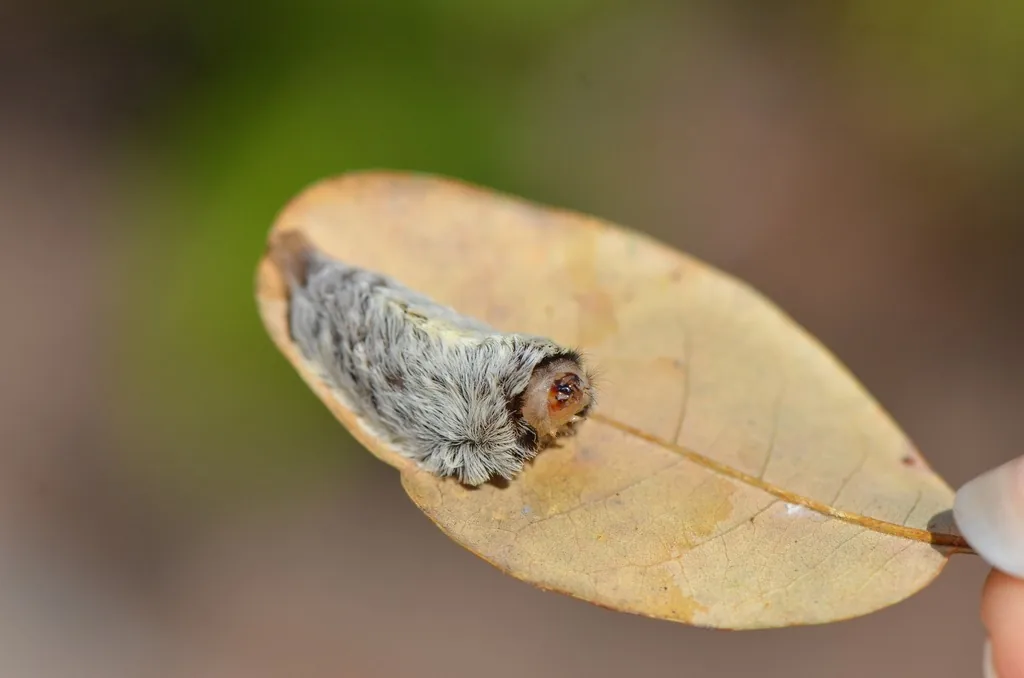
How to identify it
- A plump caterpillar about 1 inch long, or a bit more when full grown, covered in a dense coat of soft hair with a tail-like tuft at the rear.[3][1]
- The hair is usually brown, though color varies; the body is normally hidden under it, and the head shows only when it moves or feeds.[3][1]
- The short, hollow venomous spines are hidden beneath the long silky hairs, each with a venom gland at its base.[3][1]
- The adult southern flannel moth is small and furry, with yellow front wings marked with wavy white hairs and black along the front edge.[1]
Look-alikes
| Look-alike | How to tell them apart |
|---|---|
| Black-wave flannel moth caterpillar | Very similar when mature, but younger larvae bear long, white wispy hairs; its sting is usually not as severe.[3] |
| White flannel moth caterpillar | Yellow, with a wide black stripe down the back bordered with red at each end and rows of raised yellow tufts.[3] |
| Other caterpillars | Most caterpillar hairs and spines are harmless, but flannel moth caterpillars hide stinging spines under soft hair.[3] |
Where it lives
New Jersey to Florida and west to Arkansas and Texas; common in Florida and most abundant in central Texas from Dallas southward.[1]
Biology and life cycle
Two generations a year, with caterpillars peaking around July and October; a partial third brood may occur in the Deep South.[2][1]
It feeds on many trees and shrubs, especially oaks, elms, hackberry, maple and sycamore. Young larvae skeletonize leaves and older ones eat whole leaves.[2][1][3]
Mature larvae may wander off the host plant and spin cocoons on nearby plants or buildings.[1]
Cocoons are tough, with a hump on the back and a round lid the moth pushes open; fall larvae overwinter inside them.[1][2]
Damage and signs
Health risk
Brushing one causes immediate intense, burning pain, often a red grid-like pattern and swelling lasting days. Headache, fever, nausea, vomiting, chest pain or breathing difficulty can follow. Sting severity increases with caterpillar size.[1][2][3]
Control
Prevention
Learn to recognize puss caterpillars and avoid brushing against leaves they feed on, especially on oaks and elms during the summer and fall peaks.[3][1][2]
Traps and physical control
Don't brush one off with a bare hand; use a stick, or clip and relocate the leaf or stem it is on.[3]
Pesticides
Preventive sprays aren't recommended. Where they are numerous around homes or schools, carbaryl or Bacillus thuringiensis can be used, though Bt works poorly on older caterpillars.[3][2]
First aid for a puss caterpillar sting
Use adhesive or clear tape to pull broken spine tips from the skin, then wash the area thoroughly with soap and water.[3][1]
An ice pack applied promptly may help reduce pain and swelling.[3][1]
Remedies reviewed in the medical literature that may help in some cases include oral antihistamines and hydrocortisone cream; doctors may also use corticosteroids or intravenous calcium gluconate.[1]
See a physician for severe reactions; very young, older or unhealthy people are more likely to react severely.[3]
Common questions
- Why is it called a puss caterpillar?
- Its thick, fluffy hair looks like a cat's fur, and the hairy tail adds to the resemblance. It is also called an asp.[2][1]
- Can a shed skin or a small caterpillar still sting?
- Yes. All larval stages, and even shed skins, can sting, though stings get stronger as caterpillars grow.[1]
- Does the flannel moth sting?
- No. Only the caterpillar stage has stinging spines; the adult moths don't sting.[3]
Sources
- University of Florida/IFAS Extension (EDIS), “Puss Caterpillar (Larva), Southern Flannel Moth (Adult), Megalopyge opercularis, Featured Creatures IN976.” edis.ifas.ufl.edu/publication/IN976 (accessed 2026-10-06)
- NC State Extension, “Puss Caterpillar (PDIC Factsheet, reviewed May 8, 2023).” content.ces.ncsu.edu/puss-caterpillar (accessed 2026-10-06)
- University of Kentucky Entomology, “ENTFACT-003: Stinging Caterpillars.” entomology.mgcafe.uky.edu/ef003 (accessed 2026-10-06)
- iNaturalist, “Megalopyge opercularis taxon page (order and family).” www.inaturalist.org/taxa/84185 (accessed 2026-10-06)