How to identify it
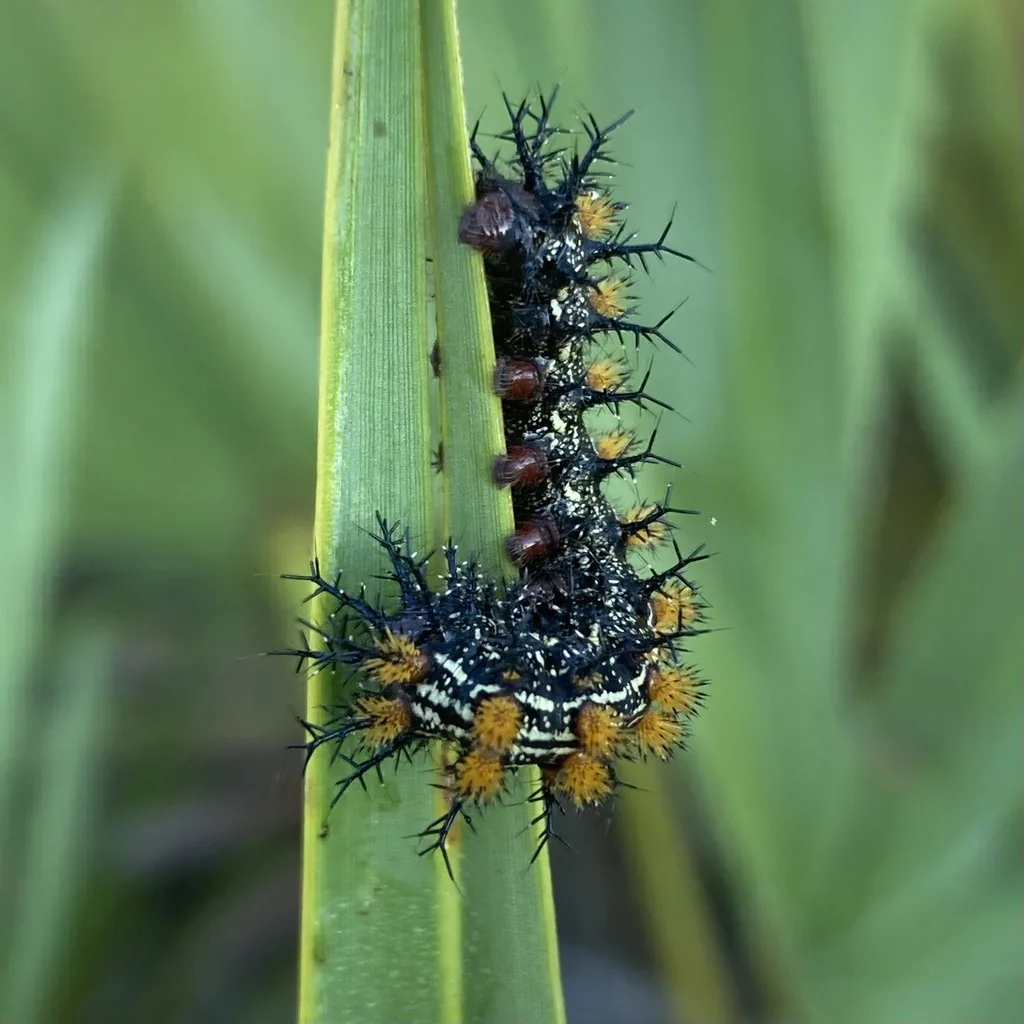
- Grown caterpillars are about 2 to 2 1/2 inches long. The common dark form is black, heavily speckled with tiny white spots; a lighter form is nearly white with a reddish head.[1][2][3]
- Branched spines sit on raised bumps in several rows along the body; the rows along the back are longer and more branched.[1][2]
- Kentucky's description is brown to purplish black with yellow spots, and spines that may have red or black tips, so coloring varies.[4]
- Young caterpillars feed in groups; older ones split up and wander alone.[2][1]
- The adult is a 2- to 3-inch black moth with a narrow white band and an eyespot on each wing. Males have a red-tipped abdomen.[1][2]
Look-alikes
| Look-alike | How to tell them apart |
|---|---|
| Io moth caterpillar | Pale green with a red and white stripe along each side and black-tipped yellow spines.[4][3] |
| Nevada and New England buck moth caterpillars | Light-colored buck moth caterpillars resemble these relatives; host plants separate them, since those feed mainly on willow or meadowsweet, and the buck moth's spines are longer.[1] |
| Saddleback caterpillar | Short and slug-shaped, brown at each end with a green middle and a purple spot in the 'saddle.'[4] |
Where it lives
Eastern United States from Maine to Florida, with records as far west as Wisconsin, Kansas and Texas.[1]
Biology and life cycle
Unlike most giant silkworm moths, females lay eggs in fall, in a tight ring around an oak twig. The eggs spend the winter there and hatch in spring as new leaves appear.[2][1]
Caterpillars stay in groups for their first three stages, then disperse and wander onto other plants to finish feeding.[1]
They feed mainly on oaks, such as scrub oak, live oak, blackjack oak and dwarf chestnut oak, and also on willow.[2][1][3]
Grown caterpillars crawl down and pupate in leaf litter or a few inches into loose soil.[2][1]
Moths emerge from September through December, though some wait one or two years. There is one generation a year.[2][1]
Adults have no working mouthparts and don't feed. They fly fast in sunny oak woods, mostly around midday.[1]
Damage and signs
- Caterpillars can be common on oak or willow from spring to midsummer. People most often meet them when mature caterpillars leave the trees looking for a place to pupate.[4]
Health risk
A sting causes immediate pain that can spread to nearby lymph nodes, followed by swelling and redness lasting from a day to over a week. Severe reactions such as anaphylaxis are rare, but some sensitive people need medical attention.[1][2]
Control
Prevention
Not handling spiny caterpillars is one of the best ways to avoid stings. Be watchful under oaks and willows in spring and early summer, when grown caterpillars wander off the trees.[1][2][4]
Traps and physical control
Use a stick, never a bare hand, to move a caterpillar that lands on you. A single caterpillar can be relocated by clipping the leaf or twig it is on.[4]
Pesticides
Buck moth caterpillars aren't especially resistant to insecticides. Bacillus thuringiensis works on young caterpillars, and carbaryl or another labeled insecticide can be used where they threaten people.[2][4]
Preventive sprays aren't recommended for stinging caterpillars; treat only where they are numerous around homes, schools or recreation areas.[4]
First aid for a buck moth sting
Wash the site right away to remove loose spines, then let it air-dry rather than rubbing it with a towel.[1][2]
Pull out remaining spines with an adhesive tape such as duct tape, then apply an ice pack to ease the pain.[1][2]
Antihistamines often used for bee and wasp stings are reportedly ineffective for caterpillar stings. See a physician if a severe reaction occurs.[4]
Common questions
- Why is it called a buck moth?
- The adult moths fly during the day in fall, during deer season, when most other moths aren't flying.[2]
- Do the adult moths sting?
- No. Only the caterpillar stage has stinging spines.[4]
- When are buck moth caterpillars around?
- Eggs hatch in spring, and caterpillars can be found from spring into midsummer before they pupate.[4][1]
Sources
- University of Florida/IFAS Extension (EDIS), “Buck Moth, Hemileuca maia (Drury), Featured Creatures EENY-464 / IN834.” edis.ifas.ufl.edu/publication/IN834 (accessed 2026-10-06)
- NC State Extension, “Buck Moth (PDIC Factsheet, reviewed October 3, 2026).” content.ces.ncsu.edu/buck-moth (accessed 2026-10-06)
- University of Florida/IFAS Extension (EDIS), “Stinging and Venomous Caterpillars of the Southeast (IN014).” edis.ifas.ufl.edu/publication/IN014 (accessed 2026-10-06)
- University of Kentucky Entomology, “ENTFACT-003: Stinging Caterpillars.” entomology.mgcafe.uky.edu/ef003 (accessed 2026-10-06)
- iNaturalist, “Hemileuca maia taxon page (order and family).” www.inaturalist.org/taxa/1587238 (accessed 2026-10-06)