The short answer
- Leave alone: monarch caterpillars on milkweed, swallowtail caterpillars (including the parsleyworm on dill, parsley and fennel), and woolly bears crossing the road in fall. Don't spray plants you grow for butterflies.[1][4][6][9]
- Garden pests: hornworms on tomatoes, velvety green cabbageworms on cabbage and broccoli, and cutworms that cut seedlings off at the soil line. Handpicking handles most of them.[11][13][16][1]
- Lawn pests: armyworms, which can turn a lawn brown within hours, often in late summer. Sod webworms are covered in our lawn guide.[17]
- Tree and shrub pests: tent caterpillars and fall webworms (silk nests), bagworms (bags hanging on evergreens) and codling moth (the worm in the apple).[18][20][21][23]
- Stinging: the puss caterpillar, saddleback, io moth caterpillar and a few others have venomous spines or hairs. Don't handle a hairy or spiny caterpillar you can't name.[25][26][10]
- If you treat, Bt (Bacillus thuringiensis kurstaki) kills only caterpillars, but it works only when they eat it and works best on small ones.[1][29]
Caterpillar profiles
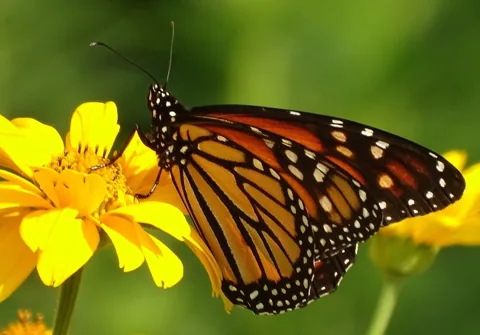 Monarch Butterfly
Danaus plexippus
The monarch is a large orange-and-black butterfly whose caterpillars feed only on milkweeds. North America has two migratory populations: eastern monarchs overwinter in mountain forests of central Mexico and western ones in groves on the California coast.
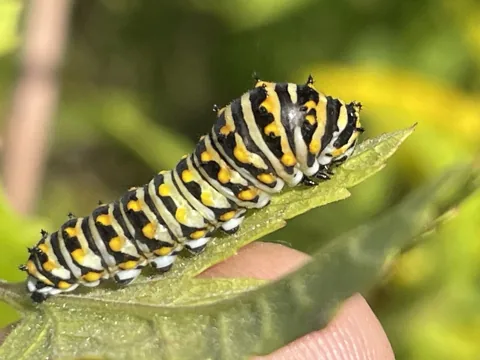 Eastern Black Swallowtail
Papilio polyxenes asterius
Eastern black swallowtail caterpillars, often called parsleyworms, feed on dill, parsley, fennel and other carrot-family plants. They are usually not numerous enough to be a real problem.
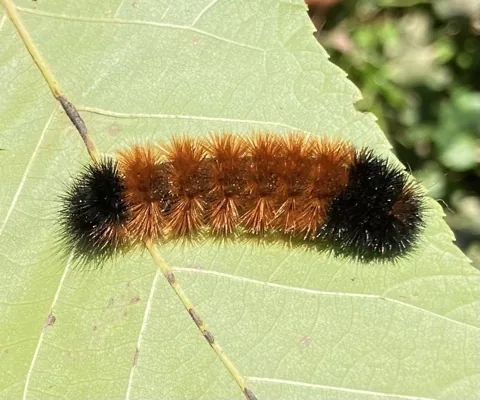 Banded Woolly Bear
Pyrrharctia isabella
The banded woolly bear is the fuzzy caterpillar of the Isabella tiger moth, famous in folklore for predicting winter. Most are noticed in fall, crossing roads in search of a sheltered spot to spend the winter.
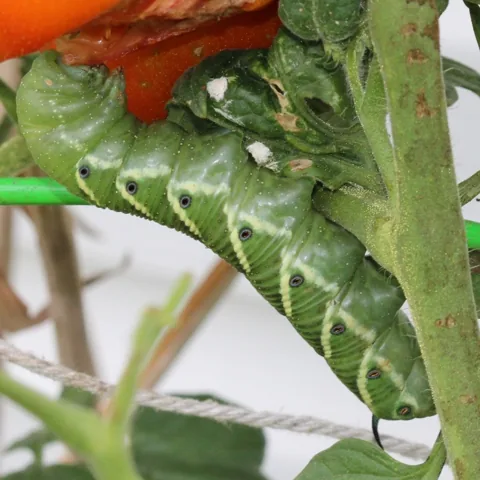 Tomato Hornworm
Manduca quinquemaculata
The tomato hornworm is one of the largest caterpillars in the vegetable garden, up to about 4 inches long, with a horn at its rear end. It chews leaves and fruit of tomato and related plants and can defoliate them quickly.
 Imported Cabbageworm
Pieris rapae
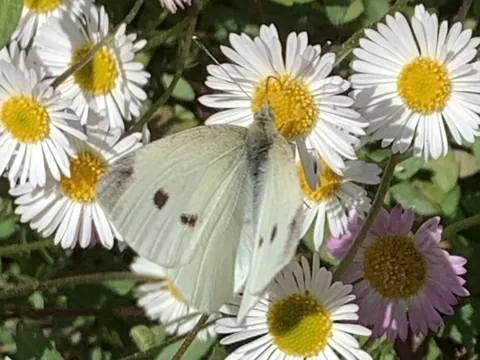
The imported cabbageworm is the caterpillar of the familiar small white butterfly, the cabbage white. It chews ragged holes in cabbage, broccoli, cauliflower, kale and other cole crops, and it bores into heads as it grows.
 Cutworms
Several moth species, e.g., black cutworm (Agrotis ipsilon)
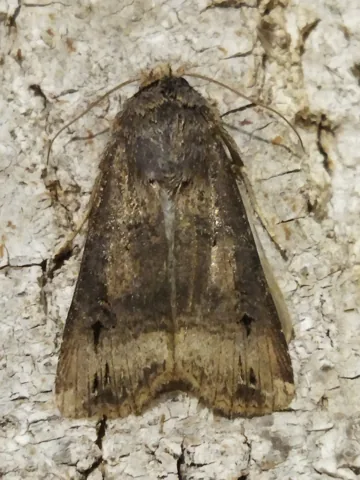
Cutworm is a general name for the caterpillars of dozens of moth species. They earned the name by cutting off young plants at or just below the soil line, and seedlings and fresh transplants suffer most.
 Fall Armyworm
Spodoptera frugiperda
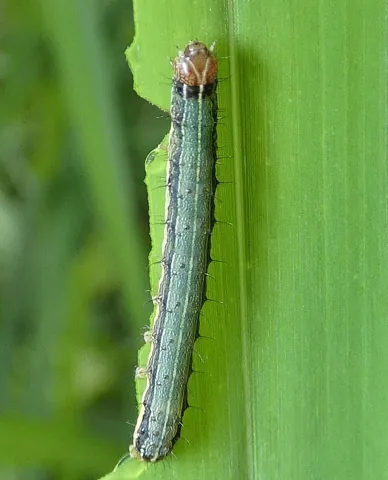
Fall armyworms are moth caterpillars that prefer grasses. Often noticed in late summer, large numbers can turn a green lawn brown in a few hours or practically overnight, and they feed and move in groups, which is how they earned the armyworm name.
 Eastern Tent Caterpillar
Malacosoma americana
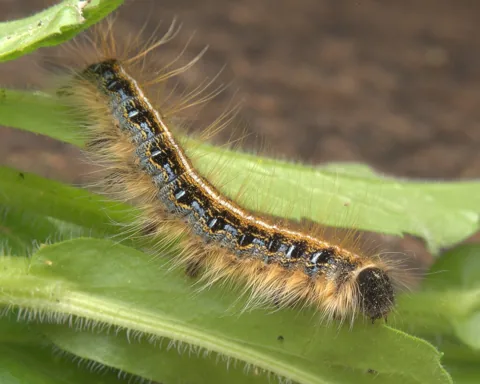
Eastern tent caterpillars build silk tents in the crotches of wild cherry, apple and crabapple in spring. They can nearly defoliate a tree, but the tree usually recovers and puts out new leaves. It is a native insect with many natural enemies, and often no spraying is needed.
 Fall Webworm
Hyphantria cunea
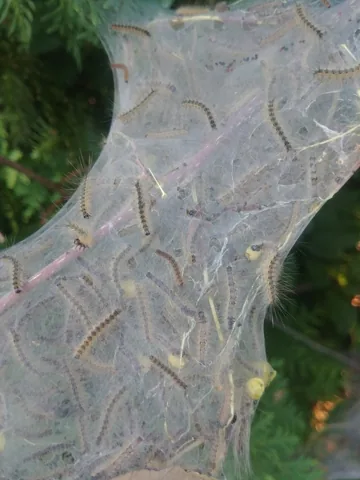
The fall webworm is a native caterpillar that spins large, loose webs over the ends of branches on a long list of deciduous trees and shrubs. The webs look alarming from midsummer into fall, but on healthy, established trees the damage is mostly cosmetic.
 Bagworm
Thyridopteryx ephemeraeformis
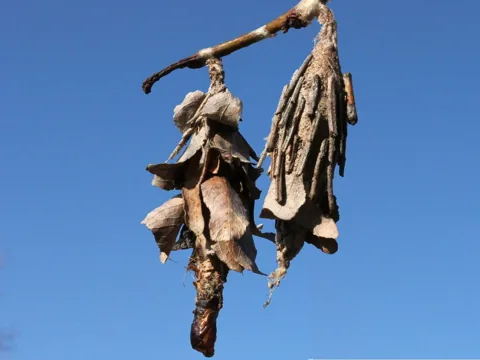
Bagworms are caterpillars that build spindle-shaped bags of silk and bits of plant material and feed from inside them. Ohio State says they are hard to control because they often go unnoticed until the larvae are mature, by which time arborvitae, cedar or juniper can be badly defoliated; Missouri Extension notes complete defoliation is not uncommon.
 Codling Moth
Cydia pomonella
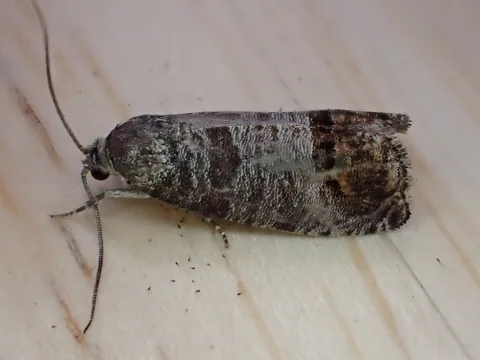
Codling moth is the infamous worm in the apple. Its caterpillars bore into apples, pears and English walnuts soon after hatching and tunnel toward the core, leaving holes packed with reddish-brown droppings.
 Puss Caterpillar (southern flannel moth)
Megalopyge opercularis
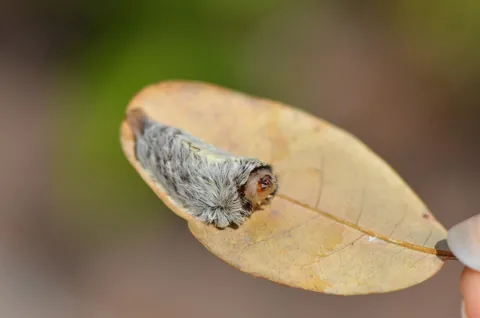
The puss caterpillar is the larva of the southern flannel moth. Its soft, fur-like coat hides short venomous spines, and medical reviews count it among the most serious stinging caterpillars in North America.
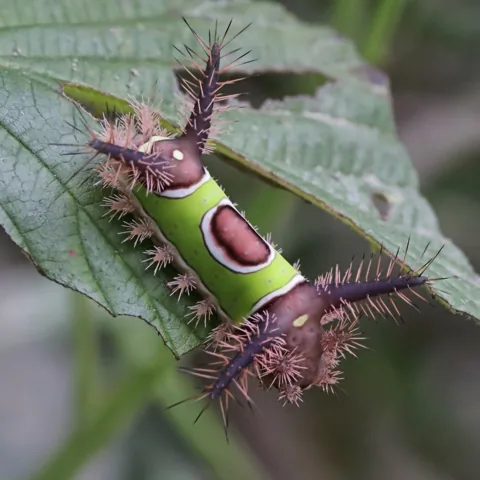 Saddleback Caterpillar
Acharia stimulea
The saddleback caterpillar is a slug caterpillar, a stinging moth larva named for the saddle-shaped spot in the middle of its green back. Clemson calls it the most common slug caterpillar, and poison center records list it among the caterpillars that actually cause stings.
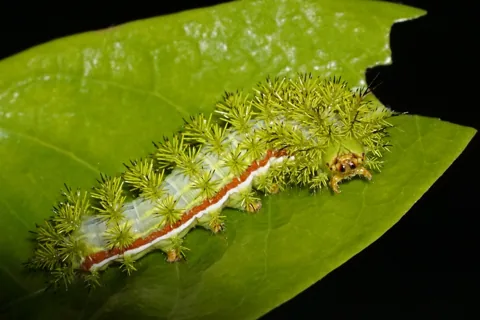 Io Moth Caterpillar
Automeris io
The io moth caterpillar is the larva of a giant silkworm moth. Most giant silkworm caterpillars are harmless, but this one carries stinging spines, and Clemson calls it the largest stinging caterpillar commonly encountered in South Carolina.
Is it a caterpillar or a sawfly larva?
Count the fleshy, leg-like bumps (prolegs) on the back half of the body. Butterfly and moth caterpillars have 2 to 5 pairs; sawfly larvae, which look very similar, have 6 or more pairs. The difference matters because Bt, the usual caterpillar spray, doesn't work on sawflies, which are larvae of non-stinging wasp relatives. Our sawfly guide covers those.[2][3]
Loopers, such as the cabbage looper, have just three pairs of prolegs, all at the rear, which makes them move in a looping pattern.[1]
Harmless caterpillars to leave alone
These turn into butterflies and moths people want around, or feed mostly on weeds. UC IPM advises against treating plants grown for butterflies, since that kills the caterpillars that become butterflies.[1][9]
- Monarch: white, black and yellow bands, with a pair of long black filaments near the head and a shorter pair near the rear; up to about 2 inches long. Found on milkweed, its required food plant. The milkweed chemicals it stores make it distasteful to many predators. Eggs hatch in about 4 days, and the caterpillar feeds for about 2 weeks before forming a chrysalis.[4][5]
- Black swallowtail (parsleyworm): young caterpillars are black and spiny with a white saddle, like a bird dropping; older ones are smooth and green with black bands dotted with yellow, reaching 1 1/2 to 2 inches. They feed on dill, parsley, fennel, celery, caraway and carrot. Wisconsin Extension says they're usually not numerous enough to be a real problem; if they are, pick them off and move them to wild host plants such as Queen Anne's lace.[6]
- Eastern tiger swallowtail: bright green with two large eyespots behind the head. Found on tulip tree, hop tree, cottonwood, ash, willow, apple and cherry.[7]
- Giant swallowtail (orange dog): brown and grayish-white, looking like a bird dropping. It feeds on citrus-family plants and is a pest in citrus groves in southern states, but elsewhere it feeds mostly on prickly ash and hop tree.[8]
- Any swallowtail caterpillar can push out a forked, orange or red, horn-like gland behind its head when disturbed. It smells bad to predators but is harmless to people.[6][7][8]
- Woolly bear (banded woollybear, Isabella tiger moth): stiff hairs, black at both ends and rusty red in the middle, a little over an inch long when grown. Usually seen in fall looking for a place to spend the winter, and it rolls into a ball when disturbed. It feeds on plantain, dandelion, dock and other weeds, so NC State Extension says spraying makes no sense. The band width doesn't forecast the winter; it changes with age and weather.[9][10]
Vegetable garden caterpillars
Clues that a caterpillar is feeding: holes in leaves, droppings (frass) on leaves below, and rolled or webbed leaves. A few leaf-feeding caterpillars usually aren't a concern, and handpicking and natural enemies often give enough control.[1]
- Tomato and tobacco hornworms: large green caterpillars with a horn on the rear end, among the largest caterpillars in Minnesota and Colorado (up to 3 inches by Colorado State's measure, up to 4 inches by Minnesota's). Tomato hornworms have V-shaped white marks on the sides; tobacco hornworms have diagonal white dashes and a red-sided horn. They blend in with the leaves and can strip a plant. If a hornworm is covered in what look like grains of white rice, those are parasitic wasp cocoons: leave it, so the wasps can emerge and attack other hornworms.[11][12]
- Imported cabbageworm: velvety green, up to 1 inch long, with a faint yellow stripe down the back; sluggish. It chews large holes in cabbage, broccoli and other cole crops, bores into heads and leaves greenish-brown droppings. The adult is a white butterfly with one to four black spots on the wings.[13][14]
- Cutworms: dull brown or gray, smooth-skinned, 1 to 2 inches long, curling into a tight C when disturbed. They hide in or on the soil by day and feed at night, chewing through young plants just above the soil line.[15][16]
- Armyworms: UC IPM lists beet armyworm as a common pest of vegetables and flowers. Armyworms can be told from other caterpillars by an upside-down Y on the head.[1][17]
Lawn caterpillars: armyworms and sod webworms
Fall armyworm is the caterpillar most often behind sudden lawn damage in South Carolina, often noticed in late summer, when it can turn green turf brown within hours. Larvae reach about 1 1/2 inches and have the inverted Y on the head. Moths may lay up to 1,000 eggs in a night, sometimes on fence posts and house siding. Our lawn guide covers the soap flush test for armyworms and sod webworms and when treatment is worth it.[17]
Caterpillars on trees, shrubs and fruit
Silk nests, bags and wormy fruit are the usual signs. Tent caterpillars and fall webworms can strip branches, but Kentucky and Penn State Extension say the trees usually recover; bagworms are more serious on evergreens, and codling moth ruins apples from the inside.[18][20][22][23][24]
- Eastern tent caterpillar: hairy, black with a solid white stripe down the back, with yellow lines and blue spots on the sides; about 2 inches long when grown by Penn State's measure, 2 to 2 1/2 inches by Kentucky's. Groups build silk tents in the forks and crotches of branches, most often on wild cherry, apple and crabapple, in spring and early summer. Trees stripped of leaves usually leaf out again.[18][19]
- Forest tent caterpillar: similar, but with a row of white spots down the back instead of a solid line.[19]
- Fall webworm: hairy, usually greenish with a broad dark stripe and yellow side stripes. It builds loose webs over the ends of branches that enclose the leaves, from late summer into fall. Penn State says it rarely kills trees.[20][18]
- Bagworm: lives inside a spindle-shaped bag of silk and plant bits, 1 1/2 to 2 inches long by Kentucky's measure or 1 1/2 to 2 1/2 inches by Ohio State's, hanging from twigs. Most common on arborvitae, juniper, red cedar and other evergreens, but also on deciduous trees.[22][21]
- Codling moth: the 'worm in the apple'. A pinkish caterpillar with a brown head, up to about 1/2 inch, that tunnels into apples, pears and walnuts and leaves reddish-brown droppings at the entry hole.[23][24]
Caterpillars that sting
Most caterpillar spines and hairs are just for show. A few species have hollow spines or hairs connected to venom glands; touching them can cause anything from itching to severe pain, swelling and blistering. Kentucky Extension notes that only the caterpillars sting, not the adult moths.[25]
Clemson Extension warns that a cute, fuzzy or brightly colored caterpillar can still sting when handled. Missouri Department of Conservation advises caution with any caterpillar you can't identify, however soft it looks. Our stinging caterpillar guide has photos, first aid and when to get medical care.[26][10]
- Puss caterpillar: about 1 inch, covered in soft brown hair with a tail-like tuft; short venomous spines hide underneath. Kentucky Extension calls it more venomous than look-alike flannel moth caterpillars.[25][26]
- Saddleback caterpillar: a green 'saddle blanket' across the middle with a brown, saddle-shaped spot in its center; Clemson describes the rest of the body as charcoal gray.[27][26]
- Io moth caterpillar: light to lime green with branched yellow spines and a red and white line along each side; 2 inches long by Kentucky's measure, up to 2 1/2 inches by Clemson's.[25][26]
- Others named in extension fact sheets include the buck moth caterpillar, spiny oak slug, hag moth caterpillar and flannel moths. Tussock moth caterpillars, such as the whitemarked tussock moth, have hairs that can irritate sensitive skin.[25][28]
- Even woolly bears can cause a rash in some people who handle them, according to Missouri Department of Conservation, although NC State calls them virtually harmless.[10][9]
What to do about caterpillars
For the pests, the linked treatment guides give timing and methods for each one. The general steps from UC IPM apply to most leaf-feeding caterpillars.[1]
- Check plants early and often; remove caterpillars before they do much damage. Many plants, especially perennials, tolerate a lot of leaf loss.[1]
- Handpick and drop them into soapy water, and prune off rolled or webbed leaves.[1]
- Let natural enemies work. Parasitic wasps and flies, birds, assassin bugs, lacewings, ground beetles, spiders and caterpillar diseases kill many caterpillars. Look for wasp cocoons on or beside a caterpillar before squashing it.[1][11]
- Spray only when damage can't be tolerated and other steps haven't worked. Bt kurstaki affects only caterpillars and is considered safe near bees and other beneficial insects, but caterpillars must eat treated leaves, and NPIC notes young larvae are affected most. It breaks down quickly, so timing matters. Spinosad also works but can harm some beneficial insects.[1][29]
- Don't handle hairy or spiny caterpillars with bare hands. If one lands on you, Kentucky Extension says not to brush it off or slap it with a bare hand but to remove it with a stick.[25]
Common questions
- What caterpillars should you not touch?
- Avoid touching hairy or spiny caterpillars you can't identify. The puss caterpillar, saddleback and io moth caterpillar are among those with venomous spines, and even some fuzzy ones like tussock moths can irritate skin.[25][26][28][10]
- Is a green caterpillar with a horn dangerous?
- That's a hornworm, the caterpillar of a large moth. Extension sources describe hornworms as plant pests, chewing tomato leaves and fruit; they aren't listed among stinging caterpillars.[11][12][25]
- Are woolly bear caterpillars poisonous?
- No. NC State calls them virtually harmless, though Missouri Department of Conservation says their bristles can cause a rash in some people.[9][10]
- What is the green caterpillar on my dill or parsley?
- Most likely a black swallowtail caterpillar. It's green with black bands and yellow spots and becomes a butterfly; move it to another host plant if you need the herbs.[6]
- What kills caterpillars but not butterflies or bees?
- Bt kurstaki kills only caterpillars and is safe near bees, but it also kills butterfly caterpillars, so don't use it on plants grown for butterflies.[1][29]
- What are the white things on a tomato hornworm?
- Cocoons of a parasitic wasp. Leave the hornworm in the garden so the wasps can emerge and parasitize others.[11]
Photo credits
- Monarch Butterfly: (c) Shirley Zundell, some rights reserved (CC BY) — via iNaturalist, CC BY 4.0
- Eastern Black Swallowtail: (c) Tom Scavo, some rights reserved (CC BY) — via iNaturalist, CC BY 4.0
- Banded Woolly Bear: Ken Kneidel, public domain (CC0), via iNaturalist
- Tomato Hornworm: (c) adam1420, some rights reserved (CC BY) — via iNaturalist, CC BY 4.0
- Imported Cabbageworm: (c) eebee, some rights reserved (CC BY) — via iNaturalist, CC BY 4.0
- Cutworms: (c) SteveM4560, some rights reserved (CC BY) — via iNaturalist, CC BY 4.0
- Fall Armyworm: (c) Helio Lourencini, some rights reserved (CC BY) — via iNaturalist, CC BY 4.0
- Eastern Tent Caterpillar: (c) Norman Kuring, some rights reserved (CC BY) — via iNaturalist, CC BY 4.0
- Fall Webworm: Andalyne Tofflemire, public domain (CC0), via iNaturalist
- Bagworm: (c) Peter Chen 2.0, some rights reserved (CC BY) — via iNaturalist, CC BY 4.0
- Codling Moth: Stephen James McWilliam, public domain (CC0), via iNaturalist
- Puss Caterpillar (southern flannel moth): Center for Urban Ecology, public domain (CC0), via iNaturalist
- Saddleback Caterpillar: Dennis White, public domain (CC0), via iNaturalist
- Io Moth Caterpillar: (c) Eridan Xharahi, some rights reserved (CC BY) — via iNaturalist, CC BY 4.0
Sources
- University of California Statewide IPM Program, “Leaf-Feeding Caterpillars (Home and Landscape).” ipm.ucanr.edu/home-and-landscape/leaf-feeding-caterpillars/ (accessed 2026-11-10)
- University of Minnesota Extension, “Sawflies (J. Hahn, J. Lloyd; reviewed 2026).” extension.umn.edu/yard-and-garden-insects/sawflies (accessed 2026-11-10)
- University of Kentucky Entomology, “ENTFACT-410: Pine Sawflies (L. Townsend; revised 3/26).” entomology.mgcafe.uky.edu/ef410 (accessed 2026-11-10)
- Missouri Department of Conservation, “Monarch (Field Guide).” mdc.mo.gov/discover-nature/field-guide/monarch (accessed 2026-11-10)
- USDA Forest Service, “Monarch Butterfly Biology.” www.fs.usda.gov/wildflowers/pollinators/Monarch_Butterfly/biology/index.shtml (accessed 2026-11-10)
- University of Wisconsin-Madison Extension, Wisconsin Horticulture, “Black Swallowtail, Papilio polyxenes.” hort.extension.wisc.edu/articles/black-swallowtail-papilio-polyxenes/ (accessed 2026-11-10)
- Missouri Department of Conservation, “Eastern Tiger Swallowtail (Field Guide).” mdc.mo.gov/discover-nature/field-guide/eastern-tiger-swallowtail (accessed 2026-11-10)
- Missouri Department of Conservation, “Eastern Giant Swallowtail (Field Guide).” mdc.mo.gov/discover-nature/field-guide/giant-swallowtail (accessed 2026-11-10)
- NC State Extension, “Banded Woollybear / Isabella Moth (J. Baker; reviewed 2026).” content.ces.ncsu.edu/banded-woollybear (accessed 2026-11-10)
- Missouri Department of Conservation, “Isabella Tiger Moth (Woolly Bear; Woolly Worm) (Field Guide).” mdc.mo.gov/discover-nature/field-guide/isabella-tiger-moth-woolly-bear-woolly-worm (accessed 2026-11-10)
- University of Minnesota Extension, “Tomato hornworms in home gardens.” extension.umn.edu/yard-and-garden-insects/tomato-hornworms (accessed 2026-11-10)
- Colorado State University, Agricultural Biology, “Hornworms.” agsci.colostate.edu/agbio/ipm-pests/hornworms/ (accessed 2026-11-10)
- University of California Statewide IPM Program, “Imported Cabbageworm (Home and Landscape).” ipm.ucanr.edu/PMG/GARDEN/VEGES/PESTS/importcabwrm.html (accessed 2026-11-10)
- University of Wisconsin-Madison Extension, Wisconsin Horticulture, “Imported Cabbageworm.” hort.extension.wisc.edu/articles/imported-cabbageworm/ (accessed 2026-11-10)
- University of California Statewide IPM Program, “Cutworms (Home and Landscape).” ipm.ucanr.edu/home-and-landscape/cutworms/ (accessed 2026-11-10)
- University of Minnesota Extension, “Cutworms.” extension.umn.edu/yard-and-garden-insects/cutworms (accessed 2026-11-10)
- Clemson Cooperative Extension Home & Garden Information Center, “Armyworms: Identification, Damage, & Control in Turfgrass.” hgic.clemson.edu/factsheet/armyworms-identification-damage-control-in-turfgrass/ (accessed 2026-11-10)
- University of Kentucky Entomology, “ENTFACT-423: Eastern Tent Caterpillar.” entomology.mgcafe.uky.edu/ef423 (accessed 2026-11-10)
- Penn State Extension, “Eastern Tent Caterpillar.” extension.psu.edu/eastern-tent-caterpillar (accessed 2026-11-10)
- Penn State Extension, “Fall Webworm.” extension.psu.edu/fall-webworm (accessed 2026-11-10)
- Ohio State University Extension, “Bagworm and Its Control, HYG-2149 (D. J. Shetlar, 2011).” ohioline.osu.edu/factsheet/HYG-2149-10 (accessed 2026-11-10)
- University of Kentucky Entomology, “ENTFACT-440: Dealing with Bagworms on Landscape Plants (J. L. Larson).” entomology.mgcafe.uky.edu/ef440 (accessed 2026-11-10)
- University of California Statewide IPM Program, “Codling Moth (Home and Landscape).” ipm.ucanr.edu/home-and-landscape/codling-moth/ (accessed 2026-11-10)
- University of Minnesota Extension, “Codling moths in home orchards.” extension.umn.edu/yard-and-garden-insects/codling-moths (accessed 2026-11-10)
- University of Kentucky Entomology, “ENTFACT-003: Stinging Caterpillars (R. Bessin).” entomology.mgcafe.uky.edu/ef003 (accessed 2026-11-10)
- Clemson University Home & Garden Information Center, “Stinging Caterpillars, HGIC 2482.” hgic.clemson.edu/factsheet/stinging-caterpillars/ (accessed 2026-11-10)
- NC State Extension, “Saddleback Caterpillar.” content.ces.ncsu.edu/saddleback-caterpillar (accessed 2026-11-10)
- NC State Extension, “Whitemarked Tussock Moth.” content.ces.ncsu.edu/whitemarked-tussock-moth (accessed 2026-11-10)
- National Pesticide Information Center, “Bacillus thuringiensis (Bt) General Fact Sheet.” npic.orst.edu/factsheets/btgen.html (accessed 2026-11-10)