The short answer
- On a small tree, bag the fruit. Enclosing young fruit in bags is the only nonchemical method UC IPM considers strong enough to use alone, even where infestations are heavy.[1]
- Every week or two from about six weeks after bloom, pick off fruit with frass-filled holes and destroy it, and pick up dropped fruit promptly, especially in May and June.[1][4]
- Thin each cluster to one fruit. Larvae often enter where two fruit touch, and thinning also lets sprays cover the fruit.[4][3][1]
- If you spray, time it to egg hatch. Hang a pheromone trap before bloom, record when moths are first caught, and add up degree-days to predict when larvae will hatch; or watch the fruit and start at the first tiny entry marks.[1][4][3]
- Lower-toxicity choices include codling moth granulosis virus and spinosad, each made more effective with 1% horticultural oil and repeated through each egg hatch. Carbaryl works too but harms bees and natural enemies.[1][4]
- Pheromone traps and mating disruption won't protect a backyard tree on their own; disruption is for plantings of several acres or more.[1][4][3]
Fruit pests to tell apart
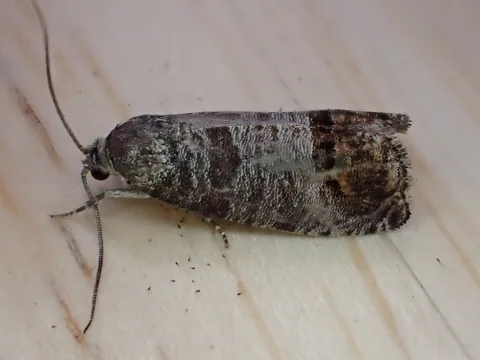 Codling Moth
Cydia pomonella
Codling moth is the infamous worm in the apple. Its caterpillars bore into apples, pears and English walnuts soon after hatching and tunnel toward the core, leaving holes packed with reddish-brown droppings.
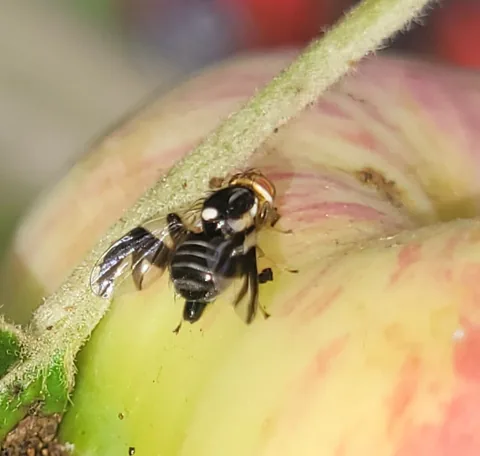 Apple Maggot
Rhagoletis pomonella
The apple maggot is a small fruit fly whose larvae tunnel through apples and leave brown, rotting trails. Minnesota Extension calls it the most important insect pest of Minnesota-grown apples, and Wisconsin's fruit specialists say few pests are as damaging to home apple growing.
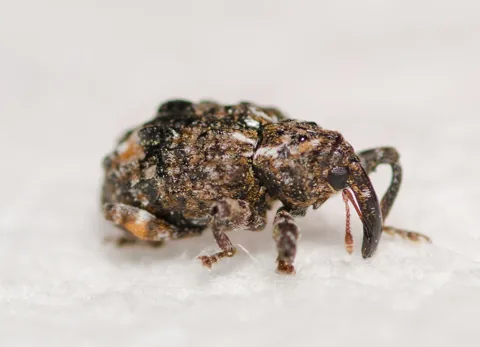 Plum Curculio
Conotrachelus nenuphar
The plum curculio is a small native snout beetle and one of the most destructive pests of apples and peaches. Females cut crescent-shaped scars into young fruit to lay eggs, and the grubs that hatch feed inside, often making the fruit drop.
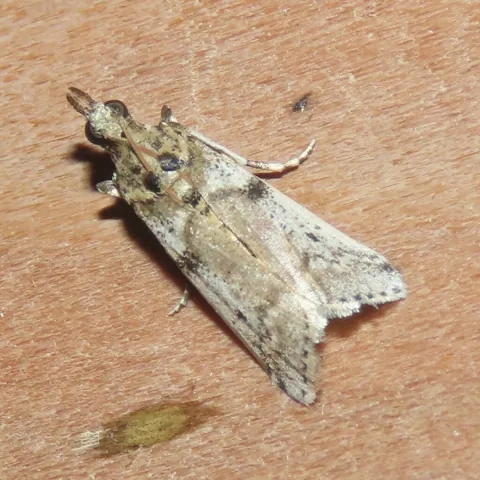 Navel Orangeworm
Amyelois transitella
Navel orangeworm larvae fill almonds, walnuts, pistachios, figs and pomegranates with webbing and frass, and old leftover nuts are where they overwinter.
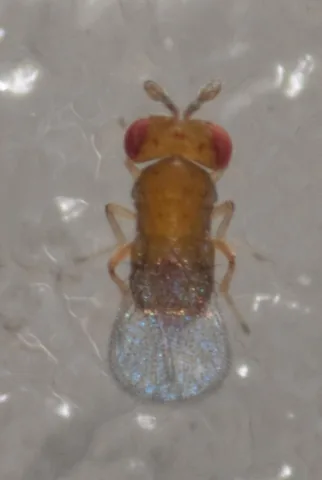 Trichogramma Wasps
Trichogramma species
Trichogramma are minute wasps that develop inside the eggs of moths and other insects, killing the pest before a caterpillar ever hatches.
Is it codling moth?
Codling moth attacks apples, pears and English walnuts. USU also lists crabapple, quince, hawthorn, apricot, plum, peach and cherry as hosts, though Colorado State says larvae in cherries, peaches and large-fruited crabapples are rare. Identification photos are on our codling moth profile; these are the signs to check before you plan control.[1][3][4]
- Stings: a newly entered larva leaves a tiny mound of reddish-brown frass about 1/16 inch across. Scrape it away and there's a small entry hole. Colorado State describes a light red ring around the entry point.[1][4]
- Where to look: larvae can enter anywhere but often choose sheltered spots such as the stem end, the calyx end, or where two fruit touch. Pears are entered mainly at the calyx end and later in the season.[4]
- Inside the fruit: the larva tunnels to the core and feeds on the seeds, then leaves through the entry hole or a new exit hole. Both holes fill with brown, crumbly frass.[3][4][1]
- The caterpillar: white to light pink with a dark brown head and legs. Full-grown size, by source: 1/2 inch (UMN), 1/2 to 3/4 inch (Colorado State, USU), about 3/4 inch (WSU).[1][5][4][3][6]
- Apple maggot is a fly larva, and its tunnels run throughout the fruit, leaving slender dark trails, unlike codling moth, which feeds mainly in the core.[8]
- Plum curculio leaves crescent-shaped scars on the fruit skin. In apples and pears almost all its larvae die in the firm young fruit, so often the scar is the only injury.[9]
- In walnuts, a navel orangeworm larva can look similar, but it has crescent-shaped marks on the second segment behind the head and leaves extra webbing in the nut.[1]
- Walnut damage: nuts hit early drop soon after; nuts hit later stay on the tree with inedible kernels. UC IPM says untreated walnut trees may have little damage, about 10 to 15% of nuts, because walnuts are a less favored host.[1]
How many generations you'll face
Codling moth spends the winter as a full-grown larva in a silken cocoon under loose bark or in soil and debris at the base of the tree, then pupates in late winter or early spring. Adults emerge around apple bloom. The number of generations after that depends on your climate, and so does how long the fruit needs protecting.[1][4][3]
- Minnesota: two generations; the second, which can start in late July or early August, is not important in home apple orchards, according to UMN.[5]
- Utah: two full generations and a partial third in the north, and most or all of a third in the south. First-generation moths peak in June in northern Utah; second-generation moths emerge from late June to early July and peak in late July to early August.[3]
- Colorado: Colorado State says most injury usually comes from the second generation, which begins in early summer, and a third generation occurs in some locations.[4]
- Washington: WSU says adults typically emerge around May to June and there can be two generations a year.[6]
- California: two to four generations depending on climate. Cooler coastal areas usually have two; the hot southern San Joaquin Valley can have a spring generation plus three summer generations.[1]
- Variety matters: late-maturing varieties are more likely to be badly damaged because they hang on the tree into later generations, and UC IPM says untreated trees often have 20 to 90% of their fruit infested, depending on variety and location.[1][4]
- Eggs per female: 30 to 70 (UC IPM, Colorado State, USU); UMN says up to 100. Eggs hatch in 6 to 14 days (Colorado State) or 6 to 20 days (USU) depending on temperature, and larvae bore into fruit within 24 hours of hatching.[1][4][3][5]
Timing with a pheromone trap and degree-days
Sprays only work if they hit larvae before they enter the fruit, so timing is the whole game. The method commercial growers use, and the most accurate one for home growers, combines a pheromone trap that shows when moths start flying with a running total of degree-days that predicts egg hatch. Trap types and lure handling are covered in our pheromone trap guide.[1][4][3]
- Hang the trap before bloom. Colorado State says before first bloom; UC IPM says mid-March in California's Central Valley and by the end of March on the coast, as high in the canopy as you can; UMN says early May at eye level in Minnesota. Check it every few days until the first moths appear.[4][1][5]
- Set the biofix. Colorado State and USU define biofix as the first sustained catch: at least two moths on consecutive nights. UC IPM's orchard guidelines use the first date moths are found on three consecutive trap checks once sunset temperatures have reached 62°F.[4][3][2]
- Add up degree-days from biofix. Codling moth develops between 50°F and 88°F. A simple daily estimate is the average of the high and low minus 50; Colorado State's example is a day with a high of 80°F and a low of 60°F, which adds 20 degree-days. Count no heat above 88°F.[4][3]
- Egg hatch, sources differ: USU and Colorado State put the start of egg hatch at 220 to 250 degree-days after biofix. UC IPM's quick tips say 250 to 300, and its granulosis virus section says 200 to 250.[3][4][1]
- The heavy hatch: USU and Colorado State put peak first-generation hatch at 340 to 600 or 640 degree-days and the end of first-generation hatch near 920.[3][4]
- Second generation: hatch begins around 1000 to 1100 degree-days, peaks between 1320 and 1720, and ends around 2100. Where a partial third generation occurs, its hatch begins at about 2160.[3][4]
- Zero moths doesn't always mean zero risk. USU notes that evening temperatures below 60°F and still evenings cut trap catches, and old or weak lures can also give zero catches.[3]
- No trap? Watch the fruit. UC IPM says to check fruit at least twice a week starting three to four weeks after bloom and spray at the first sting, after removing any stung fruit. Expect more damage than with degree-days, because the very first sting is hard to find.[1]
- Local help: UC IPM's website has a degree-day calculator, and USU says Utah tree fruit advisories and county extension offices give spray timing information.[1][3]
Bagging, thinning and cleanup
On small trees these methods can carry the whole load. UC IPM says sanitation should be the first step in any codling moth program, and bagging is the one nonchemical method strong enough to use alone. Step-by-step bagging with paper and zip-type bags is in our fruit tree calendar; this section covers timing and the points where sources differ.[1][4]
- When to bag, by source: UC IPM says four to six weeks after bloom, when fruit is 1/2 to 1 inch across; WSU says 4 to 6 weeks after petal fall, about dime-sized; UW-Madison says at 1/2 to 3/4 inch, about two weeks after petal fall; USU says wait until 1/2 to 3/4 inch to avoid fruit drop.[1][6][7][3]
- Bag only clean fruit. UW-Madison says to check that fruit isn't already damaged, and USU says an insecticide may be needed before bagging to stop early infestation. UC IPM warns that late-developing varieties can be attacked before they reach 1/2 inch.[7][3][1]
- Which bags: paper lunch bags are the standard. UC IPM says nylon bags aren't effective and some gardeners succeed with cotton tie-string bags; WSU says nylon footie bags may be less effective against codling moth. On plastic, sources differ: UW-Madison recommends zip-type bags with a drainage cut, while WSU says clear plastic bags may hold moisture and add to disease.[1][6][7]
- Taking bags off: UC IPM says remove them just as fruit begins ripening and notes fruit opened early can still be attacked; USU says 1 to 2 weeks before maturity; WSU says about 3 weeks before harvest, but warns second-generation adults emerging mid-July to early September may attack exposed fruit.[1][3][6]
- Thin to one fruit per cluster. Thinning removes the touching-fruit entry points and makes sprays much more successful on well-pruned trees.[4][3]
- Pick infested fruit. UC IPM says check every week or two starting six to eight weeks after bloom and remove fruit with frass-filled holes before larvae can leave. Take it off the site; Colorado State says larvae keep developing normally in fruit dropped on the ground.[1][4]
- Disposal: WSU says crush infested fruit or seal it in a plastic bag in hot sun for a week, and don't compost it, because larvae leave fruit to pupate in soil.[6]
- Remove hiding places. Remove loose bark flaps and clear brush, debris and cull piles from around the trees.[4][6][3]
- Check storage. UMN says larvae can leave harvested apples and spin cocoons in crates, garages or barns, which can become a source of moths the next spring. Wooden apple crates give larvae shelter through the winter.[5]
- Keep trees short. UC IPM says a canopy you can reach makes codling moth easier to manage, and WSU suggests dwarfing rootstock and pruning to keep trees under ten feet.[1][6]
- Choose early varieties. Early-maturing apples and pears and late-leafing walnuts are less likely to be damaged; Colorado State says no apple or pear is fully resistant, though firmer-fruited varieties are somewhat less susceptible.[1][4]
Trunk bands, traps and mating disruption
These are the methods people try most often after bagging. Their value depends heavily on tree size and on whether other apple, pear or walnut trees are nearby.[1][4]
- Trunk bands, sources differ. Corrugated cardboard or burlap around the trunk gives mature larvae a place to spin cocoons, and you then destroy them. UC IPM says bands catch only a very small share of larvae, can increase the population if not removed in time, and are no longer recommended for home gardens. WSU says periodic removal of the wraps can help a lot, and Colorado State and USU give instructions.[1][6][4][3]
- If you band: USU says use strips 2 to 3 inches wide, put them on in May for first-generation larvae or August for overwintering larvae, and remove and destroy them before moths emerge in mid- to late June, or in late October to November. Colorado State uses 1 1/2 to 2 inch strips checked every week or two. Bands work best on smooth-barked trees such as Red Delicious, and on isolated trees.[3][4][1]
- Pheromone traps for control: the standard lure attracts only males, and Colorado State and UC IPM say traps alone aren't a reliable control. UC IPM says several traps per tree might help only on trees isolated from other host trees. Colorado State says lures that add pear ester also catch females and may give minor suppression.[4][1]
- Homemade lures and light traps: Colorado State describes fermenting molasses diluted about 1:7 in water hung in open containers, and says light traps or bug zappers may reduce codling moths somewhat but also kill large numbers of beneficial insects.[4]
- Mating disruption, sources differ on the cutoff. Dispensers that flood an orchard with pheromone work in large commercial plantings. UC IPM says they aren't effective under 5 acres and can increase damage on small plantings or single trees; Colorado State and USU say under 10 acres.[1][4][3]
- Trichogramma egg wasps, sources differ: Colorado State calls backyard releases experimental, since they've never been studied in home orchards; UC IPM's orchard guidelines say research found limited effectiveness; USU says the wasp has shown potential combined with other lower-toxicity tactics.[4][2][3]
If you spray: timing and choices
UC IPM says trees heavily infested every year need carefully timed insecticides, and in most backyards the best course combines nonchemical methods with low-toxicity sprays and accepts some wormy fruit. Repeated applications are the rule, and coverage of the fruit has to be thorough. Make sure the product label lists the fruit or nut you are treating and follow its preharvest interval.[1][4][5]
- When to start, sources differ. UC IPM and Colorado State time the first spray to egg hatch from degree-days or first stings. UMN says spray when most or all petals have fallen and again 7 to 10 days later; WSU says about 10 days after full petal fall, or 17 to 21 days after full bloom, with reapplications through late spring and summer.[1][4][5][6]
- Granulosis virus: affects only codling moth larvae, which must eat it; it kills them within three to seven days and spares bees and natural enemies. Apply weekly through egg hatch, at least 3 or 4 times per generation, with 1% horticultural oil. UC trials found weekly applications as effective as carbaryl in backyard trees. UC IPM says it has no preharvest interval.[1][4]
- Spinosad: a microbial-derived product that is safe for most beneficials, though more toxic to them than the virus. UC IPM's schedule is three sprays 10 days apart from first-generation egg hatch and two per later generation, with 1% oil, no more than six a season and none within seven days of harvest.[1][4]
- Kaolin clay: a particle film sprayed on as a barrier. In USDA trials, larvae on coated plants moved more slowly and entered fewer fruit and females laid fewer eggs, and infestation fell for both generations. The authors suggest it as a supplement where moths are dense and possibly a stand-alone method where they're fewer. It must keep fruit fully covered while eggs are laid and leaves a visible residue.[13][4][3]
- Horticultural oil: refined oil can smother eggs and is timed to early egg-laying (100 to 200 and 1000 to 1050 degree-days, USU). UC IPM says oil alone gives variable results but improves the virus and spinosad.[3][1]
- Carbaryl: one of the more effective materials, lasting 14 to 21 days, but very disruptive to natural enemies and honey bees, and more than one spray a season can set off mite outbreaks. UC IPM says don't use it on apples within a month of bloom because it can cause fruit drop. In California carbaryl has been a restricted-use material since August 1, 2020.[1][4]
- Other active ingredients named for home codling moth sprays include acetamiprid (Colorado State; after petal fall only, up to four times a season), and esfenvalerate and malathion (UMN, WSU).[4][5][6]
- What doesn't work: UC IPM says Bt, pyrethrum and pyrethrin-rotenone combinations have been tested and not found effective against codling moth.[1]
- Tall trees: WSU says homeowners shouldn't make foliar applications to trees over 10 feet tall and should hire a commercial applicator for those.[6]
- Rotate. USU advises rotating among insecticide classes to slow resistance, and UC IPM's orchard guidelines say not to use the same mode-of-action group more than twice a season.[3][2]
Protecting bees
Apple and pear bloom is full of bees, and codling moth sprays aren't needed then: egg hatch comes after petal fall. Our pollinator spraying guide covers labels and drift in detail.[5][4][10]
- No sprays during bloom. UMN says sprays before petal fall are ineffective against codling moth and will kill pollinating bees, and Colorado State says carbaryl should never go on until petals have fallen.[5][4]
- Watch blooming weeds and neighbors. UC IPM's bee guidelines say avoid pesticides on any flowering plants, including weeds under the tree, and avoid drift onto nearby bloom.[10]
- Spray late. WSU says esfenvalerate, carbaryl and malathion are toxic to bees and, to lower the risk, apply in the evening after bees stop foraging.[6]
Resistance to the granulosis virus
Granulosis virus products are used in organic and conventional orchards. After codling moth infestations rose in Washington organic apple orchards, researchers screened five moth colonies and in 2022 reported the first U.S. case of codling moth resistance to the virus: the main virus isolate in a widely sold product failed against one colony. Three newer virus preparations still infected the resistant larvae.[12]
Your neighbors' trees, and the law
Your trees can be reinfested by moths from neighboring trees however well you manage your own. UMN says adults can fly as far as a mile to find mates, and UC IPM suggests making codling moth a neighborhood project.[1][5]
- Unmanaged trees count. UC IPM says nearby untreated trees are a continual source of moths, Colorado State says infested crabapples can be significant sources of moths for nearby apples and pears, and USU advises commercial growers to remove or treat host trees within a quarter mile (450 yards).[1][4][3]
- Fruit-growing areas: WSU says home trees can serve as alternate hosts and homeowners in fruit-growing areas are encouraged to manage codling moth, and control may be required by law in some regions. In Washington, state law requires each landowner with plants to control horticultural pests and diseases and prevent their spread.[6][11]
- Area-wide programs: in British Columbia, a program has combined sterile insect releases with other practices over orchards and neighboring urban, public and First Nations lands for 25 years, the longest-running area-wide codling moth effort anywhere.[14]
Natural enemies
Spiders, ground beetles, assassin bugs, minute pirate bugs, lacewing larvae and parasitic wasps all attack codling moth, and they do more on trees sprayed with selective products such as the granulosis virus. They won't give acceptable control by themselves, because a newly hatched larva is protected once inside the fruit and a single larva ruins a fruit.[4][1][3]
Common questions
- When should I spray for codling moth?
- At egg hatch, before larvae enter fruit. With a pheromone trap, that's about 220 to 250 degree-days after moths are first caught consistently (UC IPM says 250 to 300); without one, spray at the first stings on the fruit. Never during bloom.[3][4][1][5]
- Do codling moth traps get rid of them?
- No. Pheromone traps catch mainly males and are for timing sprays. Several traps per tree might help a little on an isolated tree.[1][4]
- Does bagging apples stop codling moth?
- Yes, if bags go on clean fruit at about 1/2 to 1 inch across and stay on until near ripening. UC IPM calls bagging the only nonchemical method effective enough to use alone.[1][7]
- Are cardboard trunk bands worth it?
- Sources differ. UC IPM no longer recommends them because they catch few larvae and can add to the problem if not removed in time; WSU, Colorado State and USU still describe them as a supplement on smooth-barked, isolated trees.[1][6][4][3]
- Is a wormy apple safe to eat?
- Cut out damaged portions, because mold in them might produce toxins such as aflatoxin.[1]
- What's the best organic spray for codling moth?
- Granulosis virus or spinosad, each with 1% horticultural oil and repeated through egg hatch. Kaolin clay is a barrier option. Bt and pyrethrins haven't proven effective.[1][4][13]
Photo credits
- Codling Moth: Stephen James McWilliam, public domain (CC0), via iNaturalist
- Apple Maggot: (c) Bex Goreham, some rights reserved (CC BY) — via iNaturalist, CC BY 4.0
- Plum Curculio: (c) Justin Williams, some rights reserved (CC BY) — via iNaturalist, CC BY 4.0
- Navel Orangeworm: (c) Mary Beth Stowe, some rights reserved (CC BY) — via iNaturalist, CC BY 4.0
- Trichogramma Wasps: (c) Kerri-Lee Harris, some rights reserved (CC BY) — via iNaturalist, CC BY 4.0
Sources
- University of California Statewide IPM Program, “Pest Notes: Codling Moth, UC ANR Publication 7412.” ipm.ucanr.edu/home-and-landscape/codling-moth/ (accessed 2026-11-10)
- University of California Statewide IPM Program, “Apple Pest Management Guidelines: Codling Moth.” ipm.ucanr.edu/agriculture/apple/codling-moth/ (accessed 2026-11-10)
- Utah State University Extension and Utah Plant Pest Diagnostic Laboratory, “Codling Moth (Cydia pomonella), ENT-13-06 (Alston, Murray and Reding, 2010).” extension.usu.edu/files-ou/publications/factsheet/codling-moths06.pdf (accessed 2026-11-10)
- Colorado State University Extension, “Codling Moth: Control in Home Plantings, Fact Sheet 5.613.” extension.colostate.edu/topic-areas/insects/codling-moth-control-in-home-plantings-5-613/ (accessed 2026-11-10)
- University of Minnesota Extension, “Codling moths in home orchards (Jeffrey Hahn, reviewed 2019).” extension.umn.edu/yard-and-garden-insects/codling-moths (accessed 2026-11-10)
- Washington State University Extension, “Apple: Codling moth (Hortsense).” hortsense.cahnrs.wsu.edu/fact-sheet/apple-codling-moth/ (accessed 2026-11-10)
- University of Wisconsin–Madison Division of Extension (Wisconsin Horticulture), “Bagging Apples for Insect and Disease Control, XHT1268 (Diana Alfuth, revised April 17, 2019).” hort.extension.wisc.edu/articles/bagging-apples-for-insect-and-disease-control/ (accessed 2026-11-10)
- University of Wisconsin–Madison Division of Extension (Wisconsin Horticulture), “Apple Maggot: Scourge of Home Apple Production.” hort.extension.wisc.edu/articles/apple-maggot-scourge-of-home-apple-production/ (accessed 2026-11-10)
- University of Wisconsin–Madison Division of Extension (Wisconsin Horticulture), “Plum Curculio (Annie Deutsch and Christelle Guédot).” hort.extension.wisc.edu/articles/plum-curculio/ (accessed 2026-11-10)
- University of California Statewide IPM Program, “Best Management Practices to Protect Bees From Pesticides.” ipm.ucanr.edu/mitigation/protect_bees.html (accessed 2026-11-10)
- Washington State Legislature, “RCW 15.09.060: Owner's duty to control pests and diseases.” app.leg.wa.gov/RCW/default.aspx?cite=15.09.060 (accessed 2026-11-10)
- Insects (PubMed 35735870), “Fan J, Jehle JA, Rucker A, Nielsen AL. First Evidence of CpGV Resistance of Codling Moth in the USA. Insects 2022;13(6):533.” pubmed.ncbi.nlm.nih.gov/35735870/ (accessed 2026-11-10)
- Journal of Economic Entomology (PubMed 10902324), “Unruh TR, Knight AL, Upton J, Glenn DM, Puterka GJ. Particle films for suppression of the codling moth in apple and pear orchards. J Econ Entomol 2000;93(3):737-43.” pubmed.ncbi.nlm.nih.gov/10902324/ (accessed 2026-11-10)
- Insects (PubMed 31510017), “Thistlewood HMA, Judd GJR. Twenty-five Years of Research Experience with the Sterile Insect Technique and Area-Wide Management of Codling Moth in Canada. Insects 2019;10(9):292.” pubmed.ncbi.nlm.nih.gov/31510017/ (accessed 2026-11-10)