The short answer
- Confirm it: look for small crescent-shaped cuts beside a tiny egg hole on young fruit, starting right after bloom. On stone fruit a drop of clear to amber sap often oozes from the scar.[3][1][5]
- Watch the weather after petal fall. Most beetle activity comes in the first warm spell when daytime highs reach about 70°F, and egg-laying runs for 3 to 5 weeks after bloom ends.[6][1]
- On small trees, spread a white sheet underneath and tap each branch early in the morning; the beetles drop and can be killed. UW-Madison says it has to be repeated almost every day for about 4 weeks starting at bloom.[1][5]
- Pick up dropped fruit all season and throw it away or bury it. Ordinary composting doesn't kill the larvae.[1][3][5]
- To protect the fruit itself, use kaolin clay reapplied about weekly from petal fall, bag fruit once it's big enough, or spray an insecticide labeled for plum curculio at petal fall and again 7 to 10 days later.[3][1][5]
- Never spray insecticides while the trees are in bloom. Wait until every petal is down to protect bees.[1][3]
Fruit pests to know
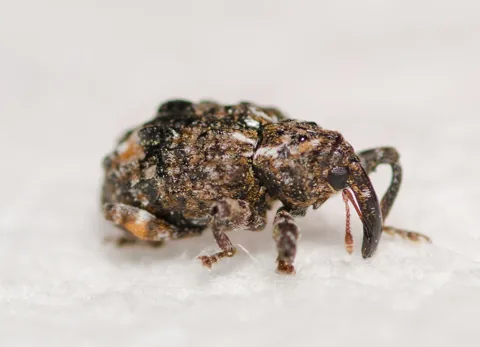 Plum Curculio
Conotrachelus nenuphar
The plum curculio is a small native snout beetle and one of the most destructive pests of apples and peaches. Females cut crescent-shaped scars into young fruit to lay eggs, and the grubs that hatch feed inside, often making the fruit drop.
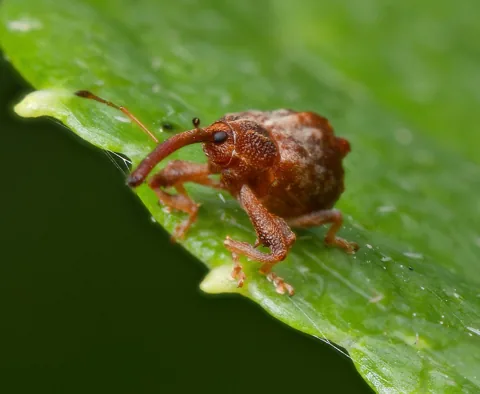 Apple curculio
Anthonomus quadrigibbus
The apple curculio, Anthonomus quadrigibbus, is a North American weevil that lays its eggs in young fruit of apple, pear, hawthorn, saskatoon, chokecherry and related plants. The grub stays inside and eats the seeds, and the adults leave small dark punctures on green fruit and shoot tips. In apple orchards it is an occasional pest, far less familiar than the plum curculio.
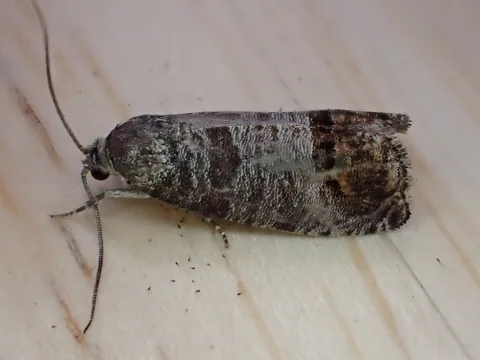 Codling Moth
Cydia pomonella
Codling moth is the infamous worm in the apple. Its caterpillars bore into apples, pears and English walnuts soon after hatching and tunnel toward the core, leaving holes packed with reddish-brown droppings.
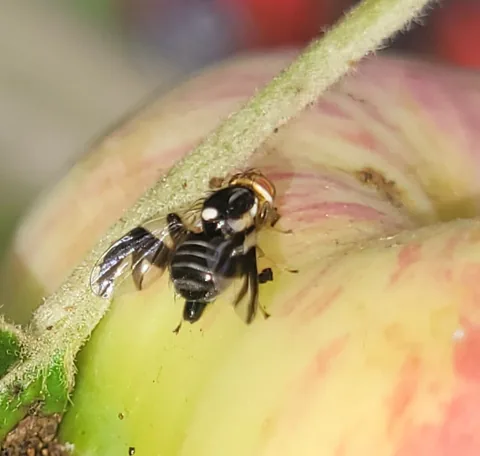 Apple Maggot
Rhagoletis pomonella
The apple maggot is a small fruit fly whose larvae tunnel through apples and leave brown, rotting trails. Minnesota Extension calls it the most important insect pest of Minnesota-grown apples, and Wisconsin's fruit specialists say few pests are as damaging to home apple growing.
 Peachtree Borer
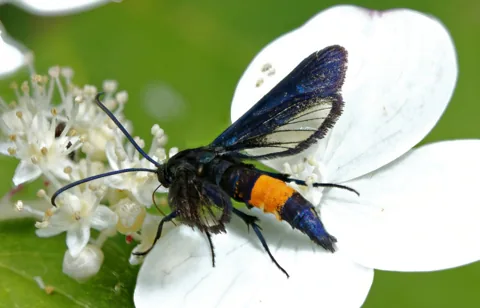
Synanthedon exitiosa
The peachtree borer is a native clearwing moth whose larvae bore into the lower trunk and roots of peach, cherry, plum, apricot and other Prunus trees. The first sign is usually a mass of gum mixed with sawdust at the base of the trunk.
Is it plum curculio? Read the scars
The female chews a small cavity under the skin of a young fruit, lays one egg, then cuts a crescent-shaped slit beside it. That half-moon scar is the sign people notice. As the fruit grows, the scar grows with it into a large semicircular mark. Adults also chew small round feeding holes in the fruit surface.[1][5][3][4]
What happens next depends on the fruit. In apples and pears, almost all larvae are killed by the firm young flesh, so often the scar is the only damage you'll see at harvest. In stone fruit the larva bores in and feeds until grown, the scar may weep sap, and frass can show where it chewed out. Infested fruit of either kind often drops early; UNH and UMass say infested apples usually fall around the time of June drop.[1][5][2][3]
The beetle itself is a dark brown snout beetle with grayish-white patches and four bumps on its wing covers, and a snout about one-third its body length. Size estimates run from 3/16 inch (UNH) to 1/4 inch (UMass, Penn State), or 5 to 6 mm in Illinois Extension's fact sheet. The larva is a legless, C-shaped, whitish grub with a brown head found inside the fruit. Our plum curculio profile has photos and the full description.[2][3][6][4]
Late summer brings a second kind of damage. New adults chew round holes into fruit, often near the stem, from late summer until cool fall weather, before they leave for the winter.[1][5]
Where the beetles come from
Plum curculio is native to eastern North America and lives east of the Rocky Mountains. Adults spend the winter in leaf litter in woods, hedgerows, fence rows and ditch banks, and USU adds compost piles near host trees. In spring they walk or fly into fruit trees, so trees next to woods are usually hit first.[1][2][5][3][6]
Wild plum, native crabapple and hawthorn are natural hosts, and wild or neglected fruit trees in woodlots and fencerows keep populations going near cultivated trees.[1][5]
In the West, the only known population is in Box Elder County, Utah, where it was found in the early 1980s. Utah State says it is a quarantine pest in western North America. The Utah Department of Agriculture and Food runs a statewide monitoring program there.[5]
Timing: bloom to a few weeks after petal fall
Every source agrees the critical period is short. UNH says the most important time to monitor is between bloom and about two weeks after petal fall. Penn State says most activity comes during the first warm period after petal fall, when the maximum temperature is 70°F or higher, and that cool, rainy weather with highs below 70°F holds them back.[2][6]
Females usually move into fruit trees about bloom, but UW-Madison says cold, wind and low humidity can delay them by 2 to 3 weeks. Egg-laying lasts 3 to 5 weeks after the end of bloom. Utah State says adults become active in spring once mean temperatures stay above 50°F for at least 3 days and move into orchards when highs pass 70°F.[1][5]
Cool, wet weather stretches the season instead of ending it. UMass says it prolongs plum curculio activity, and Penn State says low temperatures extend the time beetles are active while rain washes spray deposits off. Penn State's commercial guideline is to keep fruit protected until 308 degree days (base 50°F) have built up after petal fall on McIntosh apples.[3][6]
Sources differ on when fruit becomes a target. UNH says attacks on apple begin when fruit reaches about 1/4 inch (6 mm); Penn State says fruit about half an inch across offers abundant food and egg sites.[2][6]
Generations vary by region. In northern areas there is one generation a year. Illinois Extension says a southern strain has two generations and that plum curculio in Illinois has two; Penn State says a partial second generation may occur in southern Pennsylvania in some years.[3][4][6][5]
Shake them out: the sheet (tarp) method
Plum curculios drop when disturbed, which gives backyard growers a spray-free option on small trees where low numbers are present. UW-Madison calls branch beating an alternative or complement to chemical controls.[1][5]
- Spread a white sheet, tarp or beating tray under the tree.[1][5]
- Tap or beat each branch with a stick; Utah State suggests a padded stick to dislodge the adults.[1][5]
- Do it early in the morning. Beetles are cooler and less active then, so they fall instead of flying away.[1][5]
- Kill the beetles that land on the sheet.[1][5]
- Repeat almost every day for about 4 weeks starting at bloom. UW-Madison says that's what it takes to get any level of control, and it works best on small trees where you can reach every branch.[1]
Use the sheet to check, too, but don't rely on it alone
The same shaking tells you whether beetles are present. UW-Madison cautions that it can be unreliable and should be paired with checking fruit for fresh scars, because the beetles are active day and night and damage can turn up in trees where none were knocked down. Utah State suggests looking over fruit along the edges nearest woods, where beetles concentrate in spring.[1][5]
Orchards sometimes use black pyramid traps or trunk traps baited with benzaldehyde lures. UW-Madison says trapping to intercept adults and stop egg-laying has not been successful, so these traps are for monitoring, not control.[5][4][1]
Pick up dropped fruit and remove wild hosts
Larvae finish growing in fruit that falls, then leave it and pupate in the soil. UW-Madison says larvae are most likely to survive and develop in dropped fruit. That makes cleanup one of the few things that directly cuts next year's numbers.[1][6][5]
- Pick up fallen fruit throughout the season.[1][3][5]
- Throw it away or bury it. UW-Madison says composting isn't enough to kill the larvae. Utah State adds that fruit can be fed to animals, and larger fruit can be chopped with a flail mower.[1][5]
- Remove wild, abandoned or neglected fruit trees nearby when you can, and talk to neighbors about theirs. UW-Madison warns that the beetles can travel more than a quarter mile, so where populations are high this may not be enough by itself.[1][3][5]
- Prune during dormancy to open the canopy. More light and less moisture make the tree less favorable to plum curculio and improve spray coverage.[1][3]
Barriers: kaolin clay and fruit bags
Kaolin clay is a fine mineral clay mixed with water and sprayed on. It dries into a white film that acts as a physical barrier and makes the fruit an unsuitable place to feed or lay eggs. UMass says applications begin at petal fall and are repeated weekly; UW-Madison notes it has to be reapplied often as fruit grows and after rain. It's approved for organic use.[3][1][2]
In peach trials run by Rutgers researchers, kaolin controlled plum curculio about as well as or better than a standard pesticide program, along with oriental fruit moth and Japanese beetle. The catch: kaolin significantly increased numbers of a plant-feeding mite (Panonychus ulmi).[7]
Bagging works once fruit is large enough. Tie or staple a plastic sandwich bag around each fruit at the stem, leave room for growth, and cut two small holes in the lower corners so condensation drains. UW-Madison says plum curculio often strikes before fruit is big enough to bag, so one or two sprays may be needed first. Our codling moth guide covers bagging and thinning in detail.[1]
Insecticide sprays: petal fall, then 7 to 10 days later
If damage was bad in past years, sprays are usually needed. Utah State says insecticides are typically applied at petal fall and repeated in 7 to 10 days, with a third application 7 to 10 days after that if pressure is heavy. UW-Madison gives the same pattern: protect fruit right after bloom and then about every 7 to 10 days for the following few weeks. UNH says two or three sprays are usually aimed at this pest.[5][1][2]
For stone fruit, Penn State says to time sprays at the petal fall stage and repeat if needed; Utah State watches for activity at shuck split in stone fruit and petal fall in pome fruit.[6][5]
Do not spray during bloom. Both UW-Madison and UMass say to wait until bloom is completely finished to protect pollinators. Our guide to protecting pollinators when spraying explains why.[1][3]
Active ingredients UW-Madison lists for home fruit trees include acetamiprid, carbaryl, gamma-cyhalothrin, kaolin clay, permethrin, pyrethrins and spinosad. Check that the label lists your fruit and plum curculio, and follow its rates and pre-harvest interval.[1][5]
- Carbaryl: UW-Madison says it is effective but should not be used within a month of bloom, because it can make healthy young fruit fall off and lead to outbreaks of other pests.[1]
- Pyrethroids and carbamates can kill the predators that keep mites in check, leading to mite outbreaks.[1]
- Rotate products with different modes of action (IRAC groups). Different brand names can contain the same active ingredient, so check the label.[3][1][5]
- Sprays aimed at plum curculio can also help with codling moth, leafrollers and plant bugs, and later sprays for other pests often keep late-season curculio damage down.[1]
Beneficial nematodes and other biological options
Few natural enemies attack plum curculio, and UW-Madison says natural biological control hasn't been shown to prevent fruit damage.[1]
Insect-killing nematodes applied to soil under infested trees target larvae and pupae. Utah State cites research in which Steinernema riobrave suppressed populations. In Michigan field trials, S. riobrave was the most effective of five pathogens tested, but only in the sandiest soils (81-88% sand) and when applied 1 hour or 5 days after larvae entered the soil. In a Utah lab study, adults and pupae were more susceptible to nematodes than larvae, and a Heterorhabditis strain found in local infested soil was the more virulent of the two species tested. Even so, Utah State says relying on nematodes alone didn't give satisfactory field control.[5][10][11]
Treat nematodes as an add-on to sanitation and fruit protection, not a replacement. Our beneficial nematodes guide covers how to apply them.[5][10]
For larger plantings: trap trees and edge rows
In New England apple orchards, the 'trap tree' approach baits one perimeter tree with a two-part lure so curculios concentrate there. Growers check its fruit for fresh scars to decide whether more sprays are needed after the whole-block petal-fall spray. UMass recommends a full-block spray by petal fall and follow-up sprays on the perimeter rows as needed, usually 1 to 3.[3][9]
In USDA-ARS trials, trap trees cut the number of trees sprayed by about 70% compared with perimeter-row sprays and 93% compared with full-block sprays. A study across seven northeastern states found injury no different from conventional management, using at least 43% less insecticide.[8][9]
That edge pattern doesn't hold everywhere. A 2026 study in Georgia peach orchards found the edge effect inconsistent and says perimeter-only programs aren't recommended for Southeastern peaches.[12]
Common questions
- What do plum curculio scars look like?
- A small crescent or half-moon cut beside a tiny egg hole on young fruit. It enlarges as the fruit grows and may stay as a scar at harvest even when no larva survived.[3][1]
- When should I spray for plum curculio?
- After bloom is completely over, at petal fall, then again 7 to 10 days later, with a third spray if pressure is heavy. Never during bloom.[5][1][3]
- Does shaking the tree really work?
- On small trees with low numbers, yes, if you're persistent: tap every branch over a white sheet early in the morning, almost every day for about 4 weeks from bloom.[1][5]
- Are curculio-scarred apples safe to eat?
- The scar is often the only damage on apples and pears because the larva usually dies in the firm flesh. Fruit with larvae tunneling inside is unfit to eat or sell, according to Illinois Extension.[1][4]
- Can I compost dropped fruit?
- Not in an ordinary compost pile. UW-Madison says composting doesn't kill the larvae; bury the fruit or throw it away.[1]
- Do plum curculio traps work?
- For monitoring, yes. Trapping to stop egg-laying hasn't been successful, according to UW-Madison.[1][5]
- How many eggs does a plum curculio lay?
- Sources differ: UNH and Utah State say an average of 150 to 200 per female, UW-Madison says 100 to 500, and Illinois Extension says 400 to 500.[2][5][1][4]
Photo credits
- Plum Curculio: (c) Justin Williams, some rights reserved (CC BY) — via iNaturalist, CC BY 4.0
- Apple curculio: (c) Christian Back, some rights reserved (CC BY) — via iNaturalist, CC BY 4.0
- Codling Moth: Stephen James McWilliam, public domain (CC0), via iNaturalist
- Apple Maggot: (c) Bex Goreham, some rights reserved (CC BY) — via iNaturalist, CC BY 4.0
- Peachtree Borer: (c) Christian Back, some rights reserved (CC BY) — via iNaturalist, CC BY 4.0
Sources
- University of Wisconsin-Madison Division of Extension, “Plum Curculio (Annie Deutsch and Christelle Guédot).” hort.extension.wisc.edu/articles/plum-curculio/ (accessed 2026-11-10)
- University of New Hampshire Cooperative Extension, “Plum Curculio [fact sheet].” extension.unh.edu/resource/plum-curculio-fact-sheet (accessed 2026-11-10)
- UMass Amherst Center for Agriculture, Food, and the Environment, “Apple IPM: Plum Curculio.” www.umass.edu/agriculture-food-environment/fruit/fact-sheets/apple-ipm-plum-curculio (accessed 2026-11-10)
- University of Illinois Extension, “Life Cycle and Biology of Plum Curculio (2023).” extension.illinois.edu/sites/default/files/plum_curcurlio_insect_fact_sheet_nov._23.pdf (accessed 2026-11-10)
- Utah State University Extension, “Plum Curculio (Kate Richardson and Marion Murray).” extension.usu.edu/planthealth/research/plum-curculio (accessed 2026-11-10)
- Penn State Extension, “Tree Fruit Insect Pest - Plum Curculio.” extension.psu.edu/tree-fruit-insect-pest-plum-curculio (accessed 2026-11-10)
- Pest Management Science, abstract via PubMed, “Lalancette N et al. 2005. Evaluation of hydrophobic and hydrophilic kaolin particle films for peach crop, arthropod and disease management. Pest Manag Sci 61(1):25-39.” pubmed.ncbi.nlm.nih.gov/15593071/ (accessed 2026-11-10)
- Journal of Economic Entomology, abstract via PubMed, “Leskey TC, Piñero JC, Prokopy RJ. 2008. Odor-baited trap trees: a novel management tool for plum curculio. J Econ Entomol 101(4):1302-1309.” pubmed.ncbi.nlm.nih.gov/18767740/ (accessed 2026-11-10)
- Journal of Economic Entomology, abstract via PubMed, “Piñero JC et al. 2011. Effectiveness of odor-baited trap trees for plum curculio monitoring in commercial apple orchards in the northeast. J Econ Entomol 104(5):1613-1621.” pubmed.ncbi.nlm.nih.gov/22066191/ (accessed 2026-11-10)
- Environmental Entomology, abstract via PubMed, “Pereault RJ, Whalon ME, Alston DG. 2009. Field efficacy of entomopathogenic fungi and nematodes targeting caged last-instar plum curculio in Michigan cherry and apple orchards. Environ Entomol 38(4):1126-1134.” pubmed.ncbi.nlm.nih.gov/19689891/ (accessed 2026-11-10)
- Environmental Entomology, abstract via PubMed, “Kim HG, Alston DG. 2008. Potential of two entomopathogenic nematodes for suppression of plum curculio life stages in northern climates. Environ Entomol 37(5):1272-1279.” pubmed.ncbi.nlm.nih.gov/19036207/ (accessed 2026-11-10)
- Environmental Entomology, abstract via PubMed, “Liu TJ, Cottrell TE, Blaauw BR. 2026. Temporal, spatial, and vertical distribution of plum curculio in southeastern peach orchards. Environ Entomol 55(2):nvag034.” pubmed.ncbi.nlm.nih.gov/41996479/ (accessed 2026-11-10)