On this page
How to identify it
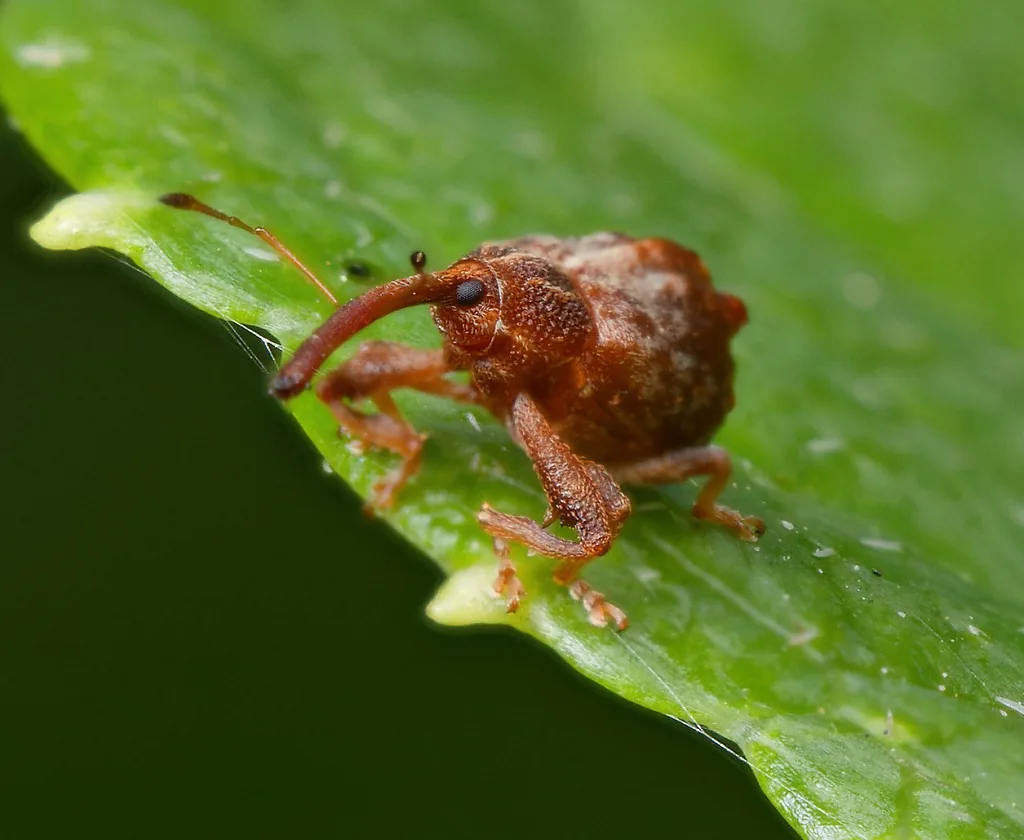
- The adult is about 5 mm (roughly 1/5 inch) long and reddish brown, with a long, distinctly curved snout.[1][2]
- Its wing covers carry two pairs of raised knobs. The plum curculio has four pairs, a shorter snout and a mottled brown, black and gray body.[2]
- The larvae are small, whitish, legless grubs with brown heads, found inside the fruit.[1]
Look-alikes
| Look-alike | How to tell them apart |
|---|---|
| Plum curculio (Conotrachelus nenuphar) | The better-known orchard curculio has a shorter, drooping snout, four pairs of knobs on its wing covers and mottled brown, black and light gray coloring. Its egg-laying scar is crescent-shaped; the apple curculio leaves a round puncture plugged with frass.[2] |
| Hawthorn weevil | Manitoba Agriculture notes a second, similar weevil, the hawthorn weevil, that is active at the same time on the same fruit crops and should also be treated as a pest.[1] |
Where it lives
EFSA's review lists it as widespread in the United States, with records from Alabama to Washington and Maine to Arizona, across Canada from British Columbia to Nova Scotia, and in parts of Mexico. It is not known to occur in the European Union, which bans its introduction.[3]
Biology and life cycle
It has one generation a year. Adults spend the winter in leaf litter, orchard debris or soil near the host plants they grew up on.[1][3]
In spring the adults come out about when saskatoons start to bloom; in Iowa and New York, emergence runs from late April to mid-May, once ground-level temperatures reach about 16 degrees C (about 61 degrees F). On warm days they fly to their hosts and feed on young fruit, shoot tips, tender growth and blossoms.[1][3][2]
A female chews a small cavity in a young fruit with her snout, lays a single egg in it and seals the hole with frass. In Manitoba saskatoons, egg laying comes near the end of fruit drop, about a month after peak bloom.[3][2][1]
Eggs hatch in four or five days. The grub tunnels through the flesh to the core and eats the developing seeds one after another until none are left, passing through three larval stages in roughly 20 to 30 days.[3][1]
The grub pupates inside the fruit, whether that fruit has dropped or is still on the plant; pupation takes about a week. In fruit that stays on the tree, the pressure of the swelling fruit kills many of the developing insects, though some survive.[1][2][3]
New adults appear from mid-July to mid-August. In Manitoba they do not feed on ripe fruit and soon move into leaf litter, while in apple orchards late-summer adults can still feed on fruit and foliage before overwintering.[1][2]
Its hosts are members of the rose family. Hawthorn gives its earliest records; apple, crabapple, pear and sour (tart) cherry are the economically important hosts, and it also develops in quince and in wild fruits such as juneberries (Amelanchier), saskatoon, pin cherry, black cherry and chokecherry.[3][2][1]
Damage and signs
- Feeding and egg laying leave small, dark puncture wounds on green fruit and young shoot tips. On apples, egg-laying punctures cause surface blemishes and the fruit grows distorted around them.[1][3][2]
- The grub destroys the seeds. Infested saskatoons do not drop the way uninfested fruit does, and damage to saskatoon can be extensive; punctured, wormy fruit is poor in quality and unwanted by pickers.[1]
- In apples it is an occasional pest. One IPM specialist found it in 3 of 20 orchards visited in 2024, usually where insecticide sprays after petal fall had been delayed.[2]
Health risk
It is a fruit-feeding weevil, and none of these sources describes any risk to people.[1][2][3]
Control
Prevention
Apple curculios survive better in poorly kept orchards, and good weed management may help keep their numbers down. No economic thresholds have been developed for this insect.[1]
Sanitation
Because the grubs stay in the fruit to pupate, picking up and destroying fallen fruit from the orchard floor removes them and breaks the life cycle. Removing infested green fruit from the plant is very slow work but may lower numbers the next year.[2][1]
Traps and physical control
Check plants shortly before and during fruit set for adults; on saskatoon and chokecherry a sweep net collects beetles that are hard to spot. Look for the small round egg-laying punctures and cut open suspect fruit to find grubs. Yellow sticky cards catch flying adults more often than the delta traps used for plum curculio, and a hand lens tells the two apart.[1][3][2]
Pesticides
There is little research on chemical control of apple curculio. Sprays used for plum curculio and other orchard pests after petal fall probably give some control, but that varies with the insecticide and its mode of action.[2]
Common questions
- How do I tell apple curculio from plum curculio?
- Look at the snout and the knobs on the back. The apple curculio is reddish brown with a long snout and two pairs of knobs; the plum curculio is mottled brown, black and gray, with a shorter, drooping snout and four pairs. Apple curculio egg punctures are round and sealed with frass rather than crescent-shaped.[2]
- Why are my saskatoon berries hollow inside?
- The apple curculio grub eats the seeds inside young saskatoons, moving from seed to seed until all are gone, and the damaged fruit stays on the bush. Small dark punctures on green berries are the sign to look for.[1]
- Will picking up dropped apples help?
- Yes. The grubs remain inside fallen fruit to pupate, so gathering and destroying dropped fruit removes them before the next generation emerges.[2][3]
Sources
- Manitoba Agriculture (Province of Manitoba), “Apple Curculio (Anthonomus quadrigibbus).” www.gov.mb.ca/agriculture/crops/insects/apple-curculio.html (accessed 2026-11-09)
- University of Minnesota Extension, Fruit and Vegetable IPM news, “Apple curculio: A lesser-known orchard pest (M. Wimmer, UMN Fruit Production Extension Educator).” blog-fruit-vegetable-ipm.extension.umn.edu/2024/08/apple-curculio-lesser-known-orchard-pest.html (accessed 2026-11-09)
- EFSA Journal (European Food Safety Authority), full text in PubMed Central (PMC7009501), “EFSA Panel on Plant Health. Pest categorisation of Anthonomus quadrigibbus. EFSA Journal 16(5): 5245 (2018), doi:10.2903/j.efsa.2018.5245.” doi.org/10.2903/j.efsa.2018.5245 (accessed 2026-11-09)
- iNaturalist, “Anthonomus quadrigibbus taxon page (order and family).” www.inaturalist.org/taxa/213778 (accessed 2026-11-09)