On this page
How to identify it
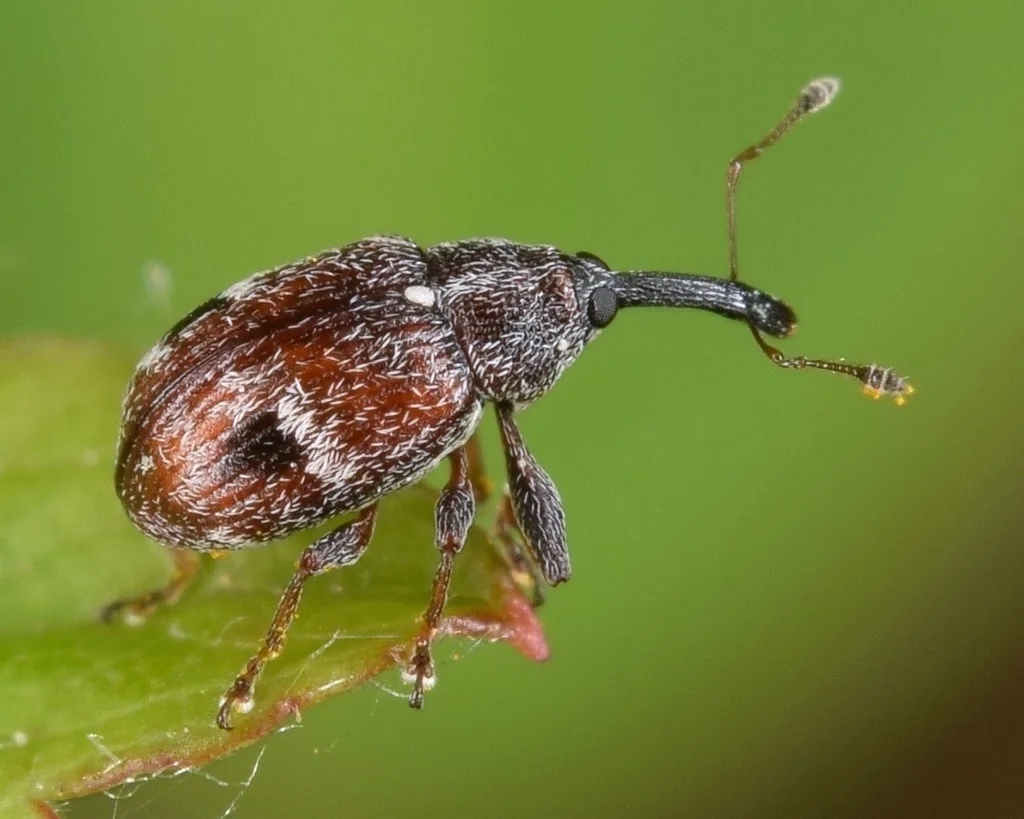
- A small brown weevil with a long snout; Virginia Tech describes it as about 1/10 inch (3 mm) long with two black spots on the wing covers, and NC State gives about 1/4 inch.[1][2]
- Larvae are tiny cream-colored grubs inside the clipped buds.[1][2]
- The telltale sign is buds dangling from partly severed stems or lying on the ground.[1][2]
Look-alikes
| Look-alike | How to tell them apart |
|---|---|
| Tarnished plant bug | Another spring strawberry pest; it deforms berries rather than clipping buds.[2] |
Where it lives
Found in virtually all strawberry-growing regions of the United States, including Virginia and North Carolina.[1][2]
Biology and life cycle
There is one generation a year; adults overwinter in wooded areas and leaf litter and move into strawberries in spring (mid to late April in North Carolina and the Mid-Atlantic).[1][2]
Females puncture an unopened bud, lay a single egg, then chew the bud's stem; larvae develop in the clipped bud in three to four weeks.[1][2]
New adults appear in summer, feed briefly on pollen and then go dormant until the next spring.[1][2]
Besides strawberry, hosts include blackberry, raspberry, dewberry and redbud.[1]
Damage and signs
- Rows nearest woods usually get the most clipped buds.[1]
- Sources differ on how much it matters: Virginia Tech cites yield losses of 50 to 100 percent in some areas, while NC State notes research and field observations showing strawberry plants can compensate in fruit size and timing for much of the bud loss.[1][2]
Health risk
Control
Prevention
Check for clipped buds, the only recommended way to sample; suggested action levels are about 0.6 clipped buds per foot of row in Virginia and 2 per meter in New York.[1]
Because plants can compensate for a good deal of bud loss, small numbers of clipped buds may not need treatment.[1]
Common questions
- Why are my strawberry flower buds hanging or falling off?
- Often the strawberry clipper, which lays an egg in the bud and then cuts its stem.[1][2]
- Will I lose my crop?
- Losses vary; plants often compensate for clipped buds.[1][2]
- When does it show up?
- In spring, around mid to late April in the Mid-Atlantic and North Carolina.[1][2]
Sources
- NC State Extension, “Strawberry Clipper Weevils in Strawberry (PDIC Factsheet).” content.ces.ncsu.edu/strawberry-clipper-weevils-in-strawberry (accessed 2026-10-16)
- Virginia Tech Department of Entomology (Virginia Fruit pages), “Strawberry bud weevil (Clipper), Anthonomus signatus.” www.virginiafruit.ento.vt.edu/StrwWeevil.html (accessed 2026-10-16)
- iNaturalist, “Anthonomus signatus taxon page (order and family).” www.inaturalist.org/taxa/213780 (accessed 2026-10-06)