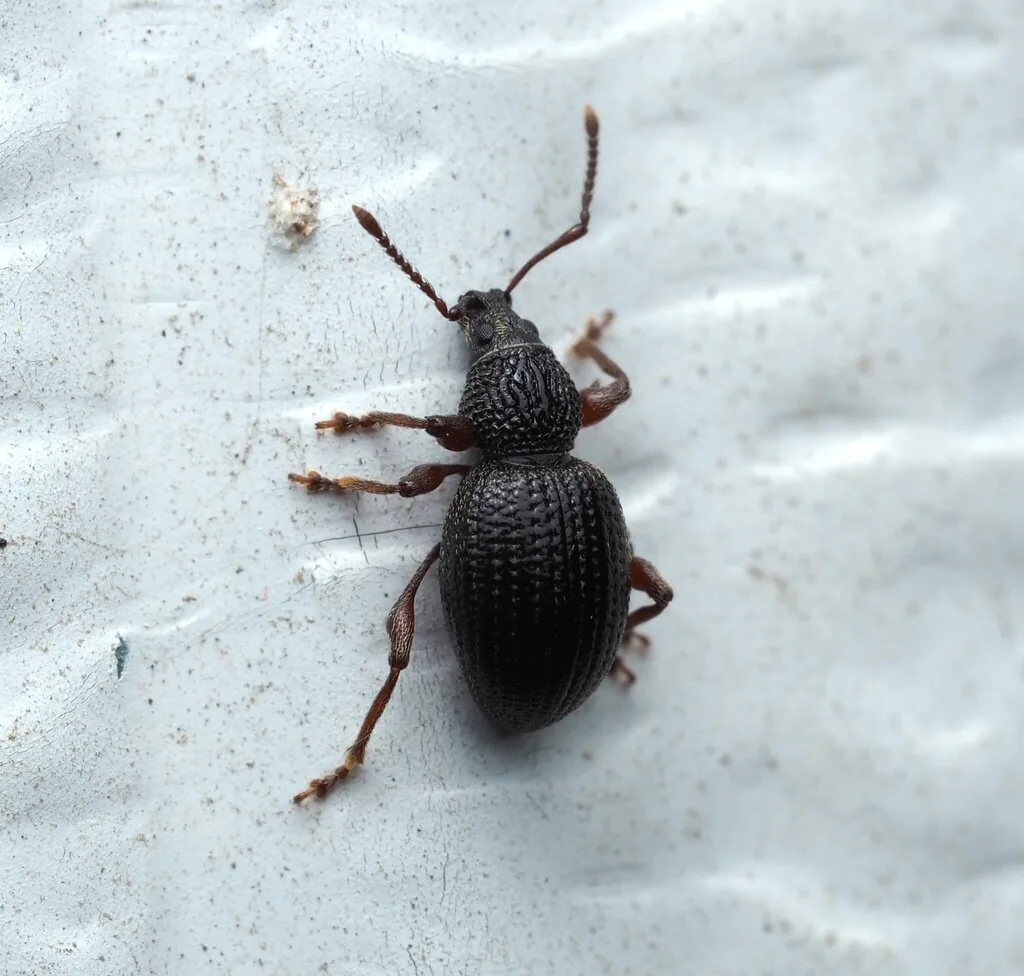
How to identify it
Look-alikes
| Look-alike | How to tell them apart |
|---|---|
| Black vine weevil | A related root weevil with a similar life history, more often seen indoors in late summer and fall.[1] |
| Lilac root weevil | Another relative, usually on lilac, privet, peony and euonymus.[1] |
Where it lives
It's one of the most common root weevils in Colorado.[1]
Biology and life cycle
Only females are produced, and they reproduce without mating; there's one generation a year.[1]
Larvae overwinter in soil feeding on roots, and adults emerge in mid to late spring and can live a couple of months.[1]
Damage and signs
- Hosts include strawberry, raspberry, rhubarb, white clover, dandelion, dahlia and mint, plus roots and bark of some trees and shrubs.[1]
Health risk
Indoors it causes no injury to people or furnishings and won't reproduce there.[1]
Control
Traps and physical control
Search plants about an hour after sunset to confirm which weevil is feeding.[1]
Biological control
Heterorhabditis nematodes drenched into moist soil from mid-July to mid-September control the larvae.[1]
Pesticides
Pyrethroids sprayed on the lower trunk and plant base late in the day kill climbing adults; avoid spraying flowers bees visit.[1]
Common questions
Sources
- Colorado State University Extension, “Root Weevils (Fact Sheet 5.551).” extension.colostate.edu/resource/root-weevils/ (accessed 2026-10-06)
- iNaturalist, “Otiorhynchus ovatus taxon page (order and family).” www.inaturalist.org/taxa/200014 (accessed 2026-10-06)