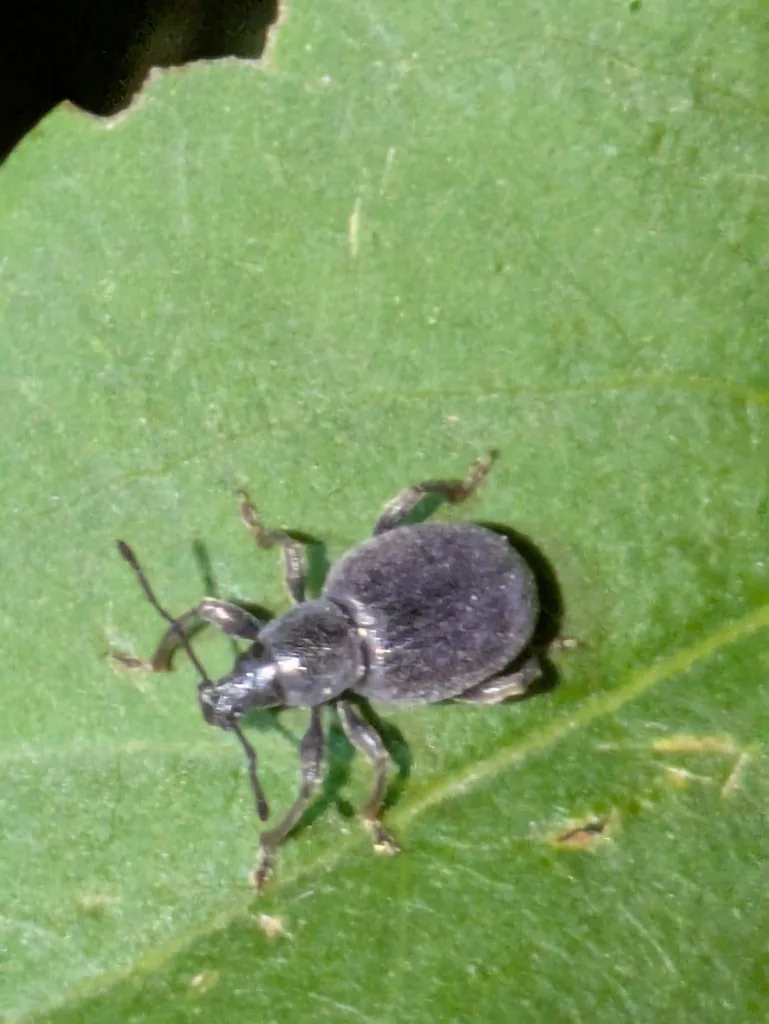
How to identify it
Look-alikes
| Look-alike | How to tell them apart |
|---|---|
| Strawberry root weevil | A relative with a much wider host range that often wanders indoors.[1] |
| Black vine weevil | Another relative, common on euonymus, heuchera, astilbe and hosta.[1] |
Where it lives
It's one of the most common root weevils in Colorado.[1]
Biology and life cycle
Unlike strawberry root weevil, it produces both males and females; there's one generation a year.[1]
Larvae overwinter in soil, and adults emerge in mid to late spring; eggs are squeezed into soil cracks in late spring and early summer.[1]
Damage and signs
- Leaf notching is the only easily seen injury; larvae feed on roots.[1]
Health risk
It feeds on plants; CSU Extension mentions no risk to people.[1]
Control
Traps and physical control
Look on plants at night to confirm which root weevil is present.[1]
Biological control
Heterorhabditis nematodes in moist, warm soil after egg hatch control the larvae.[1]
Pesticides
Pyrethroids on the lower trunk and base kill climbing adults; don't spray flowers that pollinators visit.[1]
Common questions
Sources
- Colorado State University Extension, “Root Weevils (Fact Sheet 5.551).” extension.colostate.edu/resource/root-weevils/ (accessed 2026-10-06)
- iNaturalist, “Otiorhynchus meridionalis taxon page (order and family).” www.inaturalist.org/taxa/503271 (accessed 2026-10-06)