🏷️ Brand Names — Same Active Ingredient
🎯 What It Kills
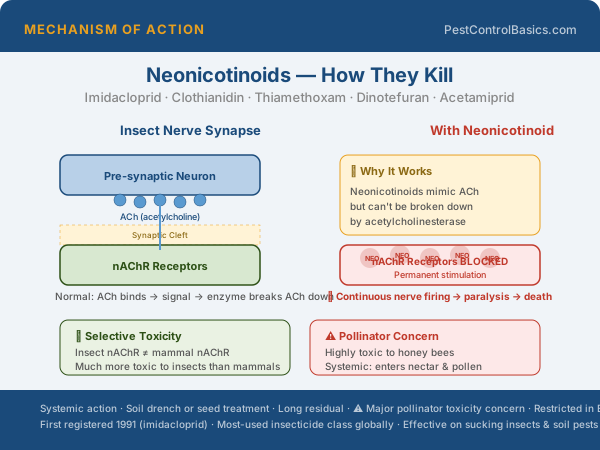
⚙️ How It Works
Acetamiprid is a neonicotinoid with shorter residual and faster breakdown than imidacloprid. Good activity against sucking pests. Used on vegetables and ornamentals.
⚗️ Mixing & Application
⚠️ Safety
- ⚠ Still toxic to bees — apply when not foraging
- ⚠ Shorter residual than other neonicotinoids
- ⚠ Rotate with non-neonicotinoid alternatives
🐛 Pests This Treats — Learn More
Click any pest to view its full identification guide, biology, and treatment options.
🌿 Environmental & Ecological Impact
⏱️ Residual & Re-entry Timeline
🔄 Alternatives & Related Products
Same chemical class or different approaches to the same pests.
🔄Same class: Neonicotinoid
Same class: Neonicotinoid
Same class: Neonicotinoid
Different approach: Botanical Pyrethrin
Different approach: Inorganic
❓ Frequently Asked Questions
📋 Safety Data Sheet (SDS)
Assail 30 SG — Safety Data Sheet
View the official SDS document for this product directly on the CDMS label database.

How Acetamiprid — Assail, TriStar performs in real-world conditions
Laboratory efficacy numbers for Acetamiprid — Assail, TriStar rarely match field performance, and the gap is wider for some product categories than others. Residual life on porous surfaces (brick, unsealed wood, concrete) is typically 30 to 50 percent shorter than on the sealed lab surfaces used in registration data. Direct sunlight reduces persistence further — UV breakdown can cut a 90-day residual to under 45 days on south-facing exterior walls. For interior treatments these effects are smaller, but humidity, cleaning products, and foot traffic all reduce real-world residual life.
Temperature interaction is equally important. Acetamiprid — Assail, TriStar, like most modern active ingredients, has an optimal temperature window for both delivery and pest susceptibility. Outside that window, the same dose may underperform by half. Field operators usually adjust application timing rather than rate to compensate, since increasing the rate beyond label specification produces diminishing returns and increases off-target risk.
Mixing partners and tank-mix compatibility also affect real-world performance. Adding an insect growth regulator extends control by addressing eggs and immatures that the adulticide misses. The cost premium for a tank mix is usually under 20 percent and doubles the effective control window.
Practical safety considerations for Acetamiprid — Assail, TriStar
The label is the law, and it covers the legal minimum. Practical safety for Acetamiprid — Assail, TriStar in a household setting goes beyond label compliance — children, pets, and food-contact surfaces all merit precautions above the regulatory floor. Re-entry intervals on consumer labels are typically calibrated for healthy adults; for nurseries, pet bedding areas, and pregnant-occupant homes, doubling the indicated interval is a reasonable default.
Ventilation matters more than most homeowners realize. Even low-VOC formulations release detectable airborne residues for several hours post-application, and an HVAC system that is running during treatment will redistribute those residues throughout the structure. Standard practice is to turn off forced air for the treatment window and the first hour after, then run on high circulation for 30 minutes before normal occupancy resumes.
Personal protective equipment listed on the label is the minimum. For larger volumes, a half-face respirator with organic-vapor cartridges adds meaningful protection at modest cost. Nitrile gloves outperform latex for solvent-based formulations and are inexpensive enough to use single-use.
Comparing Acetamiprid — Assail, TriStar to alternatives
Choosing between Acetamiprid — Assail, TriStar and a comparable product usually comes down to four factors: speed of kill, residual length, target spectrum, and household-sensitivity profile. No single product wins on all four — fast-acting contact kills typically have short residuals, while long-residual products often act slowly enough that homeowners assume they have failed within the first 48 hours. Matching the product to the situation is more important than picking the strongest available option.
Cost per application is a useful but incomplete metric. A cheaper concentrate that requires more frequent reapplication often costs more per season than a more expensive product with a longer effective window. Coverage area per gallon at the label rate is the better comparison number, and it is usually printed clearly on the label.
For most households, keeping two complementary products — one fast-acting and one long-residual, ideally from different chemical classes — covers more situations than a single all-purpose product and supports the resistance-management rotation noted above.
Active ingredient classes and rotation principles
Pesticide active ingredients are organized into classes based on their mode of action — the biological mechanism through which they affect target pests. The EPA mode-of-action (MoA) classification (and the analogous IRAC classification used internationally for insecticides) labels products by their MoA group, which is the relevant grouping for resistance management. Common residential MoA classes include pyrethroids (group 3, affecting sodium channels), neonicotinoids (group 4, affecting acetylcholine receptors), spinosyns (group 5, separate acetylcholine mechanism), insect growth regulators (group 7, hormone disruption), avermectins (group 6, chloride channels), and several others. Rotating among MoA classes — not just product brands — is the resistance management practice that matters. A homeowner using a pyrethroid product for two seasons then switching to another pyrethroid brand has not rotated meaningfully; switching to a spinosyn or neonicotinoid would be a real rotation. Product labels typically list the IRAC group number on the front panel.
Pest control and indoor air quality: the overlap most people miss
Many pest problems are also air quality problems, and treating one without considering the other produces partial results. Cockroach allergens are a documented asthma trigger, with proteins from droppings and shed cuticles persisting in dust for months after the live population is eliminated. Rodent urine and dander carry allergens that contribute to childhood asthma development. Stored-product pests in pantries can contribute to allergic reactions and food contamination. Mold associated with rodent or insect infestations adds a separate respiratory burden. The implication for control programs: post-treatment cleanup of dust, droppings, and contaminated insulation produces measurable indoor air quality gains beyond just removing live pests. HEPA-filtered vacuums (not standard household vacuums, which can re-aerosolize fine particles) are the right tool for cleanup. This matters most in homes with asthma sufferers, young children, or anyone with respiratory sensitivity.
Pesticide rotation and the resistance management problem
Resistance management — using multiple active ingredients in sequence so that no single mode of action selects for resistant individuals — is standard practice in agricultural and commercial pest control but rarely makes it into residential treatment decisions. The underlying concern is real: chronic use of a single pyrethroid product against bed bugs has produced widespread pyrethroid resistance, with some populations now showing resistance factors of 1000x or more. The same pattern is documented in German cockroach resistance to chlorpyrifos and other historical actives, mosquito resistance to organophosphates in heavy-use regions, and house fly resistance across multiple compound classes. For residential treatment, the practical implication is to avoid using the same active ingredient repeatedly across multiple treatment cycles; rotating between products in different chemical families (e.g., pyrethroid → neonicotinoid → insect growth regulator → carbamate, or whatever subset is appropriate to the target pest) reduces selection pressure and preserves efficacy. The product label specifies the active ingredient family, allowing rotation choices to be made on actual chemistry rather than brand name.
Trap and bait psychology: why placement beats product choice
Across pest categories, placement is more important than the specific brand or formulation chosen, and the diagnostic data backs this up. A mediocre bait placed in the correct location outperforms a premium bait placed wrong; a basic snap trap on a runway outperforms a designer electronic trap in the middle of a room. The underlying reason is pest behavior: most pests follow predictable physical patterns — walls, edges, vertical surfaces, harborage-to-food routes — and traps or baits intersecting those patterns get encountered, while traps placed for human convenience often don't. Practical placement principles that apply across pest types: along walls rather than in open spaces, between harborage and food/water sources, near observed activity rather than in 'symmetric' patterns, and in higher density (more units, closer together) than feels intuitively right. Cockroach gels go in corners and crevices, not on open surfaces; rodent traps go perpendicular to walls with trigger toward the wall; pheromone traps for moths go where moth flight has been observed, not centrally; ant baits go on observed trails, not where ants are 'expected.' Spending time observing pest behavior before deploying traps almost always pays back.
Application timing within the day and weather conditions
Pesticide applications produce significantly different results depending on application timing, and matching application to conditions improves outcomes substantially. For outdoor liquid applications, early morning (after dew has evaporated, before pollinators are active) and late evening (after pollinators have stopped foraging, before evening dew) produce best results: temperatures are moderate, wind is typically lower, and non-target exposure is reduced. Mid-day applications during high temperatures cause volatility losses and faster degradation. For interior treatments, timing depends on the pest: cockroach baiting works at any time but should follow rather than precede cleaning; bed bug treatments need to follow vacuuming and clutter reduction; ant baits work best when active trails are present, which often means specific times of day for specific species. Rain within 4 hours of outdoor liquid application washes off most surface residue except specifically rainfast formulations; checking the next 24-hour forecast before any outdoor treatment is the basic discipline that prevents this loss. Temperatures above 90°F or below 50°F outside the product label's recommended range produce reduced efficacy.
Pesticide drift and the neighbor dimension
Pesticide drift — the off-target movement of applied product through air, water, or runoff — is an under-discussed dimension of residential pesticide use, but it's an increasingly common source of conflict between neighbors and a real factor in the cumulative environmental load of pesticide use. Foliar sprays applied in even light wind drift further than most homeowners expect, particularly with finer droplet sizes. Granular products applied near property lines wash into adjacent properties in significant rainfall. Mosquito fogging can move across multiple properties depending on conditions. The implications are partly legal — drift onto neighboring property without consent has been the basis of successful nuisance claims in some jurisdictions — and partly ethical. Applying products only in low-wind conditions, choosing coarser droplet sizes when possible, using granulars rather than sprays near property lines, and timing applications to avoid imminent rainfall all reduce drift. For homeowners concerned about pesticide exposure from neighbors' applications, the productive conversation is usually about timing and product choice rather than about pesticide use in general, and approaching it that way tends to produce cooperation rather than escalation.
The economics of preventive versus reactive treatment
Preventive treatment costs money in a year when nothing is happening, which is precisely why most households avoid it. The decision to spend on prevention requires a willingness to compare what you actually spend against a counterfactual you never directly observe — the infestations you would have had without it. This is a hard mental move, and it's why preventive pest control consistently underconsumed relative to its economic value. The way to think about it more clearly is to compute the expected annual cost of treatment for a property like yours given local pest pressure, then compare that against the cost of a preventive program. In most regions and for most property types, a preventive program comes in lower in expected value, sometimes substantially. The variance is also lower: instead of a year with zero pest spending followed by a year with a large unexpected expense, you have a small consistent line item that smooths out the cash flow. For households where unexpected expenses are particularly painful, that variance reduction is itself worth something even before counting the expected-value benefit.
Reduced-risk pesticide selection: a category worth knowing
The EPA's reduced-risk pesticide program identifies active ingredients and formulations that meet specific criteria for lower toxicity to non-target organisms, reduced potential for groundwater contamination, lower likelihood of resistance development, or better compatibility with integrated pest management. Products in this category aren't free of toxicity — they're pesticides, and all pesticides have some toxic profile — but they represent the lower end of the risk distribution within their pest categories. For homeowners who want to use pesticides but are concerned about minimizing exposure and environmental impact, looking for products with reduced-risk actives is a defensible filter. Examples include some of the diamide insecticides, spinosyns, and certain microbial products. The catch is that retail availability lags behind the professional market for many reduced-risk products, and consumer pesticide aisles still skew heavily toward older pyrethroid and carbamate formulations. For homeowners willing to source products from agricultural supply channels or work with a pest control company that uses these products, the option exists; for those buying off the shelf at typical retail, the choices are narrower.