🏷️ Brand Names — Same Active Ingredient
🎯 What It Kills
⚙️ How It Works
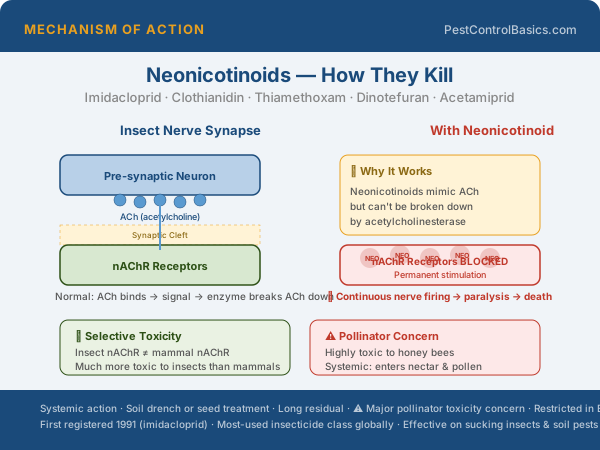
Thiamethoxam is a second-generation neonicotinoid. Meridian and Flagship are the same active ingredient at the same concentration — different labels, same product. Excellent systemic activity through foliar and soil routes.
⚗️ Mixing & Application
⚠️ Safety
- ⚠ Highly toxic to bees
- ⚠ Restrict applications when bees are foraging
- ⚠ Rotate with non-neonicotinoid modes of action
🐛 Pests This Treats — Learn More
Click any pest to view its full identification guide, biology, and treatment options.
🌿 Environmental & Ecological Impact
⏱️ Residual & Re-entry Timeline
🔄 Alternatives & Related Products
Same chemical class or different approaches to the same pests.
🔄Same class: Neonicotinoid
Same class: Neonicotinoid
Same class: Neonicotinoid
Different approach: Botanical Pyrethrin
Different approach: Inorganic
❓ Frequently Asked Questions
📋 Safety Data Sheet (SDS)
Meridian 25 WG — Safety Data Sheet
View the official SDS document for this product directly on the CDMS label database.

Practical safety considerations for Thiamethoxam — Meridian, Flagship, Actara
The label is the law, and it covers the legal minimum. Practical safety for Thiamethoxam — Meridian, Flagship, Actara in a household setting goes beyond label compliance — children, pets, and food-contact surfaces all merit precautions above the regulatory floor. Re-entry intervals on consumer labels are typically calibrated for healthy adults; for nurseries, pet bedding areas, and pregnant-occupant homes, doubling the indicated interval is a reasonable default.
Ventilation matters more than most homeowners realize. Even low-VOC formulations release detectable airborne residues for several hours post-application, and an HVAC system that is running during treatment will redistribute those residues throughout the structure. Standard practice is to turn off forced air for the treatment window and the first hour after, then run on high circulation for 30 minutes before normal occupancy resumes.
Personal protective equipment listed on the label is the minimum. For larger volumes, a half-face respirator with organic-vapor cartridges adds meaningful protection at modest cost. Nitrile gloves outperform latex for solvent-based formulations and are inexpensive enough to use single-use.
Comparing Thiamethoxam — Meridian, Flagship, Actara to alternatives
Choosing between Thiamethoxam — Meridian, Flagship, Actara and a comparable product usually comes down to four factors: speed of kill, residual length, target spectrum, and household-sensitivity profile. No single product wins on all four — fast-acting contact kills typically have short residuals, while long-residual products often act slowly enough that homeowners assume they have failed within the first 48 hours. Matching the product to the situation is more important than picking the strongest available option.
Cost per application is a useful but incomplete metric. A cheaper concentrate that requires more frequent reapplication often costs more per season than a more expensive product with a longer effective window. Coverage area per gallon at the label rate is the better comparison number, and it is usually printed clearly on the label.
For most households, keeping two complementary products — one fast-acting and one long-residual, ideally from different chemical classes — covers more situations than a single all-purpose product and supports the resistance-management rotation noted above.
Known limitations of Thiamethoxam — Meridian, Flagship, Actara
No active ingredient is universal, and Thiamethoxam — Meridian, Flagship, Actara has specific weak points worth understanding before purchase. Resistance is the most common limitation — populations in heavily-treated areas (commercial kitchens, multi-unit housing, urban cores) often show measurable tolerance compared to populations in less-treated environments. Rotating between chemical classes every two or three applications reduces resistance pressure significantly.
Substrate binding is another limitation. Thiamethoxam — Meridian, Flagship, Actara on highly absorbent surfaces like unfinished wood or carpet can become bound to the substrate within hours of application and never reach the pest in active form. For these surfaces, dust formulations or baits perform better than liquid sprays. Crack-and-crevice application using a precision tip places product where it reaches the pest while minimizing exposed-surface residue.
Pollinator and beneficial-insect impact is the third limitation to plan around. Outdoor application timing should avoid blooming plants, and any application near beneficial habitat (gardens, water features, pollinator strips) should be made in late evening when beneficials are inactive.
Active ingredient classes and rotation principles
Pesticide active ingredients are organized into classes based on their mode of action — the biological mechanism through which they affect target pests. The EPA mode-of-action (MoA) classification (and the analogous IRAC classification used internationally for insecticides) labels products by their MoA group, which is the relevant grouping for resistance management. Common residential MoA classes include pyrethroids (group 3, affecting sodium channels), neonicotinoids (group 4, affecting acetylcholine receptors), spinosyns (group 5, separate acetylcholine mechanism), insect growth regulators (group 7, hormone disruption), avermectins (group 6, chloride channels), and several others. Rotating among MoA classes — not just product brands — is the resistance management practice that matters. A homeowner using a pyrethroid product for two seasons then switching to another pyrethroid brand has not rotated meaningfully; switching to a spinosyn or neonicotinoid would be a real rotation. Product labels typically list the IRAC group number on the front panel.
How weather forecasting fits into pest treatment scheduling
Weather isn't usually considered part of pest control planning, but it's one of the variables with the largest effect on treatment outcomes. Rain within four hours of an outdoor liquid application washes off most surface residue except specifically rainfast formulations. Wind above roughly ten miles per hour produces drift that reduces target coverage and increases off-target deposition. Temperatures above the upper limit on the product label (typically 85-90°F for many residential products) cause volatility losses and reduced binding. Temperatures below about 50°F slow knockdown and can produce uneven residual films. The practical scheduling rule: check the next 24-hour forecast before any outdoor treatment, prefer mornings on calm days, and reschedule rather than apply in marginal conditions. Indoor treatments are less weather-dependent but still affected by humidity (bait acceptance) and HVAC airflow (vapor distribution and re-deposition).
Application timing within the day and weather conditions
Pesticide applications produce significantly different results depending on application timing, and matching application to conditions improves outcomes substantially. For outdoor liquid applications, early morning (after dew has evaporated, before pollinators are active) and late evening (after pollinators have stopped foraging, before evening dew) produce best results: temperatures are moderate, wind is typically lower, and non-target exposure is reduced. Mid-day applications during high temperatures cause volatility losses and faster degradation. For interior treatments, timing depends on the pest: cockroach baiting works at any time but should follow rather than precede cleaning; bed bug treatments need to follow vacuuming and clutter reduction; ant baits work best when active trails are present, which often means specific times of day for specific species. Rain within 4 hours of outdoor liquid application washes off most surface residue except specifically rainfast formulations; checking the next 24-hour forecast before any outdoor treatment is the basic discipline that prevents this loss. Temperatures above 90°F or below 50°F outside the product label's recommended range produce reduced efficacy.
When professional treatment is genuinely worth the cost
Professional pest control isn't always the right answer, but several specific situations genuinely justify the cost over DIY treatment. Severe bed bug infestations rarely yield to homeowner treatment because the required combination of vacuuming, encasements, structural treatment, and follow-up monitoring exceeds what most homeowners execute consistently. Subterranean termite treatment requires equipment (subslab injection) and product (commercial-grade termiticide quantities) not accessible to consumers, and inspection findings often dictate specific treatment that homeowners can't do safely. Roof and attic rodent problems benefit from professional exclusion that addresses access points consumers don't find. Mosquito reduction programs using barrier treatments and breeding-site management produce substantially better results than consumer foggers and yard sprays. Persistent cockroach problems in multi-unit buildings need coordination consumers can't provide. The pattern: professional treatment justifies itself when scale, access, regulatory product restrictions, or coordination requirements exceed what DIY can practically accomplish. Routine ant trails, occasional wasp nests, fruit fly outbreaks, and the like remain reasonable DIY targets where the cost-benefit math favors handling it yourself with the right products and information.
Pesticide rotation and the resistance management problem
Resistance management — using multiple active ingredients in sequence so that no single mode of action selects for resistant individuals — is standard practice in agricultural and commercial pest control but rarely makes it into residential treatment decisions. The underlying concern is real: chronic use of a single pyrethroid product against bed bugs has produced widespread pyrethroid resistance, with some populations now showing resistance factors of 1000x or more. The same pattern is documented in German cockroach resistance to chlorpyrifos and other historical actives, mosquito resistance to organophosphates in heavy-use regions, and house fly resistance across multiple compound classes. For residential treatment, the practical implication is to avoid using the same active ingredient repeatedly across multiple treatment cycles; rotating between products in different chemical families (e.g., pyrethroid → neonicotinoid → insect growth regulator → carbamate, or whatever subset is appropriate to the target pest) reduces selection pressure and preserves efficacy. The product label specifies the active ingredient family, allowing rotation choices to be made on actual chemistry rather than brand name.
Pesticide drift and the neighbor dimension
Pesticide drift — the off-target movement of applied product through air, water, or runoff — is an under-discussed dimension of residential pesticide use, but it's an increasingly common source of conflict between neighbors and a real factor in the cumulative environmental load of pesticide use. Foliar sprays applied in even light wind drift further than most homeowners expect, particularly with finer droplet sizes. Granular products applied near property lines wash into adjacent properties in significant rainfall. Mosquito fogging can move across multiple properties depending on conditions. The implications are partly legal — drift onto neighboring property without consent has been the basis of successful nuisance claims in some jurisdictions — and partly ethical. Applying products only in low-wind conditions, choosing coarser droplet sizes when possible, using granulars rather than sprays near property lines, and timing applications to avoid imminent rainfall all reduce drift. For homeowners concerned about pesticide exposure from neighbors' applications, the productive conversation is usually about timing and product choice rather than about pesticide use in general, and approaching it that way tends to produce cooperation rather than escalation.
How regional pest pressure should shape what you buy
The retail pest control aisle is largely undifferentiated by region, but pest pressure is enormously regional, and the disconnect leads to predictable purchasing mistakes. A homeowner in the Gulf Coast facing year-round subterranean termite pressure and large peridomestic cockroach populations has dramatically different needs from a homeowner in the upper Midwest facing rodent invasion in October and bed bugs in apartments. The product mix that makes sense for each is different, the level of investment that's justified is different, and the cadence of application is different. Generic shopping advice and product reviews tend to wash out these regional patterns by averaging across users. The better approach is to identify the two or three pests that actually drive pressure in your specific area, then build a product and treatment plan around those rather than around the broad category. Local cooperative extension publications, state agricultural department pest fact sheets, and regional pest control company blog content tend to be more useful sources of guidance than national review sites, precisely because they're calibrated to the conditions you're actually treating.
Reduced-risk pesticide selection: a category worth knowing
The EPA's reduced-risk pesticide program identifies active ingredients and formulations that meet specific criteria for lower toxicity to non-target organisms, reduced potential for groundwater contamination, lower likelihood of resistance development, or better compatibility with integrated pest management. Products in this category aren't free of toxicity — they're pesticides, and all pesticides have some toxic profile — but they represent the lower end of the risk distribution within their pest categories. For homeowners who want to use pesticides but are concerned about minimizing exposure and environmental impact, looking for products with reduced-risk actives is a defensible filter. Examples include some of the diamide insecticides, spinosyns, and certain microbial products. The catch is that retail availability lags behind the professional market for many reduced-risk products, and consumer pesticide aisles still skew heavily toward older pyrethroid and carbamate formulations. For homeowners willing to source products from agricultural supply channels or work with a pest control company that uses these products, the option exists; for those buying off the shelf at typical retail, the choices are narrower.