The short answer
- Look for the droppings first: dark green to black pellets on leaves and on the ground under the plant point to a hornworm above, even when only a few are present.[5][1][2]
- Search at dusk, dawn or after dark, when they feed in the open. Several extension offices suggest a handheld black light at night, which makes hornworms glow.[4][2][6][8][7]
- Pick them off and drop them in soapy water, or snip them with shears. University of Minnesota Extension calls handpicking the most effective way to manage them.[1][2][5]
- Leave any hornworm covered in small white cocoons that look like grains of rice. Those are braconid wasps that will kill it and then go after other hornworms.[1][2][3]
- If you spray, use Bt (Bacillus thuringiensis var. kurstaki) or spinosad while the caterpillars are small. Utah State says Bt only works on caterpillars under half an inch.[1][2][5]
- Till the soil after harvest to kill pupae before they become next year's moths. Wisconsin Extension says tillage can kill up to 90% of larvae in the soil.[1][5][3]
Related profiles
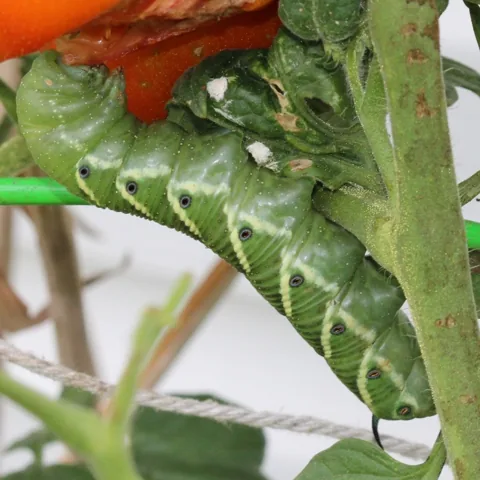 Tomato Hornworm
Manduca quinquemaculata
The tomato hornworm is one of the largest caterpillars in the vegetable garden, up to about 4 inches long, with a horn at its rear end. It chews leaves and fruit of tomato and related plants and can defoliate them quickly.
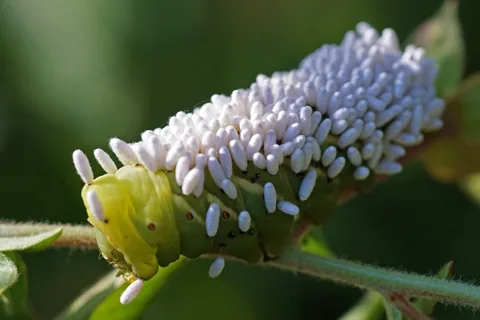 Braconid Wasps
Braconidae (shown: Cotesia congregata)
The white, rice-like cocoons on a tomato hornworm belong to a small braconid wasp. Braconids are parasitic wasps whose larvae grow inside caterpillars and other insects and kill them.
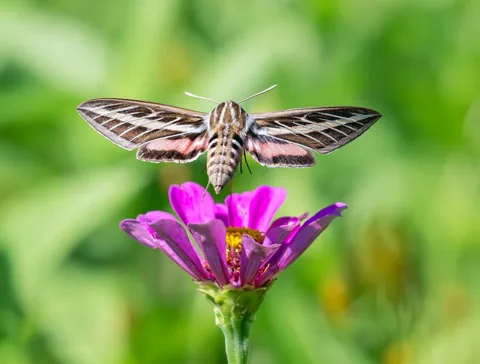 Whitelined Sphinx
Hyles lineata
The whitelined sphinx is a large hawk moth found across most of North America. It is the most common hornworm in Colorado and by far the most commonly seen 'hummingbird moth.'
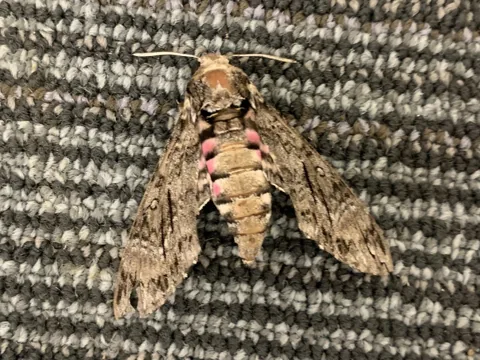 Sweetpotato Hornworm (Pink-spotted Hawkmoth)
Agrius cingulata
The sweetpotato hornworm is the caterpillar of the pink-spotted hawkmoth, a big gray moth with pink bands on its hind wings and pink spots on its body. The green or brown hornworm grows to more than 3 1/2 inches and can eat a sweet potato or morning glory vine down to bare stems. It is common in the southern US and the tropics.
Tomato hornworm or tobacco hornworm?
Two closely related caterpillars do this damage: the tomato hornworm (Manduca quinquemaculata) and the tobacco hornworm (Manduca sexta). They eat the same plants, cause the same injury and are managed the same way, so you don't need to know which one you have to control it.[2][4][3]
Despite the names, the tobacco hornworm is the one most gardeners find. Mississippi State Extension says it's the one most often found on tomato plants, and Colorado State says it's generally more common in gardens there, though both species can turn up in the same place.[6][4]
- Tomato hornworm: eight white V-shaped marks along each side, and a dark horn at the rear. Sources describe the horn differently: black (Minnesota, Utah State), dark green with black sides (Colorado State), or brownish (Mississippi State).[1][2][4][6][3]
- Tobacco hornworm: seven diagonal white stripes along each side, edged in black, and a red or orange-red horn.[2][3][4][6]
- Size: mature larvae reach about 4 inches long by most accounts; Colorado State gives up to 3 inches.[1][2][3][5][4]
- Young larvae: small tomato hornworms are yellow to white with no markings, and young hornworms of either kind blend into the leaves.[1][3]
- Look-alikes: the whitelined sphinx caterpillar lives mainly on fruit and ornamental plants and rarely on vegetables, and the tomato fruitworm feeds on the same crops but is much smaller.[2]
What the damage looks like
Hornworms feed on tomato above all, and also on pepper, potato and eggplant, plus nightshade-family weeds such as horsenettle, jimsonweed and nightshade. The tobacco hornworm also feeds on tobacco.[1][3][2]
They start on the upper leaves and work downward, eating whole leaves and small stems. When leaves run out or numbers are high, they also feed on blossoms and chew large pieces out of green fruit.[1][2][5][8]
Damage builds fast as they grow. Wisconsin Extension says a larva can eat up to four times its weight in leaves and fruit a day, and Minnesota Extension says the last larval stage eats nearly as much as all the younger stages combined. Mississippi State puts it this way: a healthy plant on Monday can be nothing but nubs by Thursday.[3][1][6]
Losing leaves can cut fruit production and leave fruit open to sunscald. Chewed fruit may rot on the vine or end up with dry scars that make it unusable.[2][3]
How to find hornworms
Their green color and stripes hide them well, so the usual first sign is the damage or the droppings rather than the caterpillar. Minnesota Extension suggests checking plants at least twice a week in summer; Utah State says to start in early July, and Wisconsin Extension says to keep checking from early July through August.[1][5][2][3]
- Droppings (frass): large dark green to black pellets on the leaves and the ground beneath the plant. Utah State notes they're plentiful even when only a few larvae are present, so look straight up from any pile.[5][1][2][8]
- Timing: larvae tend to hide during the day and feed on the outside of the plant around dusk and dawn, so scout early in the morning or in the evening.[2][4][8]
- Black light: Mississippi State, the University of Arizona and a North Carolina extension agent all suggest searching after dark with a small handheld black light (UV) flashlight, which makes the caterpillars glow. Arizona describes the glow as greenish.[6][8][7]
- Shake or spray: Utah State suggests shaking part of the plant over paper or cardboard to knock larvae loose, and a University of Arizona newsletter notes hornworms sometimes give themselves away when the leaves are sprayed hard with a hose.[2][8]
- Fresh damage: check the newer foliage at the top of the plant, where feeding usually starts.[2][1]
Handpicking
For a home garden with a few plants, hand removal is the main tool. Once you've found one, a large hornworm is easy to grab. Drop it in a container of soapy water, or cut it in half with garden shears.[1][2][5]
Keep checking twice a week. Eggs are laid singly on the leaves, so new caterpillars keep turning up, and many areas get a second generation in mid to late summer.[5][1][4]
White cocoons on a hornworm: leave it
A hornworm with small white cocoons sticking out of its back, often described as looking like grains of rice, has been parasitized by a braconid wasp, most often Cotesia congregata. The wasp lays eggs inside the caterpillar, the wasp larvae feed inside it, then chew out and spin cocoons on its skin. The hornworm dies.[1][2][3]
Leave these hornworms where they are. The adult wasps that come out of the cocoons search for more hornworms to parasitize, so removing them throws away free control.[1][2][3]
Other natural enemies help too. Lady beetles and green lacewings eat hornworm eggs and young caterpillars, paper wasps feed on small caterpillars, and tiny Trichogramma wasps parasitize the eggs. UC IPM says natural enemies normally keep hornworm numbers under control.[1][2][3][5]
Bt and other sprays
Insecticides are rarely needed in a home garden. If handpicking can't keep up, treat before defoliation gets severe. Small caterpillars are easier to kill than large ones.[1][3][2]
- Bt (Bacillus thuringiensis var. kurstaki): a soil bacterium that only works when caterpillars eat it, and only affects caterpillars, not bees or other insects. It works best on very young larvae; Utah State lists it as effective only on caterpillars under half an inch.[1][2][4][5]
- Timing Bt: a University of Arizona newsletter notes sunlight breaks Bt down within a few hours, so it suggests spraying late in the day before the caterpillars' night feeding and repeating every 7 to 10 days.[8]
- Spinosad: works on chewing caterpillars mainly when eaten, lasts about one to two weeks, and is effective against smaller larvae. It's toxic to bees while wet and much less so once dry.[1][5]
- Insecticidal soap: works only on small caterpillars it hits directly, has no residual activity, so you may need to repeat it, and has little effect on beneficial insects.[1]
- Broad-spectrum insecticides such as pyrethroids last longer but also kill the beneficial insects, including the parasitic wasps, that keep hornworms in check.[1]
- Whatever you use, make sure tomatoes or your other crop are on the label and follow the label's waiting period between spraying and harvest.[1]
Tilling, weeds and next year
Full-grown larvae drop to the ground, burrow 4 to 6 inches into the soil near the base of the plant and turn into dark brown pupae 2 to 3 inches long with a handle-like loop that holds the moth's developing mouthparts. They spend the winter there.[2][4][1]
Tilling or rototilling the bed after harvest (Utah State also suggests spring) breaks up those pupae before they can become moths. Wisconsin Extension says tillage can kill up to 90% of larvae in the soil.[1][5][2][3]
Pull nightshade-family weeds such as horsenettle, jimsonweed and nightshade, which give moths more places to lay eggs.[1][3]
Utah State mentions light traps set up in spring to catch emerging moths, but says they're more practical for monitoring on commercial farms than for home gardens.[2]
The sphinx moths they turn into
The adults are large, heavy-bodied sphinx (hawk) moths. The tomato hornworm becomes the five-spotted hawkmoth, with a wingspan up to about 5 inches and five yellow spots down each side of the abdomen. The tobacco hornworm becomes the Carolina sphinx, with a wingspan up to 4 inches and six yellow spots per side.[2][4][1]
They fly at dusk and in the evening, hovering at flowers to sip nectar with a long tongue, and are often mistaken for hummingbirds. The moths themselves don't harm plants.[2][4][3][6]
Females lay smooth, round to oval, white to light green eggs about 1.5 mm across on tomato leaves; sources differ on whether they choose the upper surface, the underside, or both. A University of Arizona newsletter says one female can lay up to 2,000 eggs.[4][2][1][3][8]
Larvae feed for about three to four weeks (Colorado State says a month or longer). Moths emerge in spring and early summer, and a second generation commonly follows in midsummer, with larvae through late summer.[1][2][4][3]
Common questions
- What do hornworm droppings look like?
- Large dark green to black pellets on the leaves and on the ground under the plant. Even a few hornworms leave plenty, so look directly above the pile.[5][1][2]
- Do hornworms really glow under a black light?
- Yes. Mississippi State and University of Arizona Extension both suggest a handheld black light after dark; hornworms glow, which makes them much easier to spot.[6][8][7]
- What are the white things on my hornworm?
- Cocoons of a small braconid wasp (Cotesia congregata) whose larvae fed inside the caterpillar. Leave it: the hornworm will die and the wasps will look for more hornworms.[1][2][3]
- Does Bt kill tomato hornworms?
- Yes, but mainly young ones. The caterpillar has to eat it, and Utah State lists it as effective only on larvae under half an inch.[1][2][5]
- What's the difference between a tomato hornworm and a tobacco hornworm?
- The tomato hornworm has eight V-shaped white marks per side and a dark horn; the tobacco hornworm has seven diagonal white stripes and a red horn. Control is the same for both.[2][3][4]
- Are the hornworm moths harmful?
- No. The adult sphinx moths feed on nectar and don't damage plants; only the caterpillars do.[3][5]
- Where do hornworms go in winter?
- They spend the winter as pupae a few inches down in the soil, which is why tilling after harvest helps.[1][2][5]
Photo credits
- Tomato Hornworm: (c) adam1420, some rights reserved (CC BY) — via iNaturalist, CC BY 4.0
- Braconid Wasps: (c) Eridan Xharahi, some rights reserved (CC BY) — via iNaturalist, CC BY 4.0
- Whitelined Sphinx: (c) Karen Szafrajda, some rights reserved (CC BY) — via iNaturalist, CC BY 4.0
- Sweetpotato Hornworm (Pink-spotted Hawkmoth): (c) Neal Kelso, some rights reserved (CC BY) — via iNaturalist, CC BY 4.0
Sources
- University of Minnesota Extension, “Tomato hornworms in home gardens (J. Hahn, S. Wold-Burkness; reviewed 2020).” extension.umn.edu/yard-and-garden-insects/tomato-hornworms (accessed 2026-11-10)
- Utah State University Extension, “Tomato Hornworm and Tobacco Hornworm (N. Volesky, M. Murray; March 2019).” extension.usu.edu/pests/research/tomato-tobacco-hornworms (accessed 2026-11-10)
- University of Wisconsin-Madison Extension, Wisconsin Horticulture, “Hornworms, XHT1107 (R. Groves; revised 2020).” hort.extension.wisc.edu/articles/hornworms/ (accessed 2026-11-10)
- Colorado State University, Agricultural Biology, “Hornworms.” agsci.colostate.edu/agbio/ipm-pests/hornworms/ (accessed 2026-11-10)
- UC Statewide IPM Program, “Hornworms (Home and Landscape).” ipm.ucanr.edu/home-and-landscape/hornworms/ (accessed 2026-11-10)
- Mississippi State University Extension Service, “How to Manage Hornworms on Tomatoes (S. Collins-Smith).” extension.msstate.edu/blogs/extension-for-real-life/how-manage-hornworms-tomatoes (accessed 2026-11-10)
- N.C. Cooperative Extension, Scotland County Center, “Weird & Wonderful Series: Hornworms (A. Grubb, 2024).” scotland.ces.ncsu.edu/2024/07/weird-wonderful-series-hornworms/ (accessed 2026-11-10)
- University of Arizona Cooperative Extension, “Coming soon to a tomato plant near you, the hornworm! (newsletter attachment).” extension.arizona.edu/sites/extension.arizona.edu/files/attachment/April%20-%20Coming%20soon%20to%20a%20tomato%20plant%20near%20you%20%281%29.pdf (accessed 2026-11-10)