On this page
How to identify it
- Older caterpillars are green or brown with bold, slanted black marks along each side and a black horn at the tail end. The head is green or brown with three dark stripes on each side. Full-grown larvae can be over 3 1/2 inches long.[1]
- Newly hatched caterpillars are white with a black tail horn.[1]
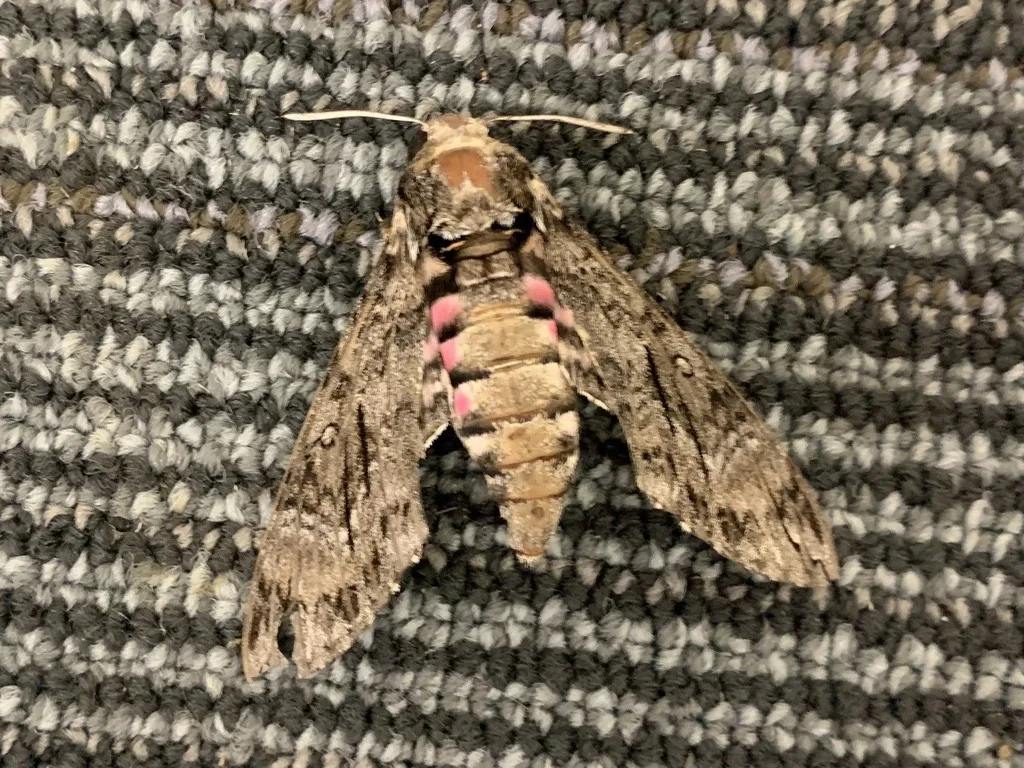
- The moth is gray and heavy-bodied with a wingspan up to about 4 5/16 inches. The abdomen has pink spots and the hind wings have bright pink bands.[1]
- Eggs are nearly round, almost 1/16 inch across, clear with a slight green tint. The pupa is reddish brown, about 2 1/2 inches long, with a tongue case that curves out like a pitcher handle.[1]
Look-alikes
| Look-alike | How to tell them apart |
|---|---|
| Tomato and tobacco hornworms | Related Manduca hornworms that feed on tomato, tobacco, eggplant and other nightshade-family plants rather than sweet potato and morning glory.[2] |
Where it lives
Common in the tropics and the southern United States, and collected from sweet potato fields in Mississippi. The moths stray as far north as Nova Scotia, but the larvae are too scarce in the north to be pests.[1][3]
Biology and life cycle
Its life history isn't well documented and is probably much like that of the tomato and tobacco hornworms. In North Carolina moths appear in early June, again in August and September, and once more before frost, for probably two and a half generations a year.[1]
Main food plants are sweet potato and morning glory; jimsonweed has also been reported. Arizona's guide adds petunias and moonflowers.[1][2]
Caterpillars often hide under large leaves near the base of the plant. Mass movements of larvae have been reported in Florida but not seen in North Carolina.[1]
Damage and signs
Health risk
The sources describe it only as a plant feeder and report no effects on people.[1][2]
Control
Traps and physical control
In small gardens, pick the hornworms off by hand. Check under large leaves near the base of the plant, where they hide.[1]
Pesticides
Commercial growers may need an insecticide; NC State refers them to the North Carolina Agricultural Chemicals Manual for current recommendations.[1]
Common questions
- What is the big hornworm eating my sweet potato vines?
- Most likely the sweetpotato hornworm, the caterpillar of the pink-spotted hawkmoth. It is green or brown with slanted black side marks and a black tail horn.[1]
- Will it eat my tomatoes?
- Its main hosts are sweet potato and morning glory, with jimsonweed, petunia and moonflower also reported. Tomato hornworms are a different species.[1][2]
Sources
- NC State Extension, North Carolina State University, “Pests of Sweetpotato, Insect and Related Pests of Vegetables.” content.ces.ncsu.edu/insect-and-related-pests-of-vegetables/pests-of-sweetpotato (accessed 2026-11-10)
- University of Arizona, Arizona Pest Management Center, “Pests of Plants (S. Nair, 2015; PDF).” cales.arizona.edu/apmc/docs/6%20Plant%20pests%20F.pdf (accessed 2026-11-10)
- Mississippi Agricultural and Forestry Experiment Station, Mississippi State University, “Results of Southern Sweetpotato IPM Project in Mississippi, Bulletin 1181 (J. T. Reed, May 2010; PDF).” www.mafes.msstate.edu/publications/bulletins/b1181.pdf (accessed 2026-11-10)
- iNaturalist, “Agrius cingulata taxon page (order and family).” www.inaturalist.org/taxa/119086 (accessed 2026-11-10)