On this page
How to identify it
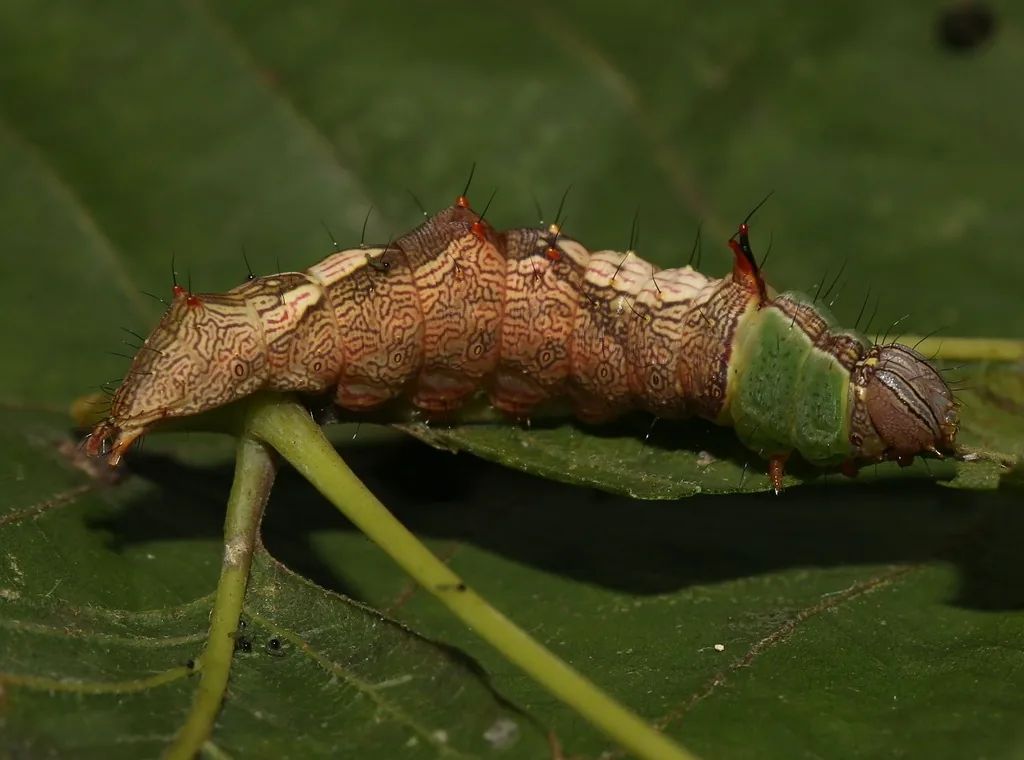
- The caterpillar is tan with brown markings and a green band on the second and third segments behind the head. The body is humped near the rear, on the fifth abdominal segment.[2]
- It is well camouflaged: when it rests along the jagged edge of a leaf it is eating, it looks like a curled, dried or dead part of the leaf margin.[1][2]
- The moth's forewings are drab gray, tan and brown with small black markings that vary a lot. Males have whitish hindwings and females dark gray ones.[2]
- The wingspan is 1 1/4 to 2 inches. The moth's legs look hairy, and its heavily scaled wings look fuzzy.[2]
- At rest the moth folds its wings like a roof and sometimes curls the forewing edges under its body, so it looks like a twig. A tuft of hair standing up over the thorax gives the prominents their name.[2]
Where it lives
It occurs statewide in Missouri, and Clemson Extension reports the caterpillars on maples, oaks, elms, buckeyes and other trees common in the Southeast.[2][1]
Biology and life cycle
Caterpillars feed on the leaves of trees and shrubs, including maples, oaks, elms, buckeyes, birches and roses.[1][2]
The common name comes from reports of the caterpillars eating morning glories. Missouri lists morning glories as a food plant, but Clemson notes that some sources doubt it.[2][1]
The moths fly at night from April or May to September and come to lights. They live in woods and nearby areas, where their camouflage hides them on tree bark.[2]
Grown caterpillars pupate below ground or in leaf litter.[2]
The Missouri Department of Conservation reasons from the caterpillar's and moth's convincing camouflage that birds and other predators that hunt by sight eat them readily.[2]
Damage and signs
Health risk
Neither Clemson nor the Missouri Department of Conservation mentions any sting, rash or other risk to people from this caterpillar.[1][2]
Control
Prevention
Damage is usually light: the Missouri Department of Conservation describes this species as hardly devastating, and neither it nor Clemson recommends any treatment.[2][1]
Common questions
- What is the brown caterpillar that looks like a dead leaf edge?
- It may be a morning-glory prominent. The caterpillar rests along the chewed edge of a leaf, where it looks like a curled, dried piece of the leaf margin.[1][2]
- Does the morning-glory prominent really eat morning glories?
- Possibly. Missouri lists morning glories among its food plants, while Clemson notes that some sources question it. Its documented hosts include maples, oaks, elms, buckeyes, birches and roses.[2][1]
Sources
- Clemson Cooperative Extension Home & Garden Information Center, “Question of the Week: Morning Glory Prominent Caterpillar (J. Ballew, June 19, 2024).” hgic.clemson.edu/question-of-the-week-morning-glory-prominent-caterpillar/ (accessed 2026-11-08)
- Missouri Department of Conservation, “Morning-Glory Prominent (Field Guide).” mdc.mo.gov/discover-nature/field-guide/morning-glory-prominent (accessed 2026-11-08)
- iNaturalist, “Schizura ipomaeae taxon page (order and family).” www.inaturalist.org/taxa/204014 (accessed 2026-11-08)