On this page
How to identify it
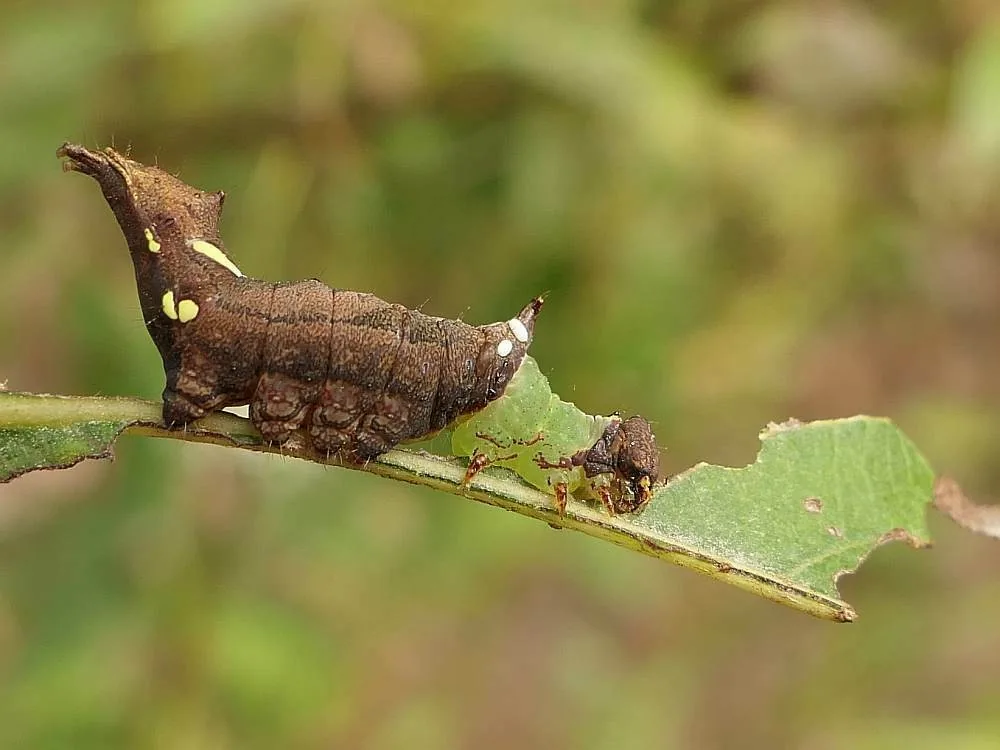
- Caterpillars are mottled brown and tan along the body, with a mottled brown head and a bright green patch on the second and third segments behind the head.[1][2]
- A prominent horn-like hump rises from the first abdominal segment, with a smaller one near the tail.[1][2]
- The moth is medium-sized, about 2.4 to 3.5 cm across the wings, maroon to purplish gray with pale greenish patches when fresh and a thin black bar in the middle of the forewing.[4][3]
Look-alikes
| Look-alike | How to tell them apart |
|---|---|
| Other prominent moths | Related species in the same genus look similar as adults; the University of Alberta museum points to Schizura leptinoides and S. ipomoeae.[4] |
Where it lives
Found in southern Canada and the United States east of the Rocky Mountains.[3]
Biology and life cycle
There is one generation a year in Missouri, with caterpillars present from summer to fall; in Alberta adults fly from late May to August and caterpillars feed from June through August.[1][4]
The caterpillars feed alone rather than in groups.[4]
Damage and signs
Health risk
None of the sources reports any harm to people or pets.[1][2]
Control
Prevention
Control isn't normally needed; the University of Illinois groups it with nondestructive caterpillars.[2]
Common questions
- What is the brown caterpillar with a green patch and a horn on its back?
- A small caterpillar with a horn-like hump just behind a bright green patch, mottled brown elsewhere, is likely a unicorn caterpillar.[1][2]
- Is the unicorn caterpillar harmful?
- Not usually; it feeds alone on tree and shrub leaves and is considered nondestructive.[4][2]
Sources
- University of Missouri Extension, “Caterpillars in Your Yard and Garden (IPM1019), page 47: unicorn caterpillar.” extension.missouri.edu/publications/ipm1019/47 (accessed 2026-10-17)
- University of Illinois Extension, “Unusual Caterpillars (Home, Yard and Garden Pest Newsletter, August 15, 2001).” hyg.ipm.illinois.edu/pastpest/200115c.html (accessed 2026-10-17)
- North Dakota State University (North Dakota Moths), “Unicorn caterpillar, Schizura unicornis (North Dakota Moths, Hodges 8007).” ndsu.edu/ndmoths/ndmoths/names/8007.htm (accessed 2026-10-17)
- University of Alberta Museums, “Schizura unicornis species details (E. H. Strickland Entomological Museum).” search.museums.ualberta.ca/g/2-461 (accessed 2026-10-17)
- iNaturalist, “Coelodasys unicornis taxon page (order and family).” www.inaturalist.org/taxa/1373714 (accessed 2026-10-06)