On this page
How to identify it
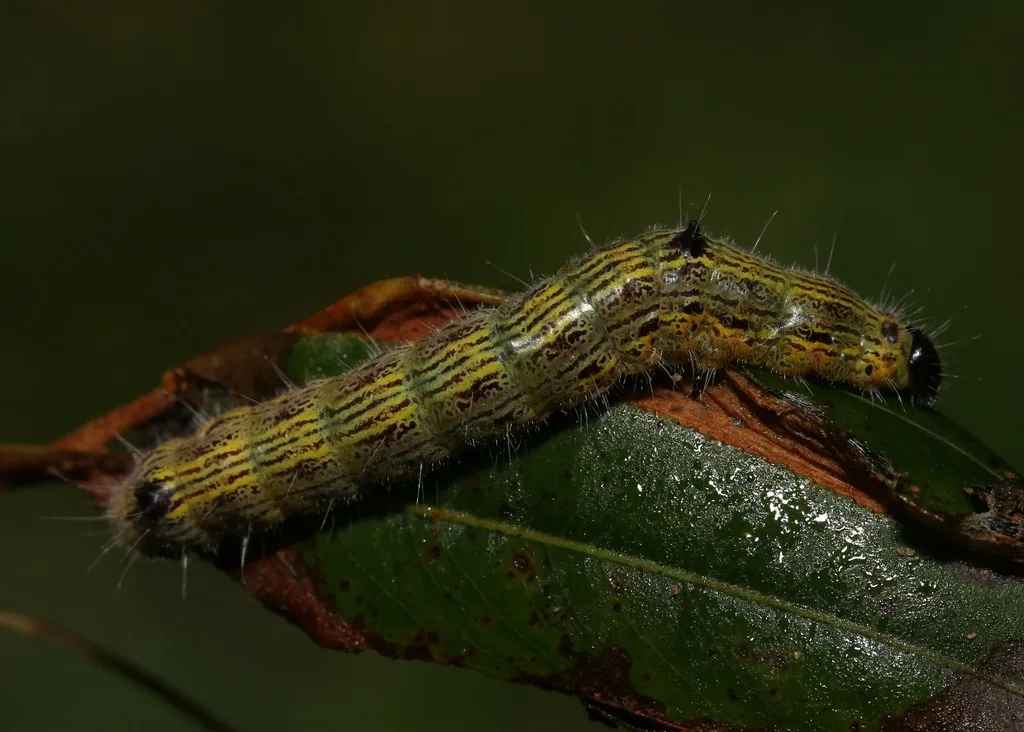
- Full-grown caterpillars are about 1 1/2 to 1 3/4 inches long, mottled brown-black and sparsely hairy, with four narrow yellow stripes down the back and a bright yellow line along each side.[1][2]
- Black bumps sit on top of the first and eighth abdominal segments, and the head is black and shiny.[1][2]
- The brownish-gray moth is about 1/2 inch long with broken white lines and blotches on each wing.[1]
Look-alikes
| Look-alike | How to tell them apart |
|---|---|
| Fall webworm | Poplar tentmakers tie leaves into small tents and hide inside by day; they feed on poplar and willow.[1][2] |
Where it lives
Found where poplars and willows grow, including North Carolina and Missouri.[1][2]
Biology and life cycle
Moths emerge from cocoons in leaf litter in late spring and lay batches of a hundred or more tiny round eggs under poplar and willow leaves.[1]
There are two generations a year, overlapping enough that caterpillars can be found from May to October.[1][2]
Damage and signs
Health risk
Control
Prevention
In late summer and fall, wait to see whether caterpillars return early the next season before treating.[1]
Biological control
Bacillus thuringiensis or neem works best on young caterpillars; the tents make older ones harder to reach.[1]
Pesticides
Carbaryl or other landscape-labeled insecticides also give control when many caterpillars are present.[1]
Common questions
Sources
- NC State Extension, “Poplar Tentmaker (PDIC Factsheet).” content.ces.ncsu.edu/poplar-tentmaker (accessed 2026-10-16)
- University of Missouri Extension (Caterpillars in Your Yard and Garden, IPM1019), “Caterpillars in Your Yard and Garden, page 35: Poplar tentmaker.” extension.missouri.edu/publications/ipm1019-35 (accessed 2026-10-16)
- iNaturalist, “Clostera inclusa taxon page (order and family).” www.inaturalist.org/taxa/196518 (accessed 2026-10-06)